Japanese bookbinding is an approachable way to make attractive, durable notebooks without specialized machinery. The right kit can provide the templates, awl, needles, thread, paper, and finishing tools needed to begin with confidence.
We’ve gathered 10 Japanese bookbinding kits and related starter sets for different projects, from compact three-book kits to larger supplies bundles with presses and punching cradles. Use the guide below to match the tools and materials to your experience level and intended notebook style.
Best 10 Japanese Bookbinding Kits Picks for 2026
Best Small Project Kit
3-Book Japanese Stab Binding Set

- Makes three 4-by-6-inch books
- Includes thread, needles, covers, bookcloth, and instructions
- Decorative Japanese stab-binding design
Best For: Kids and beginners making small blank books
Best Precision Tool
Dual-Use Bookbinding Punching Cradle Set

- Includes cradle, stainless guide, and awl
- Supports flexible hole spacing
- Works with paper, fabric, leather, and covers
Best For: Binders needing accurate piercing and alignment
Best Complete Starter Set
50-Piece Kit with Bamboo Press

- Includes an adjustable wooden book press
- Provides tools, thread, bookcloth, adhesive, and instructions
- Supports binding, repair, covers, and albums
Best For: Beginners building a versatile binding setup
Best Basic Tool Set
KOOTIKO 24-Piece Bookbinding Supplies

- Includes six colors of waxed thread
- Provides large-eye and curved needles
- Adds bone folder, awl, clips, thimble, and glue brush
Best For: Beginners needing reusable hand-binding tools
Complete Press Kit

- Includes an 11.6-by-7.8-inch book press
- 36-piece tool and materials assortment
- Suitable for binding, repairs, and albums
Best For: Crafters seeking a comprehensive press-based setup
Notebook-Making Kit
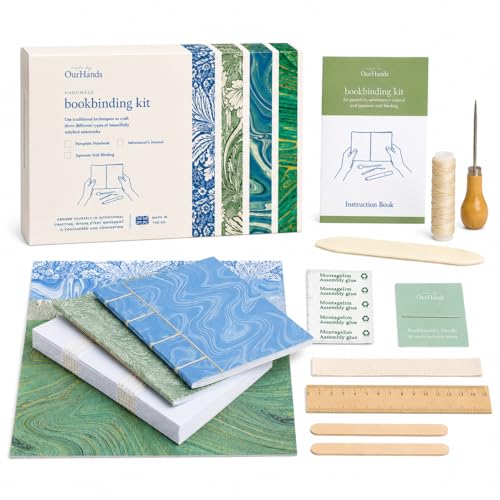
- Makes three notebook styles
- Includes materials for five notebooks
- Step-by-step instructions included
Best For: Beginners and stationery lovers wanting guided projects
Precision Cradle Tool

- 20-hole guide plate for spacing
- Beech wood cradle with awl
- Compact 0.83-pound design
Best For: Existing binders needing a portable punching guide
Best All-Around Tool Set

- Four waxed threads and several needle styles
- Pointed and rounded plastic bone folders
- Includes awl, ruler, scissors, clips, and sewing accessories
Best For: Flexible hand-binding, repair, and paper-craft projects
Best Complete Starter Kit

- Materials for up to five notebooks
- Supports perfect and sewn binding methods
- Includes printed instructions and video tutorials
Best For: Learning bookbinding and making several A5 or A6 notebooks
Best With Wooden Press

- Includes a 13-by-7.9-inch adjustable wooden press
- Adds thread, tape, needles, awl, and bone folders
- Storage bag and instructions included
Best For: Book repair and projects requiring a dedicated press
Best Small Project Kit – 3-Book Japanese Stab Binding Set
If you are looking for japanese bookbinding kits for a creative, ready-to-make project, this set provides materials and instructions for three small decorative books. Each finished book measures 4 by 6 inches and uses Japanese stab binding.
Best For: Kids, beginners, and crafters who want to make three compact blank books.
Pros:
- Includes materials for three books.
- Supplies include ivory cover paper, imported bookcloth, linen thread, needles, decorative thread, and instructions.
- Japanese stab binding creates a distinctive decorative style.
Cons:
- It is limited to small 4-by-6-inch books.
- The kit is focused on a specific three-book project rather than a broad tool collection.
This is a straightforward choice for a guided craft activity or introductory Japanese stab-binding project, especially when making multiple small blank books matters more than having reusable equipment.
Best Precision Tool – Dual-Use Bookbinding Punching Cradle Set
For japanese bookbinding kits and other sewn-binding projects, accurately spaced holes can make the finished work cleaner. This set combines a rubberwood punching cradle with a stainless-steel guide and awl for aligning and piercing covers, signatures, paper, fabric, or leather.
Best For: Crafters who already have binding materials and need a reusable hole-punching and alignment tool.
Pros:
- Dual-use guide supports cover punching and traveler’s notebook inserts.
- Multiple rail holes offer flexible spacing and placement.
- Rubberwood cradle and stainless-steel guide are designed for repeated use.
- Helps create evenly spaced holes for a neater finish.
Cons:
- It is primarily a punching and alignment set, not a complete bookmaking kit.
- The awl handle is sent randomly in wood or copper, so a specific style cannot be requested.
This set makes the most sense as a precision accessory for bookbinders who want repeatable hole placement. It is less suitable if you need paper, thread, covers, or full project instructions in one package.
Best Complete Starter Set – 50-Piece Kit with Bamboo Press
Among japanese bookbinding kits and broader hand-binding sets, this 50-piece collection is built for people who want tools and materials together. It includes an adjustable 11.6-by-7.8-inch wooden book press, waxed floss, needles, awl, scissors, bone folders, bookcloth, adhesive, and instructions.
Best For: Beginners and hobbyists making, repairing, or finishing books with a press.
Pros:
- Includes a wooden book press with adjustable screws for different book thicknesses.
- Offers a broad selection of tools and consumables, including 12 needles, waxed floss, bookcloth, adhesive, scissors, and bone folders.
- Instruction manual and storage bag support organized setup and learning.
- Suitable for binding, book repair, cover work, embossing, and album making.
Cons:
- Its larger size and 2.15-kilogram weight make it less portable than a small hand-tool set.
- The kit may be more equipment than needed for a simple introductory project.
This is the most comprehensive option in the group for building a general bookbinding workstation. Choose it when a press and repair-oriented supplies are more valuable than a narrowly focused Japanese stab-binding project.
Best Basic Tool Set – KOOTIKO 24-Piece Bookbinding Supplies
If your japanese bookbinding kits search is centered on reusable hand tools rather than a press or preplanned project, this 24-piece set is a practical starting point. It includes colored waxed thread, large-eye and curved needles, an awl, genuine bone folder, clips, thimble, and glue brush.
Best For: Beginners learning hand bookbinding, paper crafts, sewing, or simple book repair.
Pros:
- Includes six colors of flat waxed thread for decorative or coordinated projects.
- Large-eye and curved needles cover different sewing needs.
- Genuine ox-bone folder is designed for creasing without hurting paper.
- Compact selection includes an awl, clips, thimble, and glue brush.
Cons:
- It does not include a book press, covers, paper, or bookcloth.
- The set is focused on basic tools and supplies rather than a complete guided project.
This kit is a sensible low-complexity entry point for learning hand techniques or supplementing existing materials. It is especially useful when thread variety and multiple needle shapes matter more than pressing or cover-making equipment.
Complete Press Kit – Full Bookbinding Set
For shoppers comparing japanese bookbinding kits, this is a broadly equipped option that combines core hand tools with an 11.6-by-7.8-inch book press. It is designed for making handmade books, repairing older volumes, and related paper crafts.
Best For: Beginners or experienced crafters who want a comprehensive kit with a book press and storage bag.
Pros:
- Includes a book press, waxed thread, needles, awls, bone folders, cloth, scissors, ruler, and other supplies.
- Supports bookbinding, cover repair, album making, and flower pressing.
- Components are organized in a storage bag and detailed instructions are included.
- Bamboo and wood construction gives the press a sturdy, smooth design.
Cons:
- The kit is relatively broad and may include more tools than a first-time crafter needs.
- The included press is sized at 11.6 by 7.8 inches, which may not suit larger projects.
This is the strongest all-in-one choice in the group if having a press and restoration-oriented materials matters more than keeping the setup minimal.
Notebook-Making Kit – Three Soft-Cover Styles
Among japanese bookbinding kits, this OurHands set stands out as a guided project kit focused on creating soft-cover notebooks. It supplies materials and instructions for three styles rather than centering on a separate press.
Best For: Beginners, stationery fans, and gift recipients who want a structured notebook-making project.
Pros:
- Materials are provided for three notebook styles, including one larger journal and four smaller notebooks.
- Includes practical tools such as an awl, binder’s needle, ruler, and plastic bone folder.
- Step-by-step instruction book supports a guided learning experience.
- Made in the UK with locally sourced components and recyclable packaging.
Cons:
- It is focused on soft-cover notebooks and does not include a book press.
- The smaller kit is less suited to shoppers wanting a large general-purpose tool collection.
This is a good fit when the finished notebook projects and guided process are the priority, especially for a creative gift or a first binding experience.
Precision Cradle Tool – Beech Wood Hole-Punching Kit
For shoppers who want a focused tool rather than a full materials bundle, this compact option among japanese bookbinding kits is built around accurate hole punching. Its beech wood cradle uses a V-shaped guide plate and comes with an awl and basic accessories.
Best For: Bookbinders who already have paper and thread but need a portable guide for consistent punching.
Pros:
- V-shaped guide plate is designed for precise spacing and includes 20 holes.
- Hard beech wood construction is sturdy, with polished surfaces and edges.
- Compact 0.83-pound design is easy to store and transport.
- Includes an awl, thimble ring, needle, and thread.
Cons:
- It does not provide the broad paper, cover, cloth, and press assortment found in complete kits.
- The tool is specialized for punching and may be limiting for someone starting from scratch.
This cradle makes the most sense as a precision-focused addition to an existing workspace or for makers who value portability and repeatable hole placement.
Best All-Around Tool Set – 33-Piece Bookbinding Kit
If you need practical japanese bookbinding kits tools without a large supply of paper and covers, this 33-piece set focuses on the essentials for hand sewing, punching, folding, and finishing. Its assortment of needles, waxed thread, awls, clips, and bone folders makes it a flexible choice for small bookbinding and repair projects.
Best For: Beginners and crafters who already have paper or covers and need a versatile tool-and-material set.
Pros:
- Includes four rolls of waxed thread, multiple needle types, an awl, ruler, scissors, clips, and sewing accessories.
- Bone folders have pointed and rounded tips for folding, scoring, smoothing, and reaching corners.
- Useful for bookmaking, book repair, scrapbooking, leather craft, and other paper projects.
Cons:
- Does not list paper, book cloth, cardboard, or other complete book-cover materials.
- The bone folder is plastic rather than natural bone.
This is a compact, adaptable option when your priority is having the hand tools and sewing supplies needed to work across several craft projects. It is less suitable if you want a complete kit for producing multiple finished books from scratch.
Best Complete Starter Kit – 139-Piece Bookmaking Set
Among japanese bookbinding kits, this 139-piece set stands out for including both reusable tools and enough core materials to make several notebooks. It comes with A5 paper, cardboard, book cloth, gauze, adhesive, cutting supplies, thread, and instructions, making it a convenient starting point for learning book construction.
Best For: Beginners who want materials for up to five notebooks along with written and video guidance.
Pros:
- Includes paper, cardboard, book cloth, gauze, adhesive, tools, and accessories in one boxed kit.
- Designed for up to five complete books, with several A6 and A5 size combinations.
- Teaches perfect binding and sewn binding using printed instructions and video tutorials.
- Reusable bone folder, awl, cutting mat, and other tools remain available for future projects.
Cons:
- The listed project sizes focus on A6 and A5 notebooks rather than larger formats.
- At 3.34 pounds, it is less compact than a basic tool-only set.
This is the strongest choice for a first project because it combines consumable materials, equipment, and instruction. It also offers enough variety to practice techniques, make mistakes, and try again without immediately sourcing additional supplies.
Best With Wooden Press – 50-Piece Bookbinding Kit
For japanese bookbinding kits shoppers who want pressing capability as well as sewing tools, this 50-piece FUXAFU set adds a 13-by-7.9-inch wooden book press. The adjustable screw mechanism, binding tape, waxed thread, awl, needles, and accessories support both new projects and book repair.
Best For: Crafters and book-repair users who need a wooden press for holding books during finishing work.
Pros:
- Includes a 13-by-7.9-inch wooden press with an adjustable screw mechanism for different book thicknesses.
- Provides waxed thread, binding tape, bone folders, awl needles, threaders, and scissors.
- Solid wood construction, stainless steel hardware, and non-slip pads are designed for repeated use.
- Comes with a storage bag and instructions for organization and setup.
Cons:
- The press makes this kit bulkier than compact tool-only alternatives.
- The supplied notes do not specify included paper, book cloth, or cardboard for complete book construction.
This kit makes sense when a press is central to your workflow, especially for repairs, journals, photo albums, and hardcover-style projects. Choose a more materials-focused set if you want to begin making finished books without separately sourcing paper and covers.
How We Picked These Japanese Bookbinding Kits
We focused on kits and tool sets that support the core steps of Japanese stab binding: measuring and marking, punching aligned holes, stitching, folding or smoothing materials, and finishing the cover. We also considered the completeness of each package, the usefulness of included tools, expected learning curve, storage needs, and whether the contents suit one small project or several notebooks.
Because product bundles vary, check the listing carefully for the exact paper, cover stock, thread, template, tool sizes, and quantity included. Some sets are complete project kits, while others emphasize reusable equipment such as a book press, bone folder, awl, or punching cradle.
Quick Comparison
- Best for a guided first project: Choose a kit that includes instructions, preselected materials, and enough supplies for multiple notebooks.
- Best for repeat projects: Look for durable tools, replacement-friendly consumables, and a press or cradle that improves consistency.
- Best for compact workspaces: Favor small awl-and-guide sets or kits with foldable, easy-to-store equipment.
- Best for experimenting: Select a larger bundle with assorted materials and tools, even if it requires sourcing paper separately later.
Key Buying Factors for Japanese Bookbinding Kits
Project Completeness
Beginners usually benefit from an all-in-one kit containing paper, covers, thread, needles, an awl, and instructions. A tools-only set may offer better long-term value but assumes you already have suitable materials and know the basic sequence.
Hole-Punching Accuracy
Consistent spacing is central to Japanese binding. A dual-use piercing guide or bookbinding cradle can make hole placement faster and more even than measuring every point by hand. An awl should feel comfortable and be sturdy enough for the cover material you plan to use.
Included Finishing Tools
A bone folder helps crease paper and smooth folds, while a press can hold stacks securely during preparation. These tools are not always essential for a first book, but they become increasingly useful when making multiple notebooks or working with thicker covers.
Scale and Materials
Confirm the finished dimensions and the number of books each kit makes. Small kits are convenient for gifts and practice, whereas larger 50-piece bundles may provide more flexibility but can include consumables of mixed usefulness. Check whether the materials are compatible with your preferred paper weight and cover style.
Who Should Buy Which Japanese Bookbinding Kits?
First-time crafters should choose an instructional kit with premeasured materials and several projects. Experienced bookbinders may prefer a press, cradle, or piercing guide that improves workflow and can be reused across projects. Gift makers should look for kits that produce multiple finished notebooks and include attractive covers or varied materials. Budget-conscious shoppers can start with a basic awl, guide, thread, and needle set, then add a press or cradle once the craft becomes a regular hobby.
Before ordering, verify what requires separate purchase—such as paper, cutting tools, rulers, clamps, or protective work surfaces. A kit that matches your project size and current skill level will usually be more useful than the bundle with the largest item count.