Optical disc duplicators remain useful for producing multiple copies of CDs, DVDs, and archival M-Disc media without relying on a computer. The right tower can save time, simplify batch copying, and support consistent results for offices, educators, performers, and small production teams.
This roundup compares 10 standalone duplicators across target capacity, drive speed, media compatibility, and ease of use so you can choose a model that fits your workload and budget.
Best 10 Optical Disc Duplicators Picks for 2026
Best Single-Disc M-Disc Tower

- Standalone operation requires no PC
- Supports M-Disc DVD media
- Up to 24x DVD and 52x CD-R writing
Best For: Single-copy jobs, archival media, and small-business use
Best Five-Target Workhorse

- Creates five copies per cycle
- Includes verify and compare functions
- Supports major CD/DVD blank formats
Best For: Routine batch duplication in a dedicated workspace
Best Three-Disc M-Disc Option

- Makes three copies per cycle
- Supports M-Disc archival DVDs
- Standalone design needs no PC
Best For: Moderate-volume copying and DVD archiving
Best Compact Three-Target Unit
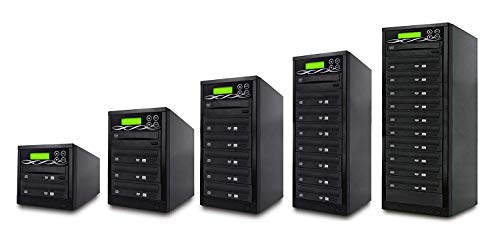
- Supports three target discs
- Includes verify and compare tools
- Provides password protection
Best For: Modest office duplication with access control
Best Overall Convenience
AutoDupe 1-to-1 Disc Duplicator

- Standalone, no-PC operation
- Automatic copy-start function
- Up to 24x DVD and 52x CD-R writing
Best For: Simple home, office, and archival duplication
Best for Format Flexibility
Standard 1-to-1 DVD/CD Duplicator

- Standalone 1-to-1 copying
- Recognizes specialized CD formats
- Supports M-Disc and up to 24x DVD writing
Best For: Personal, gaming, and business users with varied CD media
Best for Batch Duplication
BestDuplicator 11-Target Blu-ray Tower

- Burns up to 11 targets per cycle
- Supports Blu-ray, DVD, CD, and M-Disc
- Standalone operation with format recognition
Best For: Higher-volume personal or organizational duplication
Best Standalone DVD Tower

- Standalone operation with five target drives
- Up to 24x DVD and 52x CD-R writing
- Supports M-Disc and compatible free DVD Video copy protection
Best For: Businesses duplicating discs in batches
Best 5-Target Value
BestDuplicator 1-to-5 DVD Tower

- Five target slots for batch duplication
- Standalone operation with no computer required
- Supports common DVD and CD recordable formats
Best For: Straightforward multi-disc copying
Best Compact Single-Target Pick

- Standalone one-to-one duplication
- Supports M-Disc and up to 24x DVD writing
- Recognizes special CD formats including CD-TEXT and ISRC
Best For: Occasional copying and broad CD-format support
Best Single-Disc M-Disc Tower – 24X 1-to-1 DVD/CD Duplicator
PlexCopier 24X 1 to 1 CD DVD M-Disc Supported Duplicator Copier Tower with Free Copy Protection
Check Price On AmazonFor buyers comparing optical disc duplicators for occasional business use, this standalone 1-to-1 tower offers a straightforward way to copy CDs and DVDs without a computer. It also supports M-Disc DVD media and can create copy-protected DVD video copies with compatible OptoDisc media.
Best For: Small businesses and users who need one disc copy per cycle, M-Disc support, and standalone operation.
Pros:
- Operates without a PC.
- Supports up to 24x DVD and 52x CD-R write speeds.
- Supports M-Disc DVD archival media.
- Includes lifetime technical support and a one-year parts-and-labor warranty.
Cons:
- Produces only one target copy per cycle.
- Does not copy encrypted discs.
- Copy-protection creation requires compatible OptoDisc media.
This is a practical choice when simplicity and archival-media support matter more than batch throughput. Its single-target design is less suitable for frequent, high-volume duplication.
Best Five-Target Workhorse – 1-to-5 SATA DVD/CD Duplicator
This five-target standalone unit is designed for buyers who need higher output from optical disc duplicators. Its LCD interface, automatic source analysis, and copy, test, verify, and compare functions support repeatable duplication without relying on a computer.
Best For: Organizations producing up to five CD or DVD copies per cycle with built-in checking tools.
Pros:
- Burns up to five target discs per cycle.
- Supports DVD±R, DVD±RW, dual-layer DVD, CD-R, and CD-RW media.
- Includes copy, test, verify, and compare functions.
- Offers up to 24x DVD and 52x CD-R write speeds.
Cons:
- Its 26-pound weight makes it less convenient to move.
- Does not copy encrypted discs.
- Higher target capacity may be unnecessary for occasional users.
With five targets and diagnostic functions, this model is the strongest fit here for routine batch work. It is best suited to a fixed workspace rather than portable duplication.
Best Three-Disc M-Disc Option – 24X 1-to-3 DVD/CD Tower
PlexCopier 24X 1 to 3 CD DVD M-Disc Supported Duplicator Copier Tower with Free Copy Protection
Check Price On AmazonFor moderate-volume optical disc duplicators, this 1-to-3 tower balances throughput with a compact feature set. It runs independently of a PC, supports M-Disc DVD archiving, and can make copy-protected DVD video copies from an original using compatible OptoDisc media.
Best For: Users who need up to three copies per cycle, M-Disc archiving, or DVD video distribution support.
Pros:
- Produces up to three target copies per cycle.
- Supports M-Disc DVD media for archival recording.
- Offers up to 24x DVD and 52x CD-R write speeds.
- Works as a standalone unit without a PC.
Cons:
- Does not copy encrypted discs.
- Copy-protected DVD creation depends on OptoDisc media.
- Its three-target capacity is below that of larger batch duplicators.
This model is a useful middle ground for home, office, or small distribution tasks. Choose it over a single-target unit when three simultaneous copies justify the added capacity.
Best Compact Three-Target Unit – Built-In DVD/CD Duplicator
This built-in three-target unit is a practical entry point for optical disc duplicators when basic batch copying and verification are the priorities. It supports common CD and DVD formats, includes password protection, and provides self-diagnostics for more controlled operation.
Best For: Home offices and small organizations needing three simultaneous copies with basic management features.
Pros:
- Supports up to three target discs.
- Accepts DVD±R, DVD±RW, dual-layer DVD, CD-R, and CD-RW media.
- Includes copy, test, verify, and compare functions.
- Password protection helps prevent unauthorized use.
Cons:
- Its 16x optical write speed is lower than the faster models listed here.
- Uses USB connectivity rather than the SATA interface found on some alternatives.
- The supplied notes do not specify standalone, PC-free operation.
This is a sensible choice for modest duplication needs where format compatibility and access control matter. Buyers focused on maximum speed or confirmed PC-free operation should consider another model.
Best Overall Convenience – AutoDupe 1-to-1 Disc Duplicator
PlexCopier AutoDupe Easy to USE STANDALONE 24X 1 to 1 CD DVD Burner Writer Drive Duplicator Tower
Check Price On AmazonFor straightforward optical disc duplicators use, the AutoDupe is designed for standalone operation, so you can copy discs without connecting a computer. Its automatic duplication process and support for DVD, CD-R, and M-Disc media make it a practical choice for home archiving, small offices, and occasional professional tasks.
Best For: Buyers who want simple, computer-free 1-to-1 CD and DVD duplication.
Pros:
- Standalone operation requires no PC.
- Automatically starts duplication when a master and blank disc are detected.
- Supports up to 24x DVD and 52x CD-R write speeds.
- Supports archival-grade M-Disc DVD media.
Cons:
- Copies only one disc at a time.
- Does not copy encrypted or copy-protected discs.
The AutoDupe prioritizes ease of use over production volume. It is a sensible fit when occasional, uncomplicated duplication matters more than making multiple copies simultaneously.
Best for Format Flexibility – Standard 1-to-1 DVD/CD Duplicator
Vinpower Digital Standard 1 to 1 Target 24x DVD CD Disc Duplicator Tower SATA Optical Drives - Black
Check Price On AmazonThis standalone optical disc duplicator combines 1-to-1 copying with broad CD-format recognition. It supports common CD formats plus CD-TEXT, ISRC, and over-burned CDs, while also supporting M-Disc DVD media and up to 24x DVD writing.
Best For: Personal, gaming, and business users who need flexible CD-format support without a PC.
Pros:
- Operates independently of a computer.
- Recognizes common CD formats, including CD-TEXT, ISRC, and over-burned CDs.
- Supports up to 24x DVD and 52x CD-R write speeds.
- Can record to M-Disc DVD media.
Cons:
- Copies only one target disc at a time.
- Will not copy encrypted discs.
- Its copy-protection feature requires compatible OptoDisc MID media.
The Standard 1-to-1 model is a good middle ground for users who want standalone convenience but handle more varied CD formats. Its 1-to-1 design is better suited to occasional duplication than larger batch jobs.
Best for Batch Duplication – BestDuplicator 11-Target Blu-ray Tower
For higher-volume optical disc duplicators work, the BestDuplicator BDC-11T provides one source slot and 11 target slots, allowing multiple discs to be burned in one cycle. It supports Blu-ray, M-Disc, DVD, and CD media, and operates as a fully standalone tower without requiring a computer.
Best For: Users who need to produce up to 11 copies per duplication cycle across CD, DVD, or Blu-ray media.
Pros:
- 11 target slots support simultaneous multi-disc duplication.
- Supports BD-R, M-Disc, DVD, and CD blank-media standards.
- Standalone design requires no computer.
- Automatically recognizes the source disc format.
Cons:
- At about 43 pounds, it is substantially heavier than smaller towers.
- Its 11-target capacity may be excessive for occasional personal use.
- The supplied Nero software is less central because the unit is standalone.
The BDC-11T is the strongest choice here for batch production and broader media compatibility. Its large footprint and capacity make it most appropriate for organizations or users who regularly need multiple copies.
Best Standalone DVD Tower – 1-to-5 M-Disc Duplicator
This PlexCopier tower is a practical choice among optical disc duplicators when you need standalone operation and five simultaneous target copies. It supports DVD writing up to 24x, CD-R writing up to 52x, and M-Disc DVD recording for archival applications.
Best For: Businesses needing a standalone 1-to-5 DVD/CD duplication tower with M-Disc support.
Pros:
- Operates without a computer.
- Burns to five target drives from one master.
- Supports M-Disc DVD media and up to 24x DVD writing.
- Can create free copy-protected DVD Video copies with compatible OptoDisc MID media.
Cons:
- Does not copy encrypted, copy-protected discs.
- Its 17-pound tower form factor requires dedicated space.
Choose this model if throughput and archival media support matter more than compact size. Its copy-protection feature applies only to compatible DVD Video workflows and media.
Best 5-Target Value – BestDuplicator 1-to-5 DVD Tower
Bestduplicator BD-SMG-5T 5 Target 24X SATA DVD Duplicator with Built-In 1 to 5 M-Disc Support Burner
Check Price On AmazonThe BestDuplicator BD-SMG-5T is designed for straightforward batch duplication without a computer. Its one-to-five layout uses one source slot and five target slots, while the controller automatically recognizes the source disc format.
Best For: Users who want a user-friendly, standalone optical disc duplicator for five simultaneous DVD or CD copies.
Pros:
- Five target drives support efficient batch burning.
- Works as a fully standalone system.
- Supports DVD±R, DVD±RW, dual-layer DVD media, CD-R, and CD-RW.
- Includes a 128MB controller and a stated warranty with phone support.
Cons:
- Its tower design is less portable than a compact external burner.
- The supplied notes specify a 24x optical write speed but do not identify separate CD and DVD speeds.
This is a sensible pick when broad blank-media compatibility and simple controls are priorities. The dedicated five-target layout makes it better suited to repeated batches than occasional single-disc copying.
Best Compact Single-Target Pick – PioData 1-to-1 DVD Duplicator
This PioData tower is a focused option among optical disc duplicators for one-to-one copying. It runs independently of a PC, supports up to 24x DVD and 52x CD-R writing, and recognizes common CD formats plus CD-TEXT, ISRC, and over-burned CDs.
Best For: Home, office, or small-workflow users who need one duplicate at a time with broad CD-format support.
Pros:
- Standalone design requires no PC.
- Supports M-Disc recording and up to 24x DVD writing.
- Handles common CD formats plus special formats such as CD-TEXT and ISRC.
- Can create free copy-protected DVD Video copies with compatible OptoDisc MID media.
Cons:
- One-to-one operation is slower for large duplication batches.
- Does not copy encrypted discs.
- Only a one-year warranty is listed in the supplied details.
For occasional duplication, this model keeps the workflow simple while offering useful CD-format flexibility. Choose a multi-target tower instead if producing several copies at once is a regular requirement.
How We Picked These Optical Disc Duplicators
We focused on standalone towers that copy optical media directly, without requiring specialized computer software. The selection includes one-to-one models for occasional use and multi-target systems designed for faster batch production. We also considered advertised write speeds, SATA drive configurations, support for CD and DVD formats, M-Disc compatibility, built-in burners, and practical features such as copy protection or bundled software.
Specifications can vary by blank-media type, source disc condition, and burner configuration. Treat maximum speed as a ceiling rather than a guaranteed real-world result, particularly when reliability matters more than throughput.
Quick Comparison
| Best For | Recommended Configuration | Why It Matters |
|---|---|---|
| Occasional personal copying | 1-to-1 tower | Lower cost and simpler operation |
| Small office or classroom batches | 1-to-3 duplicator | Balances speed, capacity, and footprint |
| Frequent production work | 1-to-5 or larger | Creates more copies per cycle |
| Long-term archival projects | M-Disc-compatible model | Supports compatible archival media |
| Mixed optical-media workflows | BD-certified or multi-format model | May offer broader disc support |
Key Buying Factors for Optical Disc Duplicators
Target Capacity
The target count determines how many blank discs can be written in one pass. A 1-to-1 duplicator is adequate for occasional jobs, while three-, five-, or eleven-target systems are more efficient for events, training materials, music releases, and recurring office distribution.
Supported Media
Confirm that the tower supports the formats you actually use, including CD-R, CD-RW, DVD-R, DVD+R, and other writable media. If archival storage is important, look for explicit M-Disc support. A BD-certified burner may be preferable when Blu-ray compatibility is part of your workflow, but certification and included drives should be checked carefully.
Speed and Reliability
Higher advertised speeds reduce cycle time, but stable burning and verification are often more valuable than maximum throughput. Use quality blank media, keep firmware current when updates are available, and choose a model with enough drive capacity for your typical workload.
Controls and Copy Protection
Standalone duplicators should provide straightforward menu controls for copying, comparing, and checking disc status. Some models include copy-protection support or bundled authoring software. Verify that these features match your intended content and comply with applicable copyright rules.
Size, Noise, and Support
Multi-drive towers need more desk or shelf space and may generate noticeable fan and drive noise. Check dimensions, power requirements, warranty coverage, replacement-drive availability, and manufacturer support before buying for a commercial environment.
Who Should Buy Which Optical Disc Duplicators?
Choose a 1-To-1 Model for Simplicity
One-to-one towers suit home users, technicians, and small offices that make only a few copies at a time. They are generally easier to operate and less expensive than high-capacity systems.
Choose a 1-To-3 Model for Balanced Workloads
A three-target duplicator is a strong middle ground for schools, churches, clubs, and small businesses. It shortens batch jobs without demanding the space or budget of a larger production tower.
Choose a 1-To-5 or Larger Model for Volume
Frequent distributors and event organizers should consider five-target or larger Optical Disc Duplicators. The higher upfront cost can be justified when reducing operator time and repeated copy cycles.
Choose M-Disc or BD Support for Specialized Media
Select M-Disc compatibility when durable archival media is central to the project. Choose a BD-certified model only when Blu-ray support is confirmed as necessary, since added capability may not benefit a CD/DVD-only workflow.