Digitizing family albums, slides, and loose prints is much easier with the right scanner. The best photo scanners can save time, preserve detail, and handle mixed-size originals without constant manual adjustments.
Below, we focused on models that balance speed, image quality, software support, and ease of use for home archiving or heavier scanning projects.
Best 10 Photo Scanners Picks for 2026
Fastest bulk photo digitizing
Epson FastFoto FF-640 High-Speed Photo Scanning System
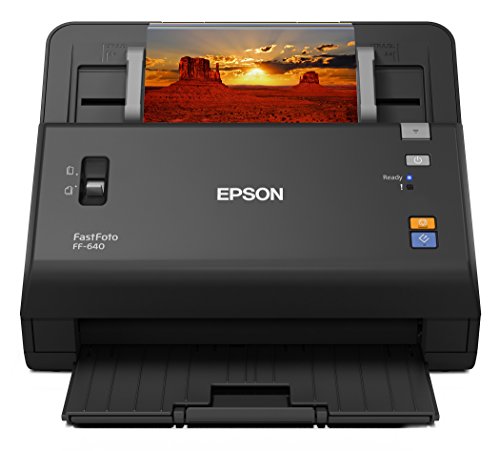
- Up to 1 photo per second
- Auto-feeds 30 photos at once
- Scans up to 600 dpi
Best For: Large photo collections that need fast batch scanning
All-in-one film and print converter
Photo, Slide & Negative Scanner with 5-inch Screen

- Scans slides, negatives, and photos
- 5-inch HD screen for previewing
- No computer or software needed
Best For: Mixed home archives and easy standalone use
Wireless batch scanner for photos and documents
Epson FastFoto FF-680W High-Speed Duplex Scanner

- Batch scans up to 36 photos
- Duplex scan captures photo backs
- Includes Wi-Fi and USB connectivity
Best For: Fast photo digitizing with wireless and document features
Compact one-by-one photo feeder
Plustek ePhoto Z300 Photo Scanner

- Scans 4x6 photos in about 2 seconds
- Auto crop and deskew included
- Supports Mac and PC
Best For: Small to medium photo batches with simple operation
High-Detail Flatbed Pick

- 4800 dpi optical resolution for sharp photo scans
- Easy Photo Fix helps restore faded images
- USB-powered, compact design for home use
Best For: Users who want detailed photo scans and simple home archiving
Compact Everyday Scanner

- 4800 dpi optical resolution for detailed scans
- One-touch scanning with ScanSmart software
- USB-powered, lightweight design for portability
Best For: Home users needing a compact scanner for photos and documents
Portable Sheetfed Choice
HP Small USB Document & Photo Scanner

- USB-powered and easy to travel with
- Scans photos plus documents and cards
- Simple software for crop and cleanup
Best For: Travelers and small offices needing a lightweight, general-purpose scanner
High-Resolution Flatbed

- 4800 x 4800 dpi for detailed photo scans
- USB Type-C carries power and data
- EZ buttons and auto scan simplify use
Best For: Home users focused on sharp, detailed photo scanning
Photo Restoration Bundle
AMBIR Photo Scanner with Cleaning Kit

- 300 and 600 DPI options for photo archiving
- Includes cleaning tools and protective carrier sheet
- Software adds tagging, albums, and restoration
Best For: Photo archiving and restoration with mixed print sizes
Fastest bulk photo digitizing – Epson FastFoto FF-640 High-Speed Photo Scanning System
If you want photo scanners that can move a whole box of prints into digital files quickly, the Epson FastFoto FF-640 is built for speed. It uses an auto-feed tray for batch scanning and is positioned for high-volume photo digitizing, with up to 600 dpi resolution for preserving details from wallet-sized shots to panoramic prints.
Best For: People with large photo piles who want fast, automated scanning with minimal hands-on work.
Pros:
- Scans thousands of photos at up to 1 photo per second.
- Auto-feed tray holds up to 30 photos at a time.
- Supports high-quality scans up to 600 dpi.
- Includes supplies like a carrier sheet and cleaning cloth.
Cons:
- Designed around Windows 7 minimum system requirements.
- Limited to USB connection rather than wireless.
- Built mainly for photos, not broad document workflows.
For sheer throughput, this is one of the most practical choices if your priority is converting a lot of printed photos fast. It favors speed and convenience over compact simplicity, making it especially useful for large home archives.
All-in-one film and print converter – Photo, Slide & Negative Scanner with 5-inch Screen
Among photo scanners for home archiving, this standalone unit stands out if you need to handle more than just printed pictures. It converts slides, negatives, photos, and business cards, and the built-in 5-inch HD screen lets you preview and edit without needing a computer.
Best For: Families who want a simple offline scanner for photos, slides, and negatives.
Pros:
- Handles 35mm slides, 110/135 negatives, printed photos, and business cards.
- Large 5-inch HD viewing screen for previewing and editing.
- Works standalone with no computer, software, or drivers needed.
- Saves files directly to the included 8GB SD card.
Cons:
- Lower-resolution output than dedicated high-end photo scanners.
- Uses fixed media trays and holders rather than batch auto-feeding.
- Less suited to large-volume print archiving.
This is a flexible pick if your archive includes mixed formats and you value simplicity over maximum scanning speed. The offline design and included accessories make it easy to start digitizing right away.
Wireless batch scanner for photos and documents – Epson FastFoto FF-680W High-Speed Duplex Scanner
If you want photo scanners that can handle both prints and paperwork, the Epson FastFoto FF-680W is built for flexible, high-speed digitizing. It scans up to 36 photos at a time, includes wireless connectivity, and can preserve the back side of a photo in a single duplex scan.
Best For: Users who want fast photo scanning with wireless convenience and document support.
Pros:
- Scans thousands of photos at up to 1 photo per second.
- Batch scans up to 36 photos at a time.
- Duplex scanning captures photo backs with handwritten notes.
- Includes Wi-Fi plus USB, along with app-based sharing and backup options.
Cons:
- Requires Windows 7 minimum system requirements.
- More expensive and feature-heavy than a basic photo-only scanner.
- At 8.2 pounds, it is less portable than smaller standalone units.
This model is a strong fit if you want speed plus extra scanning versatility. It is especially practical for people who also need OCR document scanning and wireless sharing alongside photo preservation.
Compact one-by-one photo feeder – Plustek ePhoto Z300 Photo Scanner
The Plustek ePhoto Z300 is a practical option if you want photo scanners that are simple, compact, and fast enough for home use. It scans 4×6 photos in about 2 seconds, supports several common photo sizes, and includes auto crop and deskew to help clean up results.
Best For: Home users who want an easy, space-saving scanner for moderate photo batches.
Pros:
- Scans a 4×6 photo in about 2 seconds.
- Supports 3×5, 4×6, 5×7, and 8×10 prints.
- Includes auto crop, deskew, and image enhancement tools.
- Works with both Mac and PC.
Cons:
- Feeds one photo at a time instead of batch scanning.
- Not as fast as high-capacity auto-feed systems for large archives.
- Requires manual insertion for each scan.
If you do not need an automated tray and prefer a smaller scanner that is still quick on individual prints, this is an easy recommendation. It is especially appealing for users who want a straightforward workflow with basic cleanup features built in.
High-Detail Flatbed Pick – Epson Perfection V19 II
If you want a straightforward photo scanner for home archiving and occasional document work, the Epson Perfection V19 II is built around detail. Its 4800 dpi optical resolution makes it a strong choice for enlarging prints, while the compact USB-powered design keeps setup simple and portable.
Best For: Scanning photos, artwork, books, and documents at home with strong detail.
Pros:
- 4800 dpi optical resolution for sharp photo scans and enlargements
- Easy Photo Fix can restore color to faded photos with one click
- ScanSmart software adds PDF creation, OCR, and cloud-saving support
- Compact, lightweight, and USB powered for flexible placement
Cons:
- Flatbed design means each item is scanned individually
- Standard sheet capacity is just 1, so it is not built for batch jobs
Overall, this is a practical pick if image quality matters more than speed. It gives you the tools to handle old photos, albums, and mixed home projects without adding much desk space.
Fast Batch Scanner – Canon imageFORMULA RS40
The Canon imageFORMULA RS40 is a photo scanner for people who need speed and flexibility more than flatbed-style precision. Its automatic feeder handles mixed originals, scans both sides at once, and supports photos in varying sizes, making it a practical option for tackling stacks of prints.
Best For: Batch scanning old photos, documents, and mixed paper piles quickly.
Pros:
- Automatic feeder and up to 40 items per minute for fast scanning
- Scans both sides of photos and documents at the same time
- Handles photos, Polaroids, receipts, cards, and IDs in different sizes
- Includes enhancement software with red-eye correction and face smoothing
Cons:
- 1200 dpi is interpolated, not optical
- Bulkier and heavier than compact flatbed scanners
If your priority is clearing a large backlog, this model stands out for throughput and convenience. It is less about single-image quality than about getting lots of varied originals into digital form efficiently.
Compact Everyday Scanner – Epson Perfection V39 II
The Epson Perfection V39 II is a compact photo scanner aimed at everyday home use. With 4800 dpi optical resolution, one-touch scanning, and USB-powered operation, it is designed for users who want clear scans of photos, artwork, books, and documents without a complicated setup.
Best For: Home users who want a lightweight scanner for photos and everyday documents.
Pros:
- 4800 dpi optical resolution for detailed photo scanning
- Easy Photo Fix helps restore faded photos quickly
- One-touch scanning and ScanSmart software simplify workflow
- Compact, lightweight, and USB powered for easy portability
Cons:
- Standard sheet capacity is 1, so it is not built for batch scanning
- Best suited to individual items rather than high-volume jobs
This is a sensible pick if you want a small, versatile scanner that can handle both memories and paperwork. It keeps the process simple while still offering the resolution needed for photo work.
Portable Sheetfed Choice – HP Small USB Document & Photo Scanner
If you want photo scanners that can also handle everyday paperwork, the HPPS100 is built for quick, portable digitizing. It scans one side at a time, runs off USB power, and keeps the setup simple for home, office, or travel use.
Best For: Commuters, small offices, and travelers who need a lightweight scanner for photos and documents.
Pros:
- Very compact and light, making it easy to slip into a bag or briefcase.
- USB-powered design keeps setup simple without bulky equipment.
- Handles photos, receipts, business cards, and standard documents.
- Includes HP WorkScan software for previewing, cropping, and optimizing scans.
Cons:
- Simplex scanning means it only scans one side at a time.
- 300 dpi listed in details is lower than dedicated high-resolution photo scanners.
- Best for small to medium batches rather than heavy-duty archiving.
Overall, the HPPS100 is a practical pick if portability matters more than maximum image detail. It is a flexible scanner for mixed-use households and small businesses that need quick scans on the go.
High-Resolution Flatbed – Canon CanoScan LiDE 400
Canon CanoScan LiDE 400 Slim Scanner, 7.7" x 14.5" x 0.4", Document & Photo Scanner, Black
Check Price On AmazonAmong photo scanners, the Canon CanoScan LiDE 400 stands out for its 4800 x 4800 dpi resolution and slim flatbed design. It is a strong fit if you want detailed photo capture, easy one-cable USB Type-C operation, and simple buttons for fast everyday scanning.
Best For: Home users who want sharp photo scans in a slim, easy-to-store flatbed.
Pros:
- High 4800 x 4800 dpi resolution helps preserve photo detail.
- USB Type-C cable provides both power and data in one connection.
- Auto scan mode and EZ buttons make operation straightforward.
- Image enhancements like color restore and dust removal help improve results.
Cons:
- It is a single-sheet flatbed, so it is not designed for batch feeding.
- At 3.6 pounds, it is less portable than ultra-light sheetfed options.
- Paper size support is limited to standard letter-sized scanning ranges.
This is a sensible choice if photo quality is your priority and you want a scanner that stays simple to use. The LiDE 400 is especially appealing for anyone digitizing prints, snapshots, or mixed documents at home.
Photo Restoration Bundle – AMBIR Photo Scanner with Cleaning Kit
If you are comparing photo scanners for restoring old prints, the AMBIR bundle is built around speed, organization, and cleanup tools. It scans multiple photo sizes, offers 300 or 600 DPI options, and includes software and a cleaning kit to help protect delicate prints.
Best For: People digitizing mixed-size photo collections who want restoration tools and easy organization.
Pros:
- Scans a wide range of print sizes, from small snapshots to panoramic photos up to 12 inches.
- Offers 300 DPI and 600 DPI options for different archival needs.
- Includes a photo cleaning kit and protective carrier sheet for delicate prints.
- Software supports auto-enhance, restoration, tagging, albums, and editing.
Cons:
- Focused on photos, so it is less versatile for general office document scanning.
- Uses USB connectivity only, which may limit placement options.
- At 8.62 ounces, it is still specialized rather than a full-featured desktop all-rounder.
For anyone archiving family albums or repairing faded prints, this AMBIR package is more than just a scanner. The included tools and software make it a strong option when organization and photo cleanup matter as much as the scan itself.
How We Picked These Photo Scanners
We prioritized Photo Scanners that are practical for real-world archiving: strong optical resolution, reliable color reproduction, easy setup, and features that reduce hands-on editing. We also weighed batch scanning speed, support for different media types, and compatibility with common Mac and Windows workflows.
Quick Comparison
If you want the fastest way to process stacks of prints, a feeder-based model is usually the best fit. If you need the most careful image capture for fragile prints, borders, or albums, a flatbed may be the better choice. Hybrid document-and-Photo Scanners are a smart middle ground for people scanning mixed household archives.
Key Buying Factors for Photo Scanners
Scanning Method
Auto-feeder scanners are ideal for large batches of loose photos. Flatbed scanners are slower but better for delicate originals, thicker prints, and items that need precise placement. Portable sheetfed models can work well for occasional jobs, but they are less suited to damaged or curled photos.
Resolution and Image Quality
Look for optical resolution rather than inflated interpolated numbers. Higher optical resolution helps capture finer detail, especially if you plan to enlarge, crop, or restore older prints. Features like auto crop, deskew, and dust reduction can also improve the final result.
Speed and Workflow
For large photo libraries, speed matters as much as quality. The best Photo Scanners for bulk work reduce manual handling with automatic feeding, duplex scanning, or software that batches edits efficiently. If you only scan occasionally, a slower model may still be the better value if it delivers better image quality.
Size, Media, and Compatibility
Make sure the scanner supports the photo sizes you own, along with slides, negatives, or documents if you need a versatile setup. Also check software and OS support before buying, especially if you use newer Mac or Windows systems.
Who Should Buy Which Photo Scanners?
Choose a high-speed feeder scanner if you have boxes of loose prints to digitize quickly. Pick a flatbed if you want maximum control over older, fragile, or mixed media. A compact USB model makes sense for occasional home scanning or limited desk space. If you need one device for both paperwork and archival photos, a hybrid scanner offers the most flexibility. Matching the scanner to your archive size and image-quality goals will matter more than any single spec.