If you have boxes of old slides and negatives, a dedicated scanner can make digitizing them far easier than relying on a flatbed printer or phone setup.
This roundup of slide scanners for digitizing film focuses on ease of use, image quality, supported formats, and the features that matter most for preserving family archives.
Best 10 Slide Scanners for Digitizing Film Picks for 2026
Easy Home-Use Scanning
KODAK Slide N Scan Film & Slide Scanner
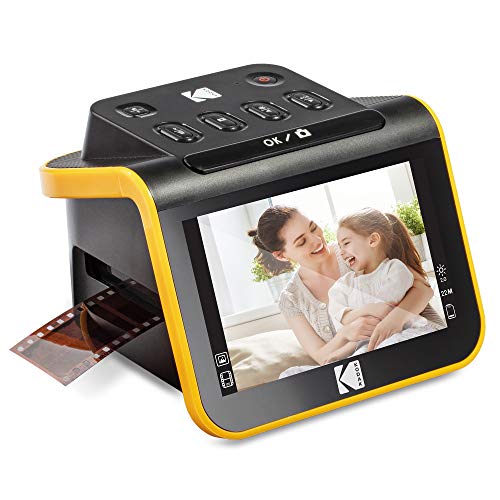
- 22MP output with a 5-inch LCD preview screen
- Handles 135, 110, and 126 slides and negatives
- Saves directly to SD/SDHC without a computer
Best For: Simple home digitizing with easy on-device editing
Touchscreen Convenience
HP Film & Slide Scanner HPFS500
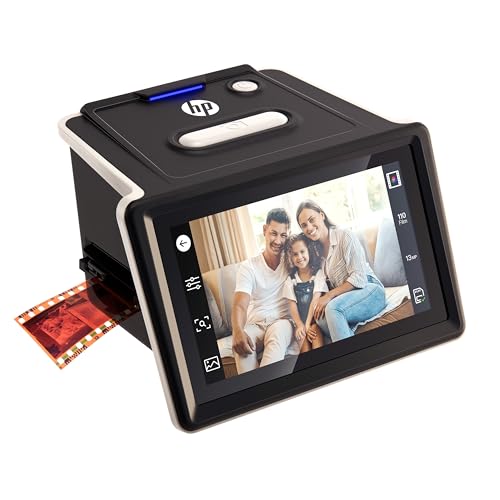
- 5-inch LCD touch screen with gallery mode
- Supports 135, 126, and 110 film and slides
- USB-C powered and saves directly to SD card
Best For: Users who want an easy touchscreen workflow
High-Res All-in-One Pick

- 24MP output with built-in brightness and color controls
- Scans 35mm, 110, 126, and Super 8 plus multiple slide sizes
- 5-inch LCD and HDMI viewing without needing a computer
Best For: Mixed-format archives where resolution and versatility matter
Fast Larger-Screen Option

- 7-inch display for easier previewing and editing
- Smooth tray feed helps speed up batch scanning
- Supports 135mm, 110mm, and 126mm slides and negatives
Best For: Batch scanning common slide formats with less repositioning
Easy All-in-One Choice
Magnasonic 24MP 5" Film Scanner

- 24MP JPEG scans from film and slides
- 5" LCD with HDMI viewing support
- No-computer operation with tray loading
Best For: Users who want a simple standalone scanner for mixed film formats
Camera-Based Digitizing Kit
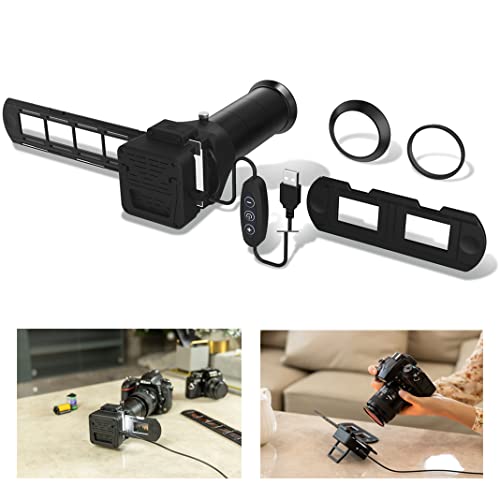
- Uses your camera with a macro lens
- Includes LED backlight and film holders
- Seven adapters for Canon, Nikon, and Sony
Best For: Photographers with compatible macro lenses who prefer a camera-based workflow
High-Compatibility Classic
KODAK SCANZA Film & Slide Scanner
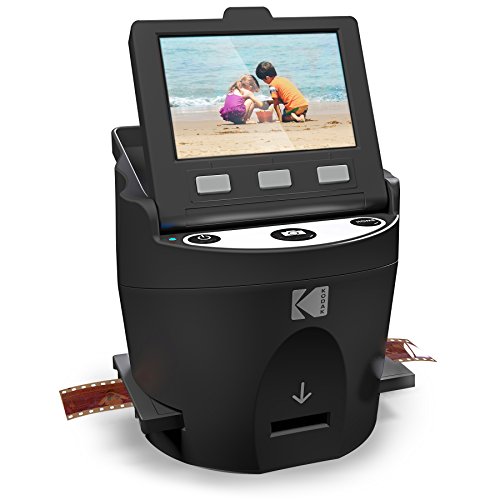
- Supports five legacy film formats
- Built-in 3.5" LCD with tilt adjustment
- Comes with adapters, cables, and brush
Best For: People digitizing a mix of common legacy negatives and slides
Quick Standalone Pick
DIGITNOW! 135 Film Negative Scanner

- Saves scans directly to SD card as JPG
- Includes adjustable rapid slide feeder
- 1800DPI with a 2.4-inch LCD screen
Best For: People who want a simple, computer-free 35mm slide and negative scanner
Large-Screen Memory Saver
22MP Film & Slide Scanner with 5" LCD

- Supports 35mm, 110, 126, and Super 8 photo scanning
- 5-inch LCD for previewing, editing, and playback
- Saves to built-in memory, SD card, or outputs via HDMI
Best For: Home users who want a simple multi-format scanner with a large display
High-Detail Preview Choice
PORTTA 22MP Slide & Negative Scanner

- Select 16MP or enhanced 22MP output
- 5-inch LCD for preview and alignment
- Adjust brightness, color, and orientation before saving
Best For: Users who want higher-resolution scans and basic in-device image adjustments
Easy Home-Use Scanning – KODAK Slide N Scan Film & Slide Scanner
If you’re shopping for slide scanners for digitizing film without a computer-heavy workflow, the KODAK Slide N Scan is built around quick viewing, simple editing, and direct SD-card saving. Its 22MP output, 5-inch LCD, and included holders for 135, 110, and 126 film make it a practical all-in-one option for turning old slides and negatives into digital files.
Best For: Home users who want a straightforward scanner with a large screen and easy one-touch operation.
Pros:
- 22MP scanning with a 5-inch LCD for previewing and editing on the device
- Supports 135, 110, and 126 slides and negatives, plus 50mm slide handling
- Direct SD or SDHC saving up to 32GB with no computer required for the main workflow
- Includes adapters, cleaning brush, USB, and HDMI cables for setup flexibility
Cons:
- SD card is not included
- Supports up to 32GB cards, which is more limited than some larger-memory workflows
- Minimum system requirement listed as Windows 7 for computer connection use
Overall, this model focuses on convenience and broad film compatibility rather than advanced controls. It suits buyers who want a simple way to digitize a mix of old formats at home.
Touchscreen Convenience – HP Film & Slide Scanner HPFS500
The HP Film & Slide Scanner HPFS500 is a good fit if you want slide scanners for digitizing film with a modern touchscreen and a compact USB-C setup. It combines a 5-inch all-angle LCD touch screen, 13MP CMOS sensor, and 22MP interpolation to preview, edit, and save slides or negatives with minimal fuss.
Best For: Buyers who want a touchscreen scanner that works smoothly with a PC USB or external USB-C power source.
Pros:
- 5-inch touch screen with gallery mode for direct previewing and editing
- Supports 135, 126, and 110 film strips and positive slides
- USB-C powered and can save directly to an SD card
- Compatible with Windows 10 or later and macOS 10.15 or later
Cons:
- Uses a 13MP sensor, so native capture is lower than some 22MP or 24MP competitors
- SD card is not included
- No HDMI connection listed in the supplied details
In practical terms, this is a user-friendly option for people who value a touchscreen interface and current connectivity. It offers a tidy balance of portability, format support, and easy image handling.
High-Res All-in-One Pick – Magnasonic FS71 Film Scanner
For shoppers comparing slide scanners for digitizing film, the Magnasonic FS71 stands out as a versatile all-in-one unit that handles both film negatives and slides. It offers 24MP output, a 5-inch LCD, and built-in controls for brightness, RGB color correction, flip, and mirror, so you can digitize and tweak images without relying on software.
Best For: Users who want the highest-resolution option here with broad format support and on-device adjustments.
Pros:
- 24MP output for detailed digital JPEG files
- Scans 35mm, 110, 126, and Super 8 film plus 135, 126, and 110 slides
- 5-inch LCD with HDMI support for viewing on a TV or monitor
- No computer needed for scanning, saving, or basic image adjustments
Cons:
- SD card is not included
- HDMI cable is not included
- Minimum system requirement listed as Windows 7 for computer use
This model is especially appealing if you want one scanner for a wide range of legacy formats. It leans toward flexibility and resolution, making it a strong option for family archives and mixed collections.
Fast Larger-Screen Option – KODAK Slide N Scan Max
The KODAK Slide N Scan Max is aimed at buyers who want slide scanners for digitizing film with a bigger screen and a streamlined feed system. With a 7-inch display, direct SD/SDHC saving, and support for 135mm, 110mm, and 126mm slides and negatives, it’s built for quicker batch-style use with fewer interruptions.
Best For: Users who want a larger display and smooth tray-fed scanning for common slide and negative formats.
Pros:
- 7-inch display for easier viewing and on-device editing
- Smooth-moving tray helps reduce constant repositioning during scanning
- Supports 135mm, 110mm, and 126mm slides and negatives
- Saves directly to SD or SDHC cards up to 32GB
Cons:
- SD/SDHC cards are not included
- Maximum supported card size is limited to 32GB
- Minimum system requirement listed as Windows 7 for computer connection use
Compared with smaller-screen models, this version emphasizes ease of use and faster handling rather than the most advanced format range. It makes sense for anyone digitizing common family slides in larger batches.
Easy All-in-One Choice – Magnasonic 24MP 5" Film Scanner
If you want a straightforward option for slide scanners for digitizing film, this Magnasonic unit keeps the process simple with built-in viewing, fast tray loading, and no computer required. It scans 35mm, 110, 126, and Super 8 film plus mounted slides into 24MP JPEG files, making it a practical pick for family archives and quick home conversions.
Best For: People who want an easy standalone scanner with a large screen and broad film compatibility.
Pros:
- 24MP output for digital JPEG scans
- 5" LCD screen plus HDMI viewing option
- No computer, driver, or editing software required
- Adjustable brightness, RGB correction, flip, and mirror controls built in
Cons:
- HDMI cable is not included
- Built-in memory is limited, so SD card expansion is important for larger collections
This is a strong all-around choice if you want slide scanning without a learning curve. It is especially appealing for users who value convenience and want to move through old photos quickly.
Camera-Based Digitizing Kit – JJC Film Digitizer Scanner
For photographers who already shoot with a compatible macro lens, this JJC kit is a different kind of option among slide scanners for digitizing film. Instead of a self-contained scanner, it uses your camera and the included LED backlight, film holders, and lens adapters to re-photograph 35mm negatives and mounted slides.
Best For: Camera users with select Canon, Nikon, or Sony macro lenses who want a film digitizing setup.
Pros:
- Works with select Canon, Nikon, and Sony macro lenses
- Includes seven lens adapters plus slide and strip film holders
- 6500K LED backlight with 10 brightness levels
- Manual tilt and angle adjustment for fine-tuning framing
Cons:
- Requires a compatible camera and macro lens
- Manual focus is recommended, so setup takes more effort than a standalone scanner
This kit makes sense if you already own the right camera gear and want more control over the capture process. It is less plug-and-play than a dedicated scanner, but it can fit an enthusiast workflow well.
High-Compatibility Classic – KODAK SCANZA Film & Slide Scanner
The KODAK SCANZA is a classic pick for slide scanners for digitizing film when you want broad format support and a built-in display. It converts 35mm, 126, 110, Super 8, and 8mm negatives and slides to JPEG files, and it includes multiple inserts, editing controls, and cables for flexible desktop use.
Best For: Users who want a feature-rich scanner with support for several common legacy film formats.
Pros:
- Supports 35mm, 126, 110, Super 8, and 8mm film formats
- 3.5" built-in LCD with adjustable brightness and tilt
- Includes multiple film inserts, adapters, and a cleaning brush
- HDMI, USB, AC adapter, and video cable are included
Cons:
- SD card is not included
- Not compatible with film formats outside the listed supported types
If you are working through a mixed legacy collection, this model offers a lot of built-in convenience. Its broader format compatibility and bundled accessories make it a solid hub for home film digitizing.
Quick Standalone Pick – DIGITNOW! 135 Film Negative Scanner
If you want a straightforward slide scanner for digitizing film without setting up a computer, the DIGITNOW! 135 Film Negative Scanner is built around speed and simplicity. It scans 35mm film and slides to JPG, saves directly to an SD card, and includes a rapid slide feeder for easier batch work. The built-in 2.4-inch LCD also makes it simple to adjust settings as you go.
Best For: Users who want a compact, no-computer scanner for turning 35mm slides and negatives into digital JPG files.
Pros:
- Standalone scanning to SD card, with no software required
- Includes an adjustable rapid slide feeder for quicker handling
- 1800DPI resolution for 35mm film and slide digitizing
- Built-in 2.4-inch TFT LCD for convenient on-device adjustments
Cons:
- Supports SDHC cards up to 32GB, which is smaller than some newer scanners
- Screen is compact compared with models that use larger displays
- Main focus is 35mm film and slides rather than broader film formats
Overall, this is a practical choice if you value a simple workflow and direct JPG output more than extra features. It fits well for anyone digitizing film in smaller home batches and wanting easy file transfer afterward.
Large-Screen Memory Saver – 22MP Film & Slide Scanner with 5" LCD
This slide scanner for digitizing film is designed for users who want a bigger screen and broader format support in one device. It handles 35mm, 110, 126, and Super 8 photo scans, and the 5-inch LCD makes previewing and editing much easier than on smaller-screen units. You can save to built-in memory or an external SD card, then transfer files over USB or show them on a TV through HDMI.
Best For: Families and home users who want an easy-to-use scanner with a large display and support for multiple film formats.
Pros:
- Supports 35mm/135, 110, 126, and Super 8 photo scanning
- 5-inch LCD gives a clear preview and playback experience
- One-touch scanning keeps the process simple for beginners
- Includes HDMI output, USB transfer, and a full accessory kit
Cons:
- Built-in memory is only 128MB, so SD card use is likely more practical
- Super 8 support is for photo only, not full film scanning
- Accessory kit is useful, but the SD card is not included
For users prioritizing ease of use and viewing comfort, this model is a strong all-around option. It balances simple operation with a larger screen and flexible output choices for old film conversion.
High-Detail Preview Choice – PORTTA 22MP Slide & Negative Scanner
The PORTTA film scanner is aimed at users who want a higher-resolution workflow for digitizing film at home. It scans 35mm, 126, 110, and Super 8 photo formats, offers 16MP or enhanced 22MP output, and uses a 5-inch LCD for real-time preview and alignment. With SD card storage and HDMI output, it keeps the process self-contained and easy to review.
Best For: Anyone who wants a no-computer scanner with adjustable resolution and on-screen preview for film and slide conversion.
Pros:
- Offers both 16MP and enhanced 22MP scan options
- 5-inch LCD helps with previewing and aligning images before saving
- Stores directly to SD card up to 128GB
- Built-in tools let you adjust brightness, color, and orientation
Cons:
- Super 8 support is for photo only
- No computer required, but that also means editing stays fairly basic
- Connectivity is centered on USB and HDMI rather than advanced workflow options
This model is a solid fit if you want more control over scan output without moving to a computer-based setup. It stands out for its adjustable resolution and built-in image tuning tools.
How We Picked These Slide Scanners for Digitizing Film
We focused on models that balance image quality, format support, and ease of use. For most home users, the best choice is a scanner that can handle common slide and negative formats without a complicated workflow.
We also looked for practical features such as built-in LCD screens, SD card saving, HDMI output, adjustable trays or holders, and enough resolution for useful archival scans.
Quick Comparison
Most buyers will choose between three approaches: standalone scanners with a screen for simple batch scanning, more compact units for occasional use, and accessory-style digitizers for users who already have a camera or separate workflow. If you want convenience, a self-contained unit is usually the easiest option. If you want more control, a scanner with external output or a more modular design may be a better fit.
Key Buying Factors for Slide Scanners for Digitizing Film
Supported Formats
Check whether the scanner supports 35mm slides, 35mm negatives, 110, 126, Super 8, or 8mm. The more varied your archive, the more valuable broad compatibility becomes.
Resolution and Output Quality
Higher megapixel claims can help, but real-world results also depend on optics, sensor quality, and the scanning workflow. For home archiving, look for consistent detail, accurate color, and enough resolution to print or share comfortably.
Display and Workflow
A built-in LCD screen can simplify framing and previewing, especially if you are scanning large volumes. Models that save directly to an SD card are often more convenient than those requiring constant computer connection.
Speed and Handling
Tray design, film holders, and loading smoothness matter if you plan to scan many images. Easy alignment and stable holders can reduce dust issues, re-scans, and frustration.
Connectivity
HDMI, USB-C, or computer support can be useful for viewing, transferring, or integrating scans into a larger workflow. Choose the connection type that best matches how you plan to store and edit files.
Who Should Buy Which Slide Scanners for Digitizing Film?
If you want the simplest path to digitize family memories, choose a standalone scanner with a large screen and direct-to-card saving. If you have mixed media formats, prioritize broad compatibility over extra features you may not use. If you are scanning only a small archive, a more affordable model may be enough. For bigger collections, look for comfortable controls, reliable holders, and a workflow that keeps you moving quickly.
In short, the best Slide Scanners for Digitizing Film are the ones that match your archive size, film types, and tolerance for hands-on setup.