The best tabletop printmaking presses make relief, linocut, etching, and intaglio work more consistent without requiring a full-size studio setup. The models in this roundup range from compact hand-lever designs to larger manual presses for broader plates and slabs.
Use the comparison and buying advice below to match press size, construction, pressure adjustment, and portability with your preferred techniques and available workspace.
Best 10 Tabletop Printmaking Presses Picks for 2026
Compact Precision Pick
Aluminum Manual Engraving Press

- 310 x 170 mm print area
- Supports intaglio, relief, and letterpress
- Compact aluminum-and-steel construction
Best For: Small studios and versatile DIY printmaking
Best Lino-Press Package

- Supports A3-size projects
- Steel frame with beech handle
- Includes brayer and felt sheet
Best For: Lino, woodcut, and rubber-block printing
Versatile Starter Press

- Supports prints up to 9 x 15 inches
- Works across several printmaking techniques
- Includes felt pad and base plate
Best For: Beginners, schools, and compact home studios
Heavy-Duty Adjustable Pick
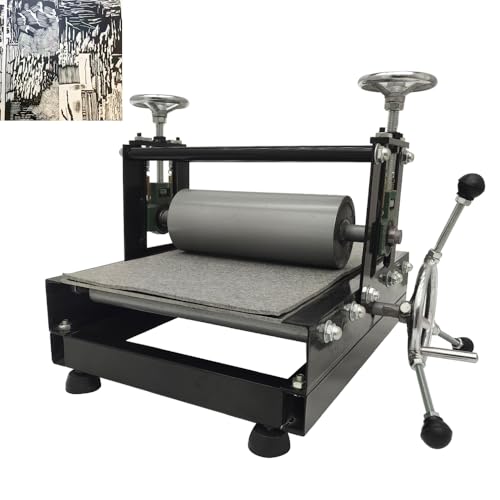
- 19.7 x 12.6-inch panel
- Adjustable roller height up to about 1.57 inches
- Heavy 48.9-pound iron-frame design
Best For: Thicker plates, embossing, and batch processing
Best Adjustable Lever Press

- Three-level adjustment for blocks up to about 25mm
- Even, effort-saving manual lever operation
- Includes roller, pads, felt, and wrenches
Best For: A4 relief printing and beginner-friendly tabletop use
Best Heavy-Duty Slab Roller
TECHTONGDA Manual Etching Press

- 19.7-by-12.6-inch working panel
- Adjustable roller height up to about 1.57 inches
- Handwheel control and anti-slip tabletop feet
Best For: Larger relief and gravure work in a stable studio setup
Best Compact Beginner Press

- A5-compatible format for small prints
- Handles blocks up to 25mm thick
- Includes roller, pads, felt, and wrenches
Best For: Beginners and compact home or classroom printmaking
Premium Adjustable Pick

- Three adjustable pressure settings
- Supports blocks up to 25 mm thick
- Stainless steel frame with felt pad
Best For: Beginners and artists using A4-sized blocks
Large-Format Choice
Legal-Size Green Linocut Press
- 14-inch legal-size working format
- Steel frame with beech handle
- Includes brayer and felt sheet
Best For: Longer relief and block-printing projects
Compact Starter Pick
- Compact A4 working format
- Powder-coated steel frame
- Brayer and felt sheet included
Best For: Hobbyists starting standard-size relief prints
Compact Precision Pick – Aluminum Manual Engraving Press
This compact tabletop printmaking press is designed for makers who want a sturdy manual machine with a comparatively large 310 x 170 mm print area. Its aluminum-alloy body, steel table, and adjustable drum support detailed work across several printmaking methods.
Best For: Home workshops, small studios, DIY craftsmen, and teaching contemporary graphic arts.
Pros:
- Supports paper, woodblocks, copperplates, intaglio, letterpress, relief, and other pressed artwork.
- Large print area accommodates projects up to 310 x 170 mm.
- Aluminum-alloy body and thickened steel table provide a stable structure.
- Compact tabletop footprint and smooth screw-and-drum adjustment.
Cons:
- Its manual operation requires hand-cranking for each print.
- The print area may not suit larger-format projects.
Choose this model when pressure consistency, material versatility, and a small footprint matter more than high-volume production.
Best Lino-Press Package – A3 Green Linocut Press
This A3 tabletop printmaking press is a practical choice for lino, relief, and block printing. Its powder-coated steel frame, beech handle, coated plywood plates, and included brayer and felt sheet create a useful starting package for manual printmaking.
Best For: Artists working with linoleum, woodcut, and rubber blocks who want A3 capacity and basic accessories included.
Pros:
- Handles projects up to A3 size, measuring 16.5 x 11.8 inches.
- Compatible with lino, woodcut, rubber block, relief, and block printing.
- Steel frame applies mechanical pressure while the beech handle provides manual control.
- Includes a 6 cm rubber brayer and felt sheet.
Cons:
- Its listed focus is relief and block printing rather than intaglio techniques.
- Manual operation may be slower for repeated production runs.
The included tools make this an appealing option for getting started, while the A3 format gives it more working room than smaller tabletop presses.
Versatile Starter Press – Basic Etching Machine
This basic tabletop printmaking press offers a broad range of uses in a compact format. It supports prints up to 9 x 15 inches and includes a felt pad and base plate, making it a convenient option for beginners, classrooms, and home studios.
Best For: Beginners and artists exploring etching, embossing, monotype, lithography, block, or relief printing.
Pros:
- Supports multiple techniques, including etching, embossing, lithography, and relief printing.
- 360-degree rotating L-shaped handle is designed for smoother operation.
- Felt pad helps cushion materials and distribute pressure.
- Heavy-duty steel construction and included base plate support ready-to-use setup.
Cons:
- Its maximum listed print size is 9 x 15 inches.
- The 18.5-pound weight may make frequent repositioning less convenient.
For buyers prioritizing versatility and included essentials over a larger work surface, this compact press is a well-rounded entry point.
Heavy-Duty Adjustable Pick – Portable Slab Roller Press
This large tabletop printmaking press is built for users who need adjustable roller height and a broad 19.7 x 12.6-inch panel. Manual operation, a large handwheel, anti-slip feet, and a painted iron frame provide hands-on control for relief plates, gravure work, and embossed artwork.
Best For: Craftsmen and artists processing thicker plates, positioning workpieces, or handling batch embossing projects.
Pros:
- Offers a 19.7 x 12.6-inch panel for larger tabletop projects.
- Roller height adjusts to about 1.57 inches for different material thicknesses.
- Large handwheel and enlarged roller are designed for smoother, more even pressure.
- Adjustable feet improve stability, while the PVC panel is smooth and wear-resistant.
Cons:
- At 48.9 pounds, it is substantially heavier than the other listed presses.
- Its 19.7 x 19.7 x 16.14-inch dimensions require considerable table space.
- Manual operation requires physical effort and setup.
This is the strongest fit for buyers who value capacity and pressure adjustment, but its weight and footprint make it less convenient for highly portable setups.
Best Adjustable Lever Press – TOPOWN A4 Linocut Hand Press
For artists comparing tabletop printmaking presses, the TOPOWN hand lever model offers adjustable pressure for blocks up to about 25mm thick and A4-size paper. Its compact steel-and-plywood construction is designed for straightforward, even manual pressing across several relief-printing projects.
Best For: A4 linocut, woodcut, letterpress, and other small-format relief printing.
Pros:
- Three-level adjustment accommodates blocks up to about 25mm thick.
- Lever design distributes pressure evenly with less effort.
- Includes a rubber roller, felt pad, rubber pad, and wrenches.
- Powder-coated alloy-steel frame and high-density plywood components provide sturdy construction.
Cons:
- Printing blocks are not included.
- Its A4-compatible format is less suited to larger work.
This is a practical choice when you want adjustable tabletop control without moving to a larger etching press. The included felt pad may also help protect blocks and support smoother impressions.
Best Heavy-Duty Slab Roller – TECHTONGDA Manual Etching Press
Among tabletop printmaking presses, the TECHTONGDA slab roller stands out for its larger 19.7-by-12.6-inch panel and handwheel-controlled movement. Its adjustable roller height and anti-slip feet are useful for artists who need steady pressure across relief, gravure, and other pressed artworks.
Best For: Larger tabletop printmaking projects and users who prefer handwheel-controlled pressure.
Pros:
- 19.7-by-12.6-inch panel supports a relatively broad working area.
- Adjustable roller height reaches about 1.57 inches.
- Handwheel operation is designed to provide even pressure.
- Four anti-slip feet help stabilize the press on a tabletop.
Cons:
- At 58 pounds, it is substantially heavier than compact lever presses.
- The manual rolling process requires multiple handwheel steps.
- Its larger footprint may be less convenient for limited workspaces.
This model makes the most sense when working area and controlled rolling matter more than portability. The iron frame, protective paint, and PVC surface are built for repeated studio use, while the 58-pound weight favors a dedicated setup.
Best Compact Beginner Press – TOPOWN Mini A5 Linocut Press
The TOPOWN Mini is a compact option for shoppers seeking tabletop printmaking presses for A5-size work. Its manual lever applies even pressure to blocks up to 25mm thick, while the included felt pad, rubber roller, and accessories make it ready for small linocut and relief-printing projects.
Best For: Beginners, children, and artists making A5 linocut, woodcut, or rubber prints.
Pros:
- Supports A5-size printing and blocks up to 25mm thick.
- Effort-saving lever design is intended for easy operation.
- Includes a rubber roller, felt pad, rubber pad, and wrenches.
- Alloy-steel construction with high-density plywood pressure components.
Cons:
- Blocks are not included.
- A5 compatibility limits the size of prints it can handle.
- It is aimed at small-format work rather than large editions.
Choose this mini press if portability and approachable operation are priorities. It offers the core features needed for small relief prints while keeping the format manageable for home studios, classrooms, or first-time printmakers.
Premium Adjustable Pick – A4 Beech Wood Linocut Press
For artists comparing tabletop printmaking presses, this A4 model combines a solid beech wood pressure plate and handle with a sturdy stainless steel frame. Its three pressure settings and 25 mm block capacity make it a flexible choice for home studios, classrooms, and craft workshops.
Best For: Beginners, artists, and makers who want adjustable pressure for linocut, woodcut, rubber printing, or handmade crafts.
Pros:
- Natural beech wood components have a smooth, burr-free surface.
- Three pressure settings accommodate blocks up to 25 mm thick.
- 304 stainless steel frame is designed for stability and corrosion resistance.
- Includes a felt pad to help protect blocks and support even ink transfer.
Cons:
- The 13-pound construction may be less convenient to move frequently.
- The A4 format is less suitable for larger prints.
This press stands out when controlled pressure and durable construction matter more than portability. Its compact footprint and manual operation suit regular tabletop use without requiring a powered setup.
Large-Format Choice – Legal-Size Green Linocut Press
This legal-size option gives tabletop printmaking presses shoppers more room for longer relief and block-printing projects. Its powder-coated steel frame, beech wood handle, coated plywood plates, and included brayer make it a practical manual setup for several printmaking techniques.
Best For: Artists who need a legal-size 14-inch working format for lino, woodcut, rubber block, and relief printing.
Pros:
- 14-inch length accommodates legal-size projects.
- Powder-coated steel frame provides a solid pressure mechanism.
- Coated plywood plates are designed to distribute pressure across the block.
- Includes a 6 cm rubber brayer and felt sheet.
Cons:
- The larger format occupies more tabletop space than the A4 version.
- Manual operation requires hand-applied pressure for each print.
Choose this model if your projects regularly exceed standard A4 dimensions. The included roller and felt sheet also make it a more immediately usable option for new printmakers.
Compact Starter Pick – A4 Green Linocut Press
Among tabletop printmaking presses, this compact A4 model is sized for standard projects while retaining a steel frame and manual beech wood handle. The coated plywood plates are designed for even pressure, and the included brayer and felt sheet provide useful starting accessories.
Best For: Adults and hobbyists working on A4 lino, woodcut, rubber block, and relief-printing projects in a home or office setting.
Pros:
- Compact 11.8-by-8.7-inch format fits A4 projects.
- Powder-coated steel frame supports manual pressure application.
- Protective coating on the plywood plates helps with pressure distribution.
- Includes a 6 cm rubber brayer and felt sheet.
Cons:
- Its A4 size limits larger print layouts.
- The manual design does not provide powered operation.
This is a sensible entry point for shoppers who want a straightforward tabletop press without moving up to a larger legal-size format. Its included accessories help reduce the number of separate items needed to begin.
How We Picked These Tabletop Printmaking Presses
We focused on manual tabletop models suited to home studios, classrooms, workshops, and developing printmakers. The selection covers compact A4 and legal-size linocut presses, larger A3 machines, hand-lever designs, etching presses with base plates and felt, and slab rollers that can support broader printmaking workflows.
Our main considerations were usable print area, pressure control, operating method, construction, portability, setup requirements, and the techniques each press can reasonably support. Because product specifications and included accessories can vary, verify the current listing details before ordering.
Quick Comparison
| Press type | Best suited to | Main advantage | Watch for |
|---|---|---|---|
| Mini hand-lever press | Small linocuts and beginners | Compact, simple operation | Limited plate size and pressure |
| A4 or legal-size linocut press | Everyday relief printing | Good balance of capacity and footprint | May not suit large blocks |
| A3 press | Larger linocuts and posters | More working area | Needs more bench space |
| Etching or intaglio press | Etching, copperplate, and relief work | More versatile pressure setup | Heavier and slower to reposition |
| Slab roller | Broad plates and slab-based work | Large rolling surface | Different workflow from a traditional press |
Key Buying Factors for Tabletop Printmaking Presses
Print Area and Working Clearance
Choose a press based on the largest block or plate you expect to use, not only the paper size. Leave room for registration, margins, and blankets or felt. A compact A4 model is practical for small editions, while A3 and larger machines offer more flexibility for posters and broad compositions.
Pressure and Adjustment
Consistent pressure is essential for even ink transfer. Look for an adjustable roller, platen, screw, or bed mechanism that lets you fine-tune pressure for different block heights and materials. Excessive pressure can damage delicate blocks or make operation unnecessarily difficult.
Construction and Stability
Wooden presses can be attractive and relatively light, while metal frames typically provide greater rigidity. Whichever material you choose, the base should resist shifting on the bench. Check overall weight, clamping needs, handle comfort, and whether the press requires a stable, level work surface.
Portability and Storage
Tabletop presses are easier to store than floor-standing equipment, but larger models may still be awkward to move. Measure your workspace, including handle clearance, and confirm the packed dimensions if you plan to carry the press to classes or workshops.
Included Accessories and Maintenance
Some machines include a base plate, felt, rollers, or other setup components; others may require separate blankets, plates, or tools. Review what is included and check for accessible adjustment points, smooth moving parts, and replacement components before committing.
Who Should Buy Which Tabletop Printmaking Presses?
Beginners and casual printmakers: Start with a mini, A4, or straightforward hand-lever model. These presses are easier to learn on and usually take less space.
Relief and linocut artists: Choose an A4, legal-size, or A3 press according to the blocks you commonly cut. A larger model is worthwhile if you regularly make poster-sized work.
Etching and intaglio users: Prioritize a dedicated etching-style press with adjustable pressure and a suitable bed, felt, or base plate.
Artists needing maximum versatility: Consider a sturdier manual engraving or etching press that can accommodate relief, copperplate, and intaglio techniques.
Studios handling larger slabs: A tabletop slab roller may be the better fit when broad rolling capacity matters more than the compact platen workflow of a linocut press.