Field research often demands a work surface that can travel easily, set up quickly, and withstand uneven outdoor conditions. The right folding table can support notebooks, instruments, samples, laptops, and other gear without adding unnecessary bulk.
We compared these 10 options by portability, adjustability, durability, setup convenience, and practical workspace so you can choose a table suited to your research environment and transport needs.
Best 10 Folding Tables for Field Research Picks for 2026
Best Compact Cooking Station

- 60-pound capacity with a heat-resistant aluminum top
- Folds compactly and weighs 4 pounds
- Built-in handle and quick telescoping-leg setup
Best For: Two-person field meals, cooking, fishing, and compact outdoor work
Best Ultralight Backpacking Surface
SOTO Pop-Up Aluminum Camping Table

- Weighs just 13.9 ounces
- Single-action pop-up setup
- Aluminum and stainless steel construction
Best For: Solo backpacking, tent use, and lightweight field organization
Best Large Team Work Surface
Camp Field 4 FT Plastic Folding Table

- Provides a 4-foot working surface
- Folds flat for transport and storage
- Designed for outdoor events, camping, and group use
Best For: Vehicle-supported team stations and shared outdoor work
Best Adjustable Field Workbench
Naturehike Tactical Camping Table

- Independent 14- to 23-inch leg adjustment
- 110-pound capacity with aluminum construction
- Folds to briefcase size and weighs 5.7 pounds
Best For: Uneven terrain, equipment staging, fishing, and vehicle-based fieldwork
Portable HDPE Workhorse

- 300-pound capacity with reinforced frame
- Water- and stain-resistant HDPE top
- Carry handle and fast folding design
Best For: Field teams needing a sturdy, easy-clean work surface
Lightweight Camp Specialist
Adjustable Aluminum Field Table
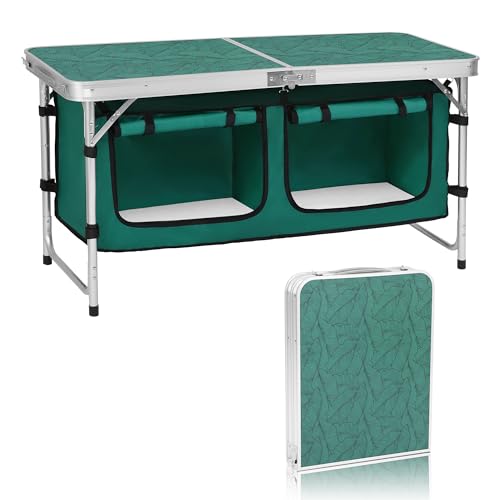
- Compact aluminum folding construction
- Includes storage canvas
- 66- to 68-pound stated capacity
Best For: Mobile users prioritizing low weight and compact storage
Heavy-Duty Height Chameleon
4-Foot Adjustable Folding Table

- 400-pound reinforced steel capacity
- Three adjustable height positions
- Safety lock and non-slip foot pads
Best For: Equipment-heavy fieldwork requiring adjustable working heights
Best Overall
Camp Field 4ft Foldable Camping Table

- Roomy 48-inch work surface with enclosed storage
- Two height positions for seated or standing use
- Stable reinforced frame with anti-slip feet
Best For: Vehicle-supported field research requiring organized outdoor workspace
Best Lightweight
Three-Height Compact Camping Table

- Weighs 5.64 pounds and folds compactly
- Three heights from 10.8 to 29.4 inches
- Designed for light gear on flat surfaces
Best For: Highly mobile fieldwork with lightweight supplies
Best Compact Cooking Station – GCI Outdoor Folding Table
For field research teams that need a compact work surface for meals, samples, or gear, this folding table for field research offers a practical balance of portability and capacity. Its aluminum top is heat resistant for use with a small camp stove, while the built-in handle and telescoping legs simplify transport and setup.
Best For: Two-person field meals, cooking stations, fishing trips, and compact outdoor work setups.
Pros:
- Supports up to 60 pounds.
- Heat-resistant aluminum tabletop can accommodate a small camp stove.
- Folds to about 18 x 2 x 17.9 inches and weighs 4 pounds.
- One-piece design includes a carry handle and tool-free setup.
Cons:
- The 20-inch tabletop is limited for larger equipment layouts.
- Its listed seating capacity is two people.
This is a strong choice when portability matters more than workspace. It is particularly useful as a lightweight cooking or staging table, but larger research setups may need additional surface area.
Best Ultralight Backpacking Surface – SOTO Pop-Up Aluminum Camping Table
When field research involves hiking between sites, the SOTO Pop-Up Aluminum Camping Table keeps the load small. This folding table for field research weighs only 13.9 ounces, folds flat, and opens with a single action for quick access to cooking gear, notes, or small equipment.
Best For: Solo researchers, backpackers, tent-based work, and lightweight campsite organization.
Pros:
- Very light at 13.9 ounces.
- Pop-up design opens and closes in seconds.
- Aluminum tabletop and stainless steel legs provide a durable outdoor surface.
- Includes a nylon stowing bag and folds to about 11.7 x 8.3 x 3.1 inches.
Cons:
- Its 3 kg maximum load is lower than that of larger tables.
- The mini surface is best suited to smaller gear and essentials.
This table prioritizes packability over workspace. It is a useful choice for mobile fieldwork where every ounce matters, but it is less appropriate for bulky instruments or multi-person staging.
Best Large Team Work Surface – Camp Field 4 FT Plastic Folding Table
For teams that need room for multiple supplies, the Camp Field 4 FT Plastic Folding Table provides a broad 4-foot surface. Among folding tables for field research, its main advantage is workspace: it can support meals, games, portable work, or the organization of field materials while still folding for transport and storage.
Best For: Group field stations, outdoor events, shared meals, and projects requiring a larger tabletop.
Pros:
- Four-foot length offers space for multiple people and items.
- Folds flat for compact storage.
- Plastic construction is intended for indoor and outdoor use.
- Reinforced legs and a solid frame are designed for stable support.
Cons:
- At 19.4 pounds, it is substantially heavier than compact camping tables.
- The supplied notes do not specify a maximum weight capacity.
- Its larger size is less convenient for backpacking or tight sites.
This is the practical pick when surface area is the priority. It suits vehicle-supported research and team use better than long-distance carry situations.
Best Adjustable Field Workbench – Naturehike Tactical Camping Table
The Naturehike Tactical Camping Table is a versatile option for field research sites with uneven ground or changing work needs. This folding table for field research has individually adjustable legs from 14 to 23 inches, a 110-pound capacity, and a lightweight aluminum frame that folds to briefcase size.
Best For: Uneven outdoor terrain, equipment staging, fishing, travel expeditions, and vehicle-based fieldwork.
Pros:
- Each leg adjusts independently from 14 to 23 inches.
- Supports up to 110 pounds.
- Folds to 15.7 x 11.4 x 2.8 inches and weighs 5.7 pounds.
- Includes a tote bag and mesh tray, with no tools required for setup.
Cons:
- At 31.5 inches wide, it is less compact than mini backpacking tables.
- The supplied notes describe a four-step setup rather than a single-action opening.
Its combination of adjustability, capacity, and portability makes it one of the most adaptable choices here. It is especially well suited to uneven ground, though ultralight hikers may prefer a smaller table.
Portable HDPE Workhorse – 4-Foot NEWBULIG Folding Table
For folding tables for field research, the NEWBULIG 4-foot model offers a practical balance of portability, cleanability, and load capacity. Its 48-inch HDPE surface wipes clean easily, while the built-in carry handle and slim folded profile simplify transport between vehicles, campsites, and work areas.
Best For: Field teams needing a sturdy, easy-clean work or meal surface for indoor and outdoor use.
Pros:
- Water-, stain-, and scuff-resistant HDPE tabletop is easy to wipe clean.
- Reinforced frame supports up to 300 pounds.
- Pre-assembled design folds flat in under a minute and includes a carry handle.
Cons:
- At 18.7 pounds, it is portable but not the lightest option.
- The fixed 29.13-inch height offers less flexibility for specialized field setups.
This is a dependable choice when durability and low-maintenance cleanup matter more than minimum carry weight or adjustable height.
Lightweight Camp Specialist – Adjustable Aluminum Field Table
Among folding tables for field research, this Camp Field model stands out for its lightweight aluminum construction and compact folded dimensions. The 47.24-inch surface provides useful room for gear, food preparation, or documentation, while the storage canvas adds a convenient place for smaller supplies.
Best For: Mobile field users who prioritize compact storage and a lightweight aluminum setup.
Pros:
- Aluminum construction keeps the table convenient for transport.
- Folds to approximately 23.62 by 18.5 by 3.96 inches for storage.
- Includes storage canvas and supports up to 66 to 68 pounds.
Cons:
- The tabletop is not waterproof and should be protected from rain.
- Assembly requires a screwdriver and wrench.
- Its listed capacity is lower than the heavier-duty alternatives.
This table makes sense for researchers carrying equipment over moderate distances, provided they protect and dry the tabletop after damp-weather use.
Heavy-Duty Height Chameleon – 4-Foot Adjustable Folding Table
For folding tables for field research that need to support substantial equipment, this 4-foot model combines a reinforced steel frame with a 400-pound capacity. Its three height positions—17.7, 23.6, and 29.1 inches—make it easier to adapt the work surface for different users, tasks, or uneven outdoor settings.
Best For: Field researchers who need high load capacity and adjustable working heights.
Pros:
- 400-pound capacity is supported by reinforced steel, dual crossbars, and corner braces.
- Three height settings accommodate seated, child-height, or standard-height tasks.
- Safety lock, non-slip feet, and carry handle support stable transport and setup.
Cons:
- At 19.8 pounds, it is heavier than the aluminum camping table.
- Assembly guidance recommends two people, despite the no-assembly-required listing.
- The manufacturer warranty is limited to 30 days.
This is the strongest all-around option for equipment-heavy fieldwork, especially when users need to alternate between low and standard working heights.
Best Overall – Camp Field 4ft Foldable Camping Table
For field research teams that need a roomy, organized work surface, this 4-foot table combines adjustable height with enclosed storage. Its reinforced aluminum frame, locking structure, and compact folding design make it a practical option among folding tables for field research, especially for campsite or outdoor staging areas.
Best For: Field researchers who need a larger outdoor workstation with protected storage for supplies, food, or equipment.
Pros:
- Spacious 48-by-24-inch tabletop provides ample working room.
- Built-in enclosed organizer helps protect and organize small supplies.
- Two height positions support seated or standing activities.
- Reinforced frame, locking structure, and anti-slip feet promote stability.
Cons:
- At 19.8 pounds, it is less convenient for long-distance carrying.
- The MDF tabletop and storage setup are more specialized than a minimalist field table.
This is the strongest all-around choice when workspace and organization matter more than minimizing pack weight. It suits vehicle-supported research, outdoor demonstrations, and campsite-based fieldwork.
Best Lightweight – Three-Height Compact Camping Table
Researchers who prioritize portability may prefer this compact table, which weighs 5.64 pounds and folds to briefcase-style dimensions. With three height settings and a carry-friendly design, it is a convenient pick among folding tables for field research when the work surface only needs to support light gear.
Best For: Mobile researchers carrying light equipment between vehicles, campsites, beaches, or temporary work areas.
Pros:
- Lightweight 5.64-pound construction is easy to transport.
- Three height settings range from 10.8 to 29.4 inches.
- Folds to approximately 16 by 12.2 by 2.6 inches for compact storage.
- U-shaped base and side clips help keep the surface steady on flat ground.
Cons:
- Its 66-pound stated capacity is better suited to light gear than heavy equipment.
- The MDF surface is not weatherproof and is not intended for rain exposure or long-term outdoor storage.
- The smaller tabletop offers less room for tools and samples.
This table is a strong portability-first option for short setups and light-duty field tasks. Keep it protected from rain and use a different table for heavy instruments or bulky equipment.
Best Heavy-Duty – 4ft Adjustable Utility Folding Table
When field research calls for a full-size, easy-clean surface, this 4-foot utility table offers a durable plastic top, steel legs, and adjustable height. Its folding-in-half design and built-in handle simplify transport, making it useful for equipment staging, demonstrations, or temporary outdoor workstations.
Best For: Researchers who need a sturdy full-size table for temporary indoor or outdoor setups.
Pros:
- 48-by-24-inch surface provides room for equipment, materials, or displays.
- Height adjusts between 20.5 and 29 inches.
- Steel frame supports up to 300 pounds according to the supplied notes.
- Folding tabletop, built-in handles, and tool-free setup improve portability.
Cons:
- At 17.5 pounds, it is heavier than the compact camping-table option.
- It lacks the enclosed storage featured on the larger camp kitchen model.
- The listed height adjustment uses four button presses, so changes are less instant than a fixed setup.
This is a practical choice when durability, capacity, and a wipe-clean surface take priority. It works particularly well for vehicle-based field stations, temporary exhibits, and research activities that require a broad, sturdy platform.
How We Picked the Best Folding Tables for Field Research
We focused on the features that matter when a table must move between vehicles, trails, temporary workstations, and outdoor sampling sites. The selection includes compact aluminum camping tables, four-foot plastic and MDF models, adjustable-height designs, and heavier-duty tables with steel legs or storage features.
Our main criteria were packed size and weight, tabletop stability, usable surface area, height flexibility, setup speed, carrying convenience, and resistance to everyday outdoor wear. Capacity claims are useful for comparing models, but they should not replace careful attention to how weight is distributed across the tabletop.
Quick Comparison
| Best For | Look For | Likely Trade-Off |
|---|---|---|
| Backpacking and remote sites | Lightweight aluminum construction and compact folding design | Smaller work surface and lower load capacity |
| Vehicle-based field stations | Four-foot tabletop, adjustable legs, and built-in carrying handle | More weight and storage space required |
| Heavy equipment or shared workspaces | Steel legs, reinforced frame, and high stated capacity | Less convenient to carry over long distances |
| Organized sampling sessions | Built-in storage, multiple height settings, and fast setup | Additional parts can add bulk |
Key Buying Factors for Folding Tables for Field Research
Weight and Packed Dimensions
Choose the lightest table that still supports your equipment. For sites reached on foot, every pound matters, and a compact table is easier to carry through narrow trails or uneven terrain. If the table travels mostly in a vehicle, a larger surface may be more useful than minimum weight.
Tabletop Material and Stability
Aluminum tables are typically lightweight and convenient for mobile work. Plastic and MDF tops often provide more workspace and may feel steadier for general-purpose tasks, but they can be heavier or more sensitive to moisture. Check the leg-locking design and frame construction, not just the tabletop material.
Height Adjustment
Adjustable legs help accommodate standing work, seated note-taking, equipment placement, and uneven ground. Multiple positions are especially useful when several researchers share one station. Confirm the minimum and maximum heights before buying.
Capacity and Weather Exposure
Consider the combined weight of instruments, cases, samples, water, and personal gear. A high weight rating is valuable, but outdoor users should also look for easy-clean surfaces, corrosion-resistant hardware, and a design that can be dried thoroughly after wet conditions.
Who Should Buy Which Folding Tables for Field Research?
Researchers hiking to remote locations should prioritize the compact aluminum and lightweight camping options. Teams creating a vehicle-supported field station will generally benefit from a four-foot adjustable table with a broad work surface. Choose a heavy-duty steel-leg model when stability and load capacity matter more than carrying distance. If organization is a recurring problem, a table with built-in storage can keep small tools, forms, and supplies within reach.
Before purchasing, measure your vehicle storage area, confirm the folded dimensions, and decide whether one person must carry and set up the table. Those practical checks will narrow the choices faster than tabletop size or capacity alone.