Choosing your first laser engraver can feel complicated when wattage, enclosure design, software, and safety features vary so widely. The right machine should match your projects, workspace, and comfort level—not simply have the highest advertised power.
We selected 10 beginner-friendly options ranging from compact enclosed machines to larger-format engravers for wood, leather, acrylic, and other compatible materials. Use the guide below to narrow the list by setup, safety, performance, and long-term value.
Best 10 Laser Engraver for Beginners Picks for 2026
Best Offline Pick

- Touchscreen design without a computer
- 95% pre-assembled beginner setup
- 400 x 400 mm workspace
Best For: Offline personalized gifts and growing craft projects
Best Enclosed Upgrade

- Fully enclosed Class 1 design
- Dual cameras reduce placement guesswork
- Templates and AI tools in xTool Studio
Best For: Guided home crafting and future expansion
Best Cutting Value

- 10W output for engraving and cutting
- Large 17 x 16 inch-class footprint
- LaserGRBL and LightBurn compatibility
Best For: Larger wood, acrylic, and craft-cutting projects
Best for Easy Setup
ACMER S1 6000mW Laser Engraver

- 99% preassembled for a quick start
- 6000mW diode laser with fine-detail capability
- Compact design supports home crafting
Best For: Beginners seeking a portable machine for small DIY projects
Best Safety-Focused Option

- 300x300mm working area for larger projects
- Multiple integrated safety protections
- Fast 20,000mm/min engraving speed
Best For: Home users and small businesses wanting room to grow
Best Small-Space Value
ACMER S1 2500mW Laser Engraver

- 99% preassembled with one-minute head installation
- Compact 130x130mm working area
- Supports multiple materials and popular software
Best For: Beginners making small crafts in limited workspace
Best Connected Workhorse

- 400 x 400 mm work area
- Supports USB, Wi-Fi, TF card, and app use
- Includes touchscreen and safety features
Best For: Beginners planning larger, more varied projects
Best Large-Format Detail
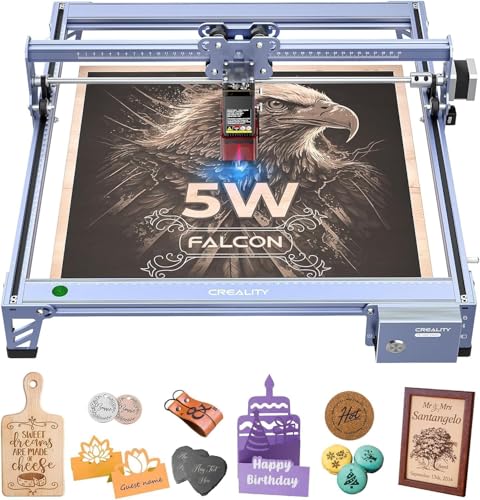
- 400 x 415 mm working area
- 0.06 mm spot for detailed work
- Speed up to 10,000 mm/min
Best For: Larger, detail-focused beginner projects
Best Offline Pick – AlgoLaser MK3 8W
If you want a laser engraver for beginners that does not require a computer for everyday projects, the AlgoLaser MK3 is a practical choice. Its touchscreen, built-in design tools, preset projects, and mostly assembled frame simplify the first steps while leaving room to advance into computer-based software.
Best For: Beginners who want offline touchscreen control, personalized gifts, and a spacious workspace for wood, leather, acrylic, and stone projects.
Pros:
- 3.5-inch touchscreen with AlgoType and AlgoSketch for computer-free design.
- 95% pre-assembled setup with a built-in manual focus stick.
- 400+ built-in projects, visual preview, and drag-and-drop positioning.
- 400 x 400 mm work area with LightBurn and LaserGRBL compatibility.
Cons:
- Remaining assembly and manual focusing are still required.
- Computer-based advanced design requires connecting to compatible software.
The MK3 stands out for reducing the usual beginner friction. Its offline controls and project library make it approachable, while the 8W laser and large work area support more ambitious crafts as your skills grow.
Best Enclosed Upgrade – xTool M2 10W
The xTool M2 is a strong laser engraver for beginners who prioritize an enclosed, guided workflow. Its Class 1 design, dual cameras, and beginner-friendly software help reduce guesswork, while optional modules can expand the machine beyond standard diode engraving.
Best For: Home crafters and aspiring side hustles seeking enclosed operation, camera-assisted placement, templates, and future expansion.
Pros:
- Fully enclosed Class 1 design with real-time safety monitoring.
- Dual cameras provide workspace previews and support Place & Go positioning.
- xTool Studio includes templates and an integrated AI image generator.
- 10W diode laser works with materials including wood, leather, felt, fabric, and paper.
Cons:
- CMYK inkjet and 3W IR laser modules are sold separately.
- The standalone machine is relatively heavy at 36.2 pounds.
For beginners who want a polished home-crafting experience, the M2 offers more built-in guidance than an open-frame machine. The higher purchase price and optional modules make it better suited to users planning regular or expanding projects.
Best Compact Starter – Twotrees TS1 Mini
The Twotrees TS1 Mini is a convenient laser engraver for beginners with limited desk space. It arrives in a fully enclosed, plug-and-play format and supports smartphone control, making it suited to small decorative projects rather than large-format work.
Best For: Beginners, classrooms, and hobbyists who need a portable engraver for small items and thin materials.
Pros:
- Compact 80 x 80 mm work area and approximately 1 kg weight.
- Fully enclosed acrylic cover, included goggles, and simple plug-and-play setup.
- Bluetooth smartphone control through the MKSLaser app.
- Supports materials such as plywood, MDF, bamboo, paper, painted metal, and leather.
Cons:
- The small work area limits projects to compact items.
- The adjustable 3W laser is intended for thin materials and light cutting.
- Adult supervision is recommended for family or classroom use.
The TS1 Mini makes sense when portability and simplicity matter more than production capacity. Its enclosed design and phone control lower the setup barrier, but the 80 x 80 mm area requires careful expectations about project size.
Best Cutting Value – Creality Falcon 10W
The Creality Falcon 10W is a capable laser engraver for beginners who want stronger cutting performance and a larger open workspace. It pairs a 10W output laser with beginner-compatible LaserGRBL, straightforward focusing, and multiple connection options.
Best For: New makers who want to move beyond light engraving into larger wood, acrylic, paper, leather, and craft-cutting projects.
Pros:
- 10W output with stated one-pass cutting of 5 mm basswood and 3 mm black acrylic.
- 0.06 x 0.06 mm spot focus and stated high positioning precision.
- Compatible with beginner-oriented LaserGRBL and advanced LightBurn.
- Supports Wi-Fi, USB, and SD-card data transfer, with a focusing plate included.
Cons:
- Open-frame design offers less enclosure than fully enclosed alternatives.
- Assembly is required, even though the stated assembly time is 10–20 minutes.
- Some material results vary by material type and settings.
The Falcon 10W is a good fit for beginners who expect their projects to grow in size and cutting ambition. Its software flexibility and quick focusing are approachable, while the open design means workspace safety and ventilation deserve careful attention.
Best for Easy Setup – ACMER S1 6000mW Laser Engraver
The ACMER S1 is a practical laser engraver for beginners who want a compact machine with minimal setup. Its 99% preassembled design, included AcmerStudio software, and support for LightBurn and LaserGRBL make it approachable for first projects, while the 6000mW diode laser adds capability for detailed engraving and light cutting.
Best For: Beginners, hobbyists, and home makers working on small DIY crafts, personalized gifts, and light cutting projects.
Pros:
- 99% preassembled, with quick laser-head installation
- 6000mW laser and 0.04mm spot support detailed engraving
- Compact 2kg aluminum-alloy design is easy to move and store
- Works with AcmerStudio, LightBurn, and LaserGRBL
Cons:
- 130x130mm working area is suited to smaller projects
- Class 4 laser certification means users need to follow appropriate laser-safety practices
Choose this ACMER model if portability and a fast start matter more than a large work area. It offers a beginner-friendly entry point while retaining file-format and software flexibility for continued learning.
Best Safety-Focused Option – 5.5W Beginner Laser Engraver
This 5.5W laser engraver for beginners emphasizes simple assembly, safety features, and room to grow. Its 300x300mm working area is substantially larger than compact desktop designs, while support for LightBurn, LaserGRBL, Cutlabx, Wi-Fi, USB, mobile control, and offline TF-card workflows gives users multiple ways to operate it.
Best For: Home users and small-business makers who want a larger work area, fast engraving, and multiple safety and workflow options.
Pros:
- Five-piece modular assembly is designed to take under 15 minutes without tools
- 300x300mm working area accommodates larger designs
- Safety cover, flame sensor, emergency stop, safety lock, and tilt auto-pause are included
- 20,000mm/min speed and compatibility with several software and connection methods
Cons:
- Additional accessories such as a rotary roller or air assist are optional add-ons
- The broad feature set may be more than a beginner needs for simple projects
This is a strong choice for beginners who expect to work on larger pieces or expand into small-business production. The modular setup and integrated protections reduce initial friction, while the broad connectivity supports different workflows.
Best Small-Space Value – ACMER S1 2500mW Laser Engraver
The ACMER S1 2500mW is a straightforward laser engraver for beginners who need a small, easy-to-store machine for wood, acrylic, leather, and other supported materials. It arrives 99% preassembled, includes free Acmerstudio software, and supports LightBurn and LaserGRBL for users who want to explore different engraving workflows.
Best For: First-time users, hobbyists, and home crafters focused on small engraving and light-cutting projects.
Pros:
- Only a one-minute laser-head installation is required
- Compact 130x130mm working area fits small workspaces
- Supports engraving on wood, bamboo, leather, plastic, ceramics, and more
- Compatible with macOS, Windows, Linux, LightBurn, and LaserGRBL
Cons:
- Smaller working area limits the size of projects
- Lower 2500mW laser power is less suited to demanding cutting than higher-powered options
For beginners prioritizing affordability of space and simple operation, this compact ACMER model is easy to position and start using. Its software compatibility and material range provide a useful foundation for learning engraving before moving to larger equipment.
Best Portable Pick – LaserPecker LP1 Plus
If you want a laser engraver for beginners that is easy to carry and quick to start, the LaserPecker LP1 Plus is designed for small, portable projects. It can run from a power bank, and its app supports importing photos or doodles for engraving on compatible non-metal materials.
Best For: Beginners who want a pocket-sized engraver for wood, leather, paper, acrylic, and other compatible non-metal projects.
Pros:
- Pocket-sized, lightweight 2.4-pound design for portable use.
- Can be ready to engrave in under two minutes and powered by a power bank.
- Adjustable stand and magnetic base support flexible positioning and small items.
- Cross-platform app is intended for simple photo and doodle importing.
Cons:
- Metal engraving is not supported.
- Requires a precise 200 mm lens-to-material distance using the included ruler.
- Its compact format is better suited to smaller projects than large workpieces.
The LP1 Plus is a practical entry point when portability and simplicity matter more than a large work area. Follow the required distance setting and use compatible non-metal materials for the most straightforward beginner experience.
Best Connected Workhorse – Longer Ray5 5W
For beginners who want room to grow, the Longer Ray5 5W combines a 400 x 400 mm work area with multiple connection options and support for LaserGRBL and LightBurn. Its touchscreen and offline capabilities make it a flexible laser engraver for beginners learning different workflows.
Best For: New users who want a larger working area, detailed engraving, and flexible USB, TF card, Wi-Fi, or app connectivity.
Pros:
- 400 x 400 mm working area accommodates larger projects.
- 0.08 x 0.08 mm laser point size and stated 0.01 mm engraving accuracy support detailed designs.
- Supports USB, TF card, Wi-Fi, and app connections, including offline use.
- Includes emergency shutdown, motion protection, overheating detection, protective covers, and goggles.
Cons:
- At 8.26 pounds, it is less portable than a pocket-sized machine.
- Its broader software and connectivity options may require more setup than a simpler beginner engraver.
- Although listed for several materials, users should follow the supplied specifications for material-specific results.
The Ray5 is a strong choice if your beginner projects may expand beyond small crafts. Its larger bed, offline operation, and software compatibility provide useful flexibility without giving up stated safety features.
Best Large-Format Detail – Creality Falcon 5W
The Creality Falcon 5W suits beginners who want a relatively large work area and fine spot size for detailed projects. It reaches speeds up to 10,000 mm/min, supports offline usage, and is positioned for engraving across more than 200 material types.
Best For: Beginners working on larger wood, leather, acrylic, glass, and other supported materials who value precision and speed.
Pros:
- 400 x 415 mm working area handles larger materials in one setup.
- 0.06 x 0.06 mm compression spot supports detailed engraving.
- Speeds up to 10,000 mm/min can support higher-volume tasks.
- Eye-protective cover and active stop function add safety-oriented features.
Cons:
- At 10.82 pounds, it is not designed for frequent portability.
- Rotary roller and raisers for cylindrical or taller objects must be purchased separately.
- The machine is listed as Laser Class 4, so users should take its safety requirements seriously.
The Falcon 5W is a sensible option when a beginner wants detailed results and a wider working area from the start. Its optional upgrades can broaden project types, but they add to the overall setup cost.
How We Picked the Best Laser Engraver for Beginners
We compared these machines using the factors that matter most to first-time buyers: laser output, work-area size, enclosure and safety protections, ease of setup, control options, software compatibility, precision, and material support. We also considered whether a model suits occasional crafts, personalized gifts, classroom-style projects, or more demanding DIY work.
Advertised power and precision figures can vary by manufacturer and testing method, so they should be treated as useful guidelines rather than guaranteed results. Ventilation, material settings, focusing, and multiple passes also affect finished quality.
Quick Comparison
| Best For | What to Prioritize | Models to Consider |
|---|---|---|
| Maximum convenience and safety | Fully enclosed design, cameras, and simple controls | xTool M2, Twotrees TS1 Mini |
| Wood and leather projects | Moderate diode power, reliable focusing, and broad software support | AlgoLaser MK3, ACMER S1, LONGER Ray5 |
| Larger signs and decorations | At least a 300 × 300 mm work area | 5.5W 300 × 300 mm model, Creality options |
| Portable or compact crafting | Small footprint and adjustable positioning | LaserPecker LP1 Plus |
Key Buying Factors for a Laser Engraver for Beginners
Safety and Ventilation
Safety should come before speed. An enclosed machine can reduce exposure to laser light and help contain smoke, while an open-frame model requires more careful placement, shielding, supervision, and ventilation. Look for emergency stops, lid or cover sensors, flame detection, protective viewing windows, and clear operating instructions. Never leave an active engraver unattended, and verify that the material is laser-safe before cutting or engraving it.
Power and Work Area
Lower-power diode lasers are often suitable for engraving wood, leather, paper, cardboard, and some coated materials. Higher output can improve cutting capability, but it does not automatically produce better engraving. A larger bed is valuable for signs and batch projects; a compact bed may be easier to fit and learn on.
Setup, Controls, and Software
Beginners benefit from straightforward focusing, guided setup, touchscreen or offline controls, and software that works with common image formats. Camera alignment is particularly useful for positioning artwork on irregular or pre-shaped items. Check operating-system support and whether the machine relies on a computer, memory card, USB connection, or mobile app.
Materials and Upkeep
Confirm the manufacturer’s approved material list before buying. Expect to clean lenses and rails, check belts, remove residue, and maintain ventilation. Air assist, an enclosure, and a honeycomb bed can improve results, but they may add cost beyond the machine itself.
Who Should Buy Which Laser Engraver for Beginners?
Choose the xTool M2 if an enclosed, camera-assisted workflow is your top priority. The Twotrees TS1 Mini suits buyers seeking a compact enclosed option. For offline operation and accessible controls, consider the AlgoLaser MK3 or LONGER Ray5.
Buy a larger-format Creality or 300 × 300 mm machine if you expect to make signs, plaques, or several small items in one session. The ACMER S1 models are worth considering when you want a choice between higher and lower output. Finally, the LaserPecker LP1 Plus is a practical fit for portability, small objects, and multi-angle work rather than large panels.