Choosing the best 3D scanner for jewelry means balancing fine detail, accuracy, surface tracking, and ease of use. A scanner that performs well on large objects may struggle with reflective metal, delicate settings, or tiny stones.
We selected these 10 scanners for different jewelry workflows, from rapid concept capture and 3D printing to color reference, repair documentation, and professional design work. Use the guide below to narrow the options by precision, scanning method, portability, and budget.
Best 10 3d Scanner for Jewelry Picks for 2026
Best Portable Pick

- 0.03mm stated accuracy with blue laser mode
- Scans dark and metallic surfaces without spray
- 260g wireless design with color capture
Best For: Portable jewelry scanning plus larger-object versatility
Best Fine-Detail Specialist
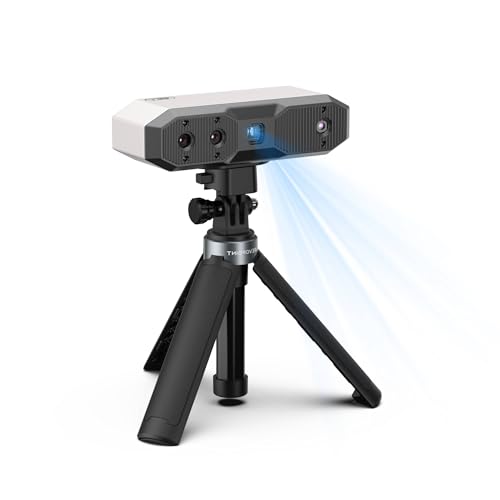
- Up to 0.02mm single-frame precision
- Blue light technology for intricate details
- 175g body with USB-C and Wi-Fi 6
Best For: Small jewelry and detail-focused object scanning
Best for Fast Laser Capture

- 0.02mm stated laboratory-condition accuracy
- Up to 60 FPS and 660,000 points per second
- Scans objects from 5mm to 2000mm
Best For: Fast, precision-focused scanning across varied object sizes
Best No-Dot Workflow

- Dual 13MP autofocus cameras
- No tracking dots required for alignment
- 0.033mm stated accuracy with true-life color
Best For: Studio scanning of jewelry and larger mechanical objects
Best Precision Pick

- Up to 0.02 mm accuracy
- Five specialized scanning modes
- Spray-free laser scanning
Best For: Precision-focused jewelry design and reverse engineering
Best Versatile Scanner

- 0.05 mm accuracy at 30 fps
- Scans dark and metallic surfaces
- Captures full-color textures
Best For: Mixed-size projects from jewelry to large objects
Best for Comfort

- Lightweight 190 g design
- Infrared and laser scanning modes
- Wireless and outdoor scanning support
Best For: Mobile jewelry scanning and flexible field workflows
Best Budget Pick
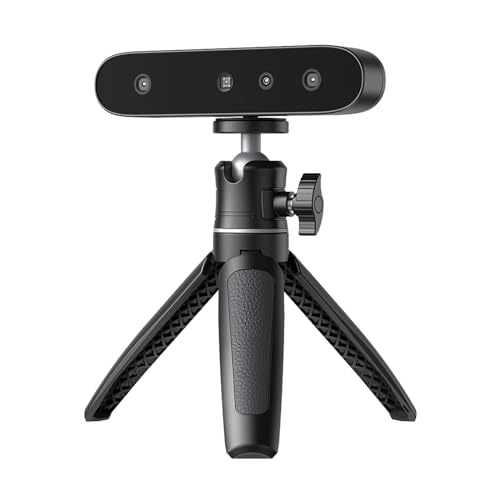
- Anti-shake tracking for steadier scans
- Scans black and metal objects without spray
- Lightweight 24-bit full-color capture
Best For: Beginners using a Windows PC for jewelry and dark-metal scanning
Best Wireless Option

- Wi-Fi 6 wireless scanning with low latency
- Quad lenses capture small and large objects
- Up to 3 hours of battery-powered scanning
Best For: Mobile users scanning jewelry and varied object sizes
Best for Mobile Workflows

- Up to 0.1mm accuracy with 30 FPS scanning
- Wi-Fi 6 support for compatible phones
- Exports OBJ, STL, and PLY files
Best For: Jewelry designers needing accurate scans across multiple devices
Best Portable Pick – Creality Pika
If you need a versatile 3d scanner for jewelry that can also handle larger objects, the Creality Pika combines a 0.03mm accuracy rating with blue laser and NIR structured-light modes. Its compact, wireless design, color capture, and marker-free capability in wired PC mode make it practical for detailed scans with less setup.
Best For: Jewelry makers and creators who want a portable scanner for small detailed objects, collectibles, and occasional full-body or larger scans.
Pros:
- Blue laser mode captures fine detail with up to 0.03mm accuracy and 0.1mm resolution.
- Can scan dark and metallic surfaces without scanning spray, according to the supplied notes.
- Portable 260g design includes Wi-Fi 6, a touchscreen, and swappable batteries.
- Exports STL, OBJ, PLY, and ASC files for common CAD and 3D-printing workflows.
Cons:
- The listed 0.03mm accuracy is a stated maximum rather than a guarantee for every jewelry scan.
- Its broad feature set may be more than needed for buyers focused exclusively on small objects.
The Pika is a strong all-around choice when portability and surface versatility matter alongside jewelry detail. Its dual scanning modes also give it more room to grow than a scanner designed only for miniature subjects.
Best Fine-Detail Specialist – Revopoint MINI 2
The Revopoint MINI 2 is a focused option for a 3d scanner for jewelry, using industrial-grade blue light technology to capture small, intricate forms. It offers up to 0.02mm single-frame precision, color capture, and connection choices that support both computer and mobile scanning.
Best For: Users prioritizing detailed scans of jewelry, small components, figurines, and other objects within its 10mm-to-0.5m scanning range.
Pros:
- Up to 0.02mm single-frame precision is suited to intricate small-object details.
- RGB camera and six flash LEDs help capture texture, color, and marker recognition.
- Lightweight 175g body supports handheld use and portability.
- Supports USB-C and Wi-Fi 6, with exports including PLY, OBJ, STL, 3MF, GLTF, and FBX.
Cons:
- The notes recommend scanning spray for improved results depending on the material and color.
- Scanning is limited to objects from 10 × 10 × 10mm up to 0.5 × 0.5 × 0.5m.
- Revo Design is paid separately and works only on Windows with x86_64 architecture.
For jewelry and other small objects, the MINI 2’s blue-light system and stated 0.02mm precision make it an especially detail-oriented candidate. Plan for surface preparation when working with challenging finishes, and confirm that your device supports the included software workflow.
Best for Fast Laser Capture – Creality Raptor Pro
The Creality Raptor Pro is a high-speed 3d scanner for jewelry and other precision work, pairing 22 blue laser lines with seven additional lines and scanning speeds up to 60 FPS. Its 0.02mm laboratory-condition accuracy rating and broad object-size range make it suitable when speed and detailed capture are important.
Best For: Experienced makers, designers, and professionals scanning detailed parts, jewelry, and objects ranging from 5mm to 2000mm.
Pros:
- Stated 0.02mm accuracy in laboratory conditions supports precision-focused work.
- Captures up to 660,000 points per second at speeds up to 60 FPS.
- Supports full-color 3D scanning for texture reproduction.
- Includes a Scan Bridge for wireless scanning and marker-based alignment for stitching.
Cons:
- Marker-based alignment may require more preparation than marker-free workflows.
- The supplied notes do not specify operating-system compatibility or export formats.
- The listed package weight is 12.17 pounds, which may be less convenient for mobile use.
The Raptor Pro stands out when rapid capture and a high stated precision figure matter more than minimal setup. Its wide scanning range also makes it a practical choice for users who want one system for jewelry and much larger parts.
Best No-Dot Workflow – Matter and Form THREE
Matter and Form THREE is designed for buyers seeking a straightforward 3d scanner for jewelry with autofocus and feature-based alignment. Its dual 13MP cameras, stated 0.033mm accuracy, and true-life color capture are intended to support both small jewelry scans and much larger objects.
Best For: Jewelry, art, engineering, and reverse-engineering users who want autofocus and no tracking dots across multiple device platforms.
Pros:
- Dual 13MP autofocus cameras are designed to maintain sharp detail at varying distances.
- Feature-based alignment eliminates the need for tracking dots.
- Stated 0.033mm accuracy supports detailed professional-oriented scans.
- Works with Windows, Mac, Linux, iOS, Android, and Chromebooks without downloads or subscriptions, according to the notes.
Cons:
- The listed scanner weight is 9.46 pounds, making it less portable than handheld alternatives.
- The notes do not specify wireless connectivity or detailed export formats.
- Although it covers jewelry to car engines, users should verify that their specific object and workflow fit the stated 20cm-to-100cm capture distance.
THREE is compelling for users who value a cleaner alignment process and broad computer compatibility. Its autofocus cameras and wide intended application range make it a practical studio scanner, particularly when setup convenience matters.
Best Precision Pick – Revopoint MetroY Pro
If you need a highly precise 3d scanner for jewelry, the Revopoint MetroY Pro stands out with blue-laser scanning, accuracy up to 0.02 mm, and multiple modes for capturing intricate surfaces. Its automatic turntable mode and spray-free scanning can streamline detailed work, although the required computer specifications are substantial.
Best For: Jewelry designers, reverse-engineering specialists, and makers who prioritize measurement accuracy and fine surface detail.
Pros:
- Blue-laser scanning delivers accuracy up to 0.02 mm and precision up to 0.01 mm.
- Five scanning modes cover detailed, deep-hole, full-field, and turntable scanning.
- Can scan shiny and dark surfaces without scanning spray in laser modes.
- Wi-Fi 6 and professional processing tools support flexible workflows.
Cons:
- Requires a powerful Windows computer or an M2 Pro Mac with at least 16 GB RAM.
- Revo Design and Revo Measure are paid separately and support Windows only.
The MetroY Pro is the strongest choice here when dimensional accuracy matters most. It is better suited to a dedicated studio or professional workflow than casual scanning, but its laser modes and turntable automation are valuable for detailed jewelry work.
Best Versatile Scanner – Creality Otter Lite Basic
The Creality Otter Lite Basic is a versatile 3d scanner for jewelry and larger objects, pairing 0.05 mm accuracy with a 30 fps scanning rate. Its quad-camera design, full-color capture, and ability to scan dark or metallic surfaces without spray make it useful when your projects range from small pieces to oversized forms.
Best For: Creators who want one handheld scanner for jewelry, product models, figurines, automotive parts, and other varied objects.
Pros:
- Offers accuracy up to 0.05 mm and scanning speeds up to 30 frames per second.
- Quad-camera design handles objects from 0.8 inches to 78 inches.
- Scans dark, shiny, and metallic surfaces without powder or spray.
- Captures 24-bit full-color textures and supports multiple export formats.
Cons:
- The optional Scan Bridge handle costs extra.
- Its one-year warranty is shorter than some professional alternatives.
Choose the Otter Lite Basic if versatility is more important than the MetroY Pro’s higher claimed accuracy. It is especially appealing for workshops that scan jewelry alongside larger items and want broad device compatibility across Windows, macOS, iOS, and Android.
Best for Comfort – Revopoint INSPIRE 2
The Revopoint INSPIRE 2 is a lightweight 3d scanner for jewelry designed for flexible scanning at home, in a studio, or outdoors. It combines infrared structured light with 11-line laser scanning, supports reflective and dark surfaces without spray, and includes a built-in RGB camera for color and texture capture.
Best For: Mobile creators and designers who need a lightweight scanner for detailed models, outdoor work, and color-textured scans.
Pros:
- Weighs just 190 g and supports Wi-Fi 6 wireless scanning.
- Offers accuracy up to 0.05 mm and precision up to 0.03 mm.
- Handles reflective and dark surfaces without scanning spray.
- Includes a mini turntable, tripod, calibration board, and outdoor filters.
Cons:
- Its listed fused point distance is 0.1 mm, less detailed than the MetroY Pro’s 0.05 mm.
- Revo Design is paid separately and supports Windows only.
- Outdoor scanning is specified for lighting up to 20,000 lux.
The INSPIRE 2 is a practical middle ground for users who value portability and wireless operation. Its optical zoom, dual scanning modules, and included accessories make it convenient for mobile jewelry scanning, while its accuracy remains suitable for many design and modeling tasks.
Best Budget Pick – Creality CR-Ferret SE
The Creality CR-Ferret SE is a practical 3d scanner for jewelry and other small objects when you want anti-shake tracking, full-color capture, and support for dark or metallic surfaces without scanning spray. Its compact 105g design is easy to carry, though it is intended for PC scanning only.
Best For: Beginners and PC users scanning jewelry, dark metal pieces, and other detailed objects.
Pros:
- Anti-shake technology helps maintain accurate tracking with unsteady hands.
- Can scan black and metallic objects without spraying.
- Built-in 2MP camera captures 24-bit full-color models.
- Compact, lightweight 105g design is easy to transport.
Cons:
- Does not include a battery handle.
- Supports PC scanning only.
- Requires a Windows computer with at least 8GB of RAM.
The CR-Ferret SE stands out as an accessible option for jewelry scanning, especially if you work from a Windows PC and value simple operation, color capture, and reduced sensitivity to hand movement.
Best Wireless Option – Creality Otter Lite
The Creality Otter Lite is a flexible 3d scanner for jewelry that combines wireless Wi-Fi 6 transmission, a built-in battery, and quad-lens scanning for small details and larger objects. Its 30 FPS performance and anti-shake tracking are useful for handheld scanning, while the included software supports model processing and point-cloud editing.
Best For: Users who want wireless scanning for jewelry, figurines, mechanical parts, and larger objects.
Pros:
- Wireless Wi-Fi 6 operation avoids USB and power-cord tethering.
- Quad-lens system adapts to small details and large objects.
- 30 FPS scanning and anti-shake tracking support smooth handheld use.
- Built-in 3400mAh battery provides up to 3 hours of continuous scanning.
Cons:
- At 330g, it is heavier than the CR-Ferret SE.
- Fast charging requires the separately noted 40W HyperCharge capability.
- Wireless operation depends on its Wi-Fi 6 and battery setup.
Choose the Otter Lite if mobility matters more than the smallest possible form factor. Its small-object focus, wireless workflow, and larger-object versatility make it a strong all-around choice for jewelry makers and modelers.
Best for Mobile Workflows – Creality CR-Scan Ferret Pro
The Creality CR-Scan Ferret Pro is a capable 3d scanner for jewelry when you need 0.1mm accuracy, fast 30 FPS capture, and wireless compatibility with supported phones. It also exports OBJ, STL, and PLY files, making it suitable for 3D printing, design, and reverse-engineering workflows.
Best For: Creators who want accurate, fast scanning across compatible iOS, Android, Mac, or Windows devices.
Pros:
- Offers up to 0.1mm accuracy and 0.16mm resolution.
- 30 FPS scanning helps capture complex shapes smoothly.
- Wi-Fi 6 enables wireless scanning with supported mobile devices.
- Exports OBJ, STL, and PLY files for flexible downstream use.
Cons:
- Optimal results require avoiding highly reflective, transparent, or extremely dark surfaces.
- Wireless mobile scanning requires compatible devices and the dedicated bridge.
- System requirements include at least 8GB of RAM on Windows, Mac, and Android setups.
The Ferret Pro is the most workflow-oriented choice in this group. Its accuracy, speed, file-export options, and broad device compatibility make it appealing for jewelry design and production, provided the object surface and host device meet its requirements.
How We Picked the Best 3d Scanner for Jewelry
We evaluated the selected models according to the needs of jewelry designers, makers, repair professionals, educators, and advanced hobbyists. Important criteria included advertised accuracy, resolution, tracking stability, scan speed, supported object sizes, color capture, and the scanner’s ability to handle complex shapes.
Jewelry scanning is unusually demanding because polished metals, gemstones, narrow gaps, and repeating details can confuse optical systems. We therefore included scanners with different strengths: high-precision blue-laser systems, structured-light models, compact scanners for small objects, wireless options, and devices with color cameras or tracking assistance. Advertised specifications are useful for comparison, but real-world results also depend on lighting, surface preparation, calibration, software, and the operator’s scanning technique.
Quick Comparison
| Priority | Look For | Best Fit From This List |
|---|---|---|
| Maximum fine-detail potential | Blue laser, high resolution, stable tracking | Creality Raptor Pro or Revopoint MetroY Pro |
| Small-object scanning | Close-range capture and high precision | Revopoint MINI 2 |
| Color reference | Full-color cameras and strong texture capture | Matter and Form Three or Creality Otter Lite |
| Wireless portability | Wi-Fi connectivity, anti-shake tracking | Creality Otter Lite Wireless or CR-Scan Ferret Pro |
| Flexible general use | Multiple modes and broad object-size support | Creality Pika or Revopoint INSPIRE 2 |
Key Buying Factors for a 3d Scanner for Jewelry
Accuracy and Resolution
Accuracy describes how closely measurements match the original object, while resolution affects how much small surface detail the scanner can capture. For ring profiles, prongs, engraved lines, and repair measurements, prioritize the highest practical precision rather than scan speed alone.
Laser Versus Structured Light
Blue-laser scanners can be excellent for geometric detail and controlled studio work, while structured-light scanners are often easier to use for general objects and faster coverage. A multi-mode scanner may be the most versatile choice if you scan both jewelry and larger models.
Reflective and Dark Surfaces
Polished gold, silver, gemstones, and black materials can reduce tracking reliability. Check whether the workflow supports scanning spray, markers, turntables, or additional lighting. “No spray” claims may improve convenience, but they do not guarantee perfect results on every reflective piece.
Software and Export
Confirm that the scanner exports common formats such as STL, OBJ, or 3MF and works with your CAD, mesh-editing, or slicing software. Helpful features include hole filling, alignment, texture processing, measurement tools, and automatic body or surface completion.
Ergonomics and Workflow
For repeated scans, weight, cable or wireless options, battery life, scan-to-computer speed, and tracking recovery matter as much as headline accuracy. A slightly less precise scanner may be more productive if it produces clean files with fewer rescans.
Who Should Buy Which 3d Scanner for Jewelry?
Choose a high-precision blue-laser model if you create detailed CAD references, reproduce components, or need dependable capture of crisp geometry. Pick a compact small-object scanner if rings, settings, and miniature parts are your primary subjects. A full-color model is preferable when texture, stone color, or visual documentation matters alongside geometry.
For mobile work, online selling, classroom use, or scanning away from a workstation, a wireless handheld model offers the best convenience. If you are new to 3D scanning, choose a versatile scanner with guided software and forgiving tracking rather than selecting solely by the smallest advertised accuracy figure.
Before buying, verify computer requirements, operating-system support, included accessories, warranty coverage, and the manufacturer’s current software compatibility. The best 3d Scanner for Jewelry is the one whose accuracy, surface-handling requirements, and workflow match the materials and designs you scan most often.