A four-bay storage enclosure gives you room to combine capacity, redundancy, and future expansion without immediately investing in a large rack-mounted system. The products in this roundup range from straightforward USB DAS units to full NAS platforms with networking, apps, and media features.
Before choosing, consider whether you need shared network access or simply more local drive bays. Interface speed, RAID options, drive compatibility, cooling, software support, and upgrade potential can make a bigger difference than raw bay count.
Best 10 Nas Enclosure with Four Bays Picks for 2026
Performance Pick

- Intel Core i3 with expandable DDR5 memory
- 10GbE and 2.5GbE networking
- Docker, VMs, RAID, and dual M.2 support
Best For: Developers, creators, and power users
Versatile DAS Value
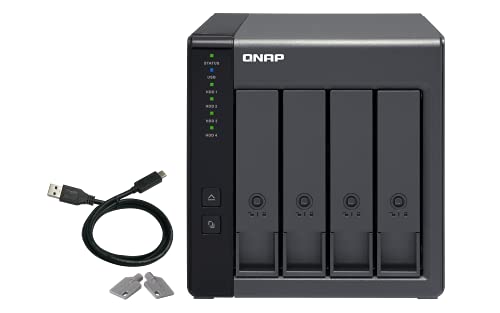
- USB Type-C direct-attached storage
- Hardware RAID 0, 1, 5, and JBOD
- Lockable bays and metal construction
Best For: USB expansion and QNAP NAS backup
Creator-Focused Choice

- Dual 10GbE networking for fast transfers
- SD slot and USB ports for media import
- Docker, surveillance, RAID, and 144TB support
Best For: Creators and small office media workflows
Simple Hot-Swap DAS
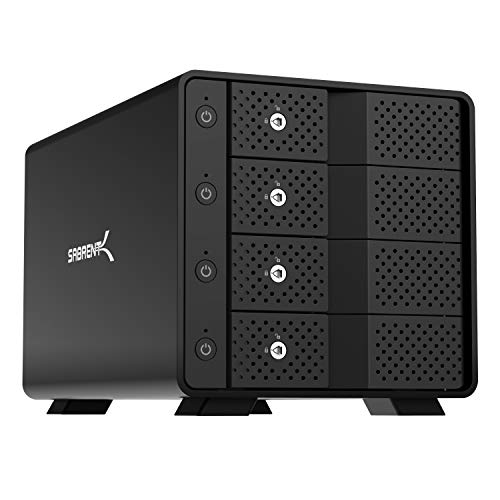
- Four trayless SATA drive bays
- 10Gbps USB-C connectivity
- JBOD design with active cooling
Best For: Direct-attached multi-drive access
Best Beginner-Friendly Pick

- Automatic photo backup with AI albums and duplicate removal
- 2.5GbE networking, 8GB RAM, and 4K HDMI output
- Beginner-friendly private cloud with remote access
Best For: Families and first-time NAS users
Best Thunderbolt Expansion Enclosure

- Four SATA bays accept 3.5-inch or 2.5-inch drives
- Thunderbolt 3 supports up to 1527MB/s sustained performance
- Configurable RAID 0, 1, 4, 5, and 1+0
Best For: Thunderbolt-connected Mac and Windows workstations
Best Power-User Home NAS

- Intel N100, 8GB RAM, and dual 2.5GbE ports
- RAID support, two NVMe slots, and up to 144TB raw capacity
- Docker and compatible third-party NAS OS flexibility
Best For: Home media servers, small offices, and homelabs
Simple DAS Storage

- Supports four 2.5- or 3.5-inch SATA drives
- Up to 80TB with USB 3.0 connectivity
- Tool-free and hot-swappable design
Best For: Direct-attached storage users who do not need RAID or NAS networking
Home NAS Pick

- True network storage with four drive bays
- Quad-core CPU, 2GB RAM, and TOS 7
- Supports backups, file services, and 4K decoding
Best For: Home and SOHO users needing shared storage and NAS software
RAID DAS Option
4-Bay USB/eSATA RAID Enclosure

- Eight modes include RAID 0, 1, 3, 5, and 10
- Supports four drives and up to 80TB
- USB 3.0 and eSATA connectivity included
Best For: Local RAID storage users who do not need network-attached features
Performance Pick – UGREEN DXP4800 Pro
If you need a nas enclosure with four bays for demanding workloads, the UGREEN NAS DXP4800 Pro is built for more than basic file storage. Its Intel Core i3-1315U processor, expandable DDR5 memory, 10GbE and 2.5GbE networking, and support for Docker and virtual machines make it a strong fit for advanced home labs, creative work, and small teams.
Best For: Developers, video editors, IT professionals, and power users who need virtualization, fast transfers, and expandable storage.
Pros:
- Intel processor, 8GB DDR5 RAM, and memory expansion up to 96GB
- 10GbE plus 2.5GbE networking for high-speed file transfers
- Supports RAID 0, 1, 5, and 10, Docker, virtual machines, and dual M.2 SSDs
- Tool-free slide-out trays and multi-zone cooling support easier 24/7 operation
Cons:
- Its advanced features may be more than casual storage users need
- Hard drives and SSDs are required separately
The DXP4800 Pro is a capable four-bay NAS for users who expect workstation-like performance and room to grow. Its combination of fast networking, virtualization support, privacy-focused local AI, and flexible storage makes it one of the more versatile options in this roundup.
Versatile DAS Value – QNAP TR-004
QNAP TR-004 4 Bay USB Type-C Direct Attached Storage (DAS) with hardware RAID (Diskless)
Check Price On AmazonThe QNAP TR-004 is a four-bay enclosure designed for direct-attached storage rather than a standalone NAS operating system. Connect it over USB Type-C to a Windows, macOS, or Linux computer, or use it to expand or back up a compatible QNAP NAS with hardware RAID options built in.
Best For: Users who want a straightforward USB storage expansion or backup enclosure with configurable RAID.
Pros:
- Supports RAID 0, 1, 5, JBOD, and individual disks
- Works with Windows, macOS, and Linux through USB Type-C
- Lockable drive bays and a metal enclosure
- Can serve as external storage or expand a compatible QNAP NAS
Cons:
- It is a DAS, not a standalone NAS with installable NAS applications
- Compatibility limitations apply to certain older QNAP NAS models
- Drives are not included
The TR-004 makes sense when USB simplicity matters more than network-based access. Check QNAP compatibility carefully before buying, especially if you plan to connect it to an older NAS, and remember that its storage pools cannot be combined with the connected NAS.
Creator-Focused Choice – UGREEN DXP4800 GT
For creators looking for a nas enclosure with four bays, the UGREEN DXP4800 GT combines fast networking with workflow-friendly connections. Dual 10GbE ports, an SD card slot, USB 10Gbps ports, HDMI, and support for media, Docker, surveillance, and virtual machine workloads make it useful for both creative teams and tech enthusiasts.
Best For: Photographers, videographers, office teams, and users managing large media libraries or local security footage.
Pros:
- AMD Ryzen Embedded processor with 8GB expandable DDR4 RAM
- Dual 10GbE ports can provide high aggregate bandwidth with compatible equipment
- Built-in SD card slot enables convenient camera-media backups
- Supports Docker, virtual machines, surveillance, RAID, and up to 144TB total capacity
Cons:
- Full networking performance requires compatible 10GbE equipment
- Drives are not included
- Its broad feature set may require more setup than a basic storage enclosure
The DXP4800 GT is particularly appealing for media-heavy workflows and mixed office use. Its SD import, dual 10GbE connectivity, local surveillance tools, and expandable storage give it a practical edge for users who want one central system for files, footage, backups, and applications.
Simple Hot-Swap DAS – SABRENT DS-SC4B
The SABRENT DS-SC4B is a practical four-bay enclosure for attaching up to four 3.5-inch SATA drives to a computer over USB-C. It uses an individual-drive JBOD design rather than hardware RAID, making it a straightforward choice for Windows, macOS, and Linux users who want convenient multi-drive access.
Best For: Users needing trayless hot-swap access to several SATA drives without a full NAS operating system.
Pros:
- USB 3.2 Gen 2 Type-C connectivity with up to 10Gbps transfer rate
- Trayless hot-swap design with independent bay switches and activity LEDs
- Supports up to four 3.5-inch SATA HDDs or SSDs
- Aluminum-and-metal housing includes a 92mm cooling fan and security features
Cons:
- It uses JBOD and does not provide hardware RAID
- Drives are not included
- Maximum practical speed depends on the host connection and individual drives
The DS-SC4B is best viewed as a flexible direct-attached drive dock, not a network storage server. Its independent connections, hot-swap bays, active cooling, and broad operating-system support make it a useful option for adding or moving drives between compatible computers.
Best Beginner-Friendly Pick – UGREEN NAS DH4300 Plus
If you want a nas enclosure with four bays for private family storage, the UGREEN NAS DH4300 Plus is an approachable starting point. It combines automatic photo backup, AI-powered album organization, remote access, Docker support, and 2.5GbE networking in a diskless enclosure designed for home users and remote workers.
Best For: Families, first-time NAS buyers, and users moving from cloud storage or external drives to a private home cloud.
Pros:
- Automatic phone photo and video backup with AI search, recognition, and duplicate removal.
- 8GB LPDDR4X RAM, a 2.5GbE port, and 4K HDMI output support everyday multitasking and media use.
- Remote access works across Windows, macOS, Android, iOS, browsers, and smart TVs.
- Local storage avoids recurring cloud fees and keeps data under your control.
Cons:
- Supports Docker but not virtual machines.
- Storage drives are not included.
- Its entry-level positioning may be limiting for advanced server workloads.
The DH4300 Plus is a practical choice when easy setup, family photo management, and private storage matter more than advanced virtualization. Confirm drive compatibility and capacity requirements before buying.
Best Thunderbolt Expansion Enclosure – OWC ThunderBay 4
The OWC ThunderBay 4 is a high-speed nas enclosure with four bays for users who need direct-attached storage rather than a complete network server. Its dual Thunderbolt 3 ports support fast connections to compatible Mac and Windows computers, while the enclosure accepts four 3.5-inch or 2.5-inch SATA drives without adapters.
Best For: Mac and Windows users with Thunderbolt-equipped computers who want expandable RAID storage for desktop or laptop workflows.
Pros:
- Four-drive design supports both 3.5-inch and 2.5-inch SATA drives.
- Up to 1527MB/s sustained performance is suited to demanding local storage tasks.
- Supports software RAID configurations including RAID 0, 1, 4, 5, and 1+0.
- Aluminum chassis provides heat dissipation, with a three-year limited warranty.
Cons:
- Requires a compatible Thunderbolt connection and is not presented as a standalone network NAS.
- Drives are not included in the 0TB configuration.
- Its value depends on having a Thunderbolt-based workflow.
Choose the ThunderBay 4 when fast, direct-attached multi-drive storage is the priority. It is better suited to a Thunderbolt workstation than to users seeking built-in remote-access NAS software.
Best Power-User Home NAS – Yxk Zero1 Pro 4-Bay NAS
The Yxk Zero1 Pro is a nas enclosure with four bays aimed at home users, small offices, and homelab enthusiasts. Its Intel N100 processor, 8GB DDR4 RAM, dual 2.5GbE ports, NVMe expansion, and 4K HDMI output give it more flexibility than a basic file-storage box, while the enclosure remains diskless so you can choose your own drives.
Best For: Home media servers, family backups, small-office storage, and users who want Docker or third-party NAS operating-system flexibility.
Pros:
- Intel N100 and 8GB DDR4 RAM support everyday NAS, office, and home-server tasks.
- Four SATA bays support RAID 0, 1, or 5 and up to 144TB of combined raw capacity with compatible drives.
- Dual 2.5GbE ports support link aggregation with compatible networking equipment.
- Two M.2 NVMe slots, 4K HDMI, Docker support, and compatibility with TrueNAS, Unraid, and OMV add flexibility.
Cons:
- HDDs and SSDs must be purchased separately.
- RAID capacity and features depend on the installed drives and configuration.
- Third-party operating-system compatibility, features, and licenses can vary.
The Zero1 Pro is a strong fit for buyers who want room to grow beyond simple backups. Its hardware and software flexibility make it appealing for media, Docker, and homelab projects, provided you are comfortable selecting drives and configuring the system.
Simple DAS Storage – 4-Bay USB Drive Enclosure
If you need a nas enclosure with four bays but do not require network access or RAID, this CENMATE model is a straightforward direct-attached storage option. It supports up to four 2.5- or 3.5-inch SATA HDDs or SSDs, connects over USB 3.0, and includes both USB-A and USB-C cables.
Best For: Individuals or small businesses that want expandable desktop storage connected directly to a computer.
Pros:
- Supports four SATA drives with a stated maximum capacity of up to 80TB.
- Tool-free, hot-swappable drive design simplifies installation and replacement.
- Aluminum construction and a built-in fan help with heat management.
- USB 3.0 supports transfer speeds up to 5Gbps under UASP control.
Cons:
- This is a DAS enclosure, not a network-attached storage system.
- The fan may produce about 40–50dB of noise.
- It does not provide RAID functionality.
The CENMATE is a practical choice when direct USB access matters more than NAS features. Its flexible drive support and tool-free bays make it convenient, provided you are comfortable with fan noise and managing storage from the connected computer.
Home NAS Pick – TerraMaster F4-212 4-Bay NAS
For shoppers specifically seeking a nas enclosure with four bays, the TerraMaster F4-212 is a true network-attached storage system rather than a USB-only enclosure. It is diskless, supports 2.5- and 3.5-inch SATA drives, and combines a quad-core processor with 2GB of RAM for home and small-office file services.
Best For: Home and SOHO users who want shared network storage, backup tools, and multimedia support.
Pros:
- Provides four drive bays and supports up to 22TB per bay, according to the supplied specifications.
- Runs TOS 7 with SMB, NFS, SFTP/FTP, AFP, iSCSI, and WebDAV support.
- Offers multiple backup applications, including CloudSync and other TerraMaster tools.
- Quad-core 1.7GHz CPU and 4K video hardware decoding support home media use.
Cons:
- Hard drives are not included.
- The 2GB RAM is not upgradeable.
- Network storage setup is more involved than using a basic USB enclosure.
The F4-212 is the strongest fit for buyers who genuinely need NAS functionality, including shared folders, permissions, backups, and network media access. Its diskless design lets you choose the drives, though the fixed memory limits future hardware expansion.
RAID DAS Option – 4-Bay USB/eSATA RAID Enclosure
This CENMATE model suits buyers comparing a nas enclosure with four bays but actually need local RAID rather than network storage. The aluminum enclosure accepts four 2.5- or 3.5-inch SATA drives, connects through USB 3.0 or eSATA, and offers eight selectable modes, including RAID 0, 1, 3, 5, and 10.
Best For: Users who want multi-drive RAID configurations in a direct-attached enclosure for a Windows, Mac, or Linux computer.
Pros:
- Supports four SATA HDDs or SSDs and up to 80TB total capacity as stated.
- Offers RAID 0/1/3/5/10 plus CLONE, LARGE, and NORMAL modes.
- Includes USB-A, USB-C, and eSATA connection options.
- Aluminum construction and built-in fans help manage drive heat.
Cons:
- It is a DAS enclosure, not a NAS, so it does not provide network sharing by itself.
- Hot-swapping is not supported.
- RAID mode changes require a manual procedure and may result in data loss.
This enclosure is more versatile than a basic four-bay USB reader because it adds hardware RAID modes and eSATA connectivity. However, the manual RAID process and lack of hot swapping make it better suited to deliberate storage setups than frequent drive changes.
How We Picked the Best Nas Enclosure with Four Bays
We selected products that represent the main ways shoppers use a four-bay enclosure: network-attached storage for shared files and services, direct-attached storage for computers, Thunderbolt expansion for demanding creative work, and simple USB or eSATA RAID storage. We also considered drive support, connection standards, hardware capability, cooling, setup complexity, and the needs of home users, small teams, and professionals.
Because these devices vary substantially, the best choice depends on the host system and workload. A diskless NAS requires separate hard drives or SSDs, while a DAS enclosure generally depends on the computer’s operating system for file management and backup software.
Quick Comparison
- Best for advanced NAS workloads: Choose a model with a stronger processor, more memory, faster Ethernet, and broader application support.
- Best for simple local expansion: A USB-C DAS can add four drives without requiring a network setup or always-on server.
- Best for creative professionals: Thunderbolt connectivity can provide high bandwidth for large video, photo, and project files.
- Best for budget-conscious home storage: A basic four-bay NAS or RAID enclosure can support backups and media storage at a lower entry cost.
Key Buying Factors for a Nas Enclosure with Four Bays
NAS or DAS?
A true NAS connects through Ethernet and can serve multiple users, run backups, host applications, and provide remote access. A DAS connects directly over USB, Thunderbolt, or eSATA and is usually simpler, faster to deploy, and less expensive. Confirm the product type before buying, since a DAS cannot provide the same independent network services as a NAS.
Drive Compatibility and RAID
Check whether the enclosure supports 3.5-inch hard drives, 2.5-inch SSDs, or both, along with maximum drive capacities and drive-health features. RAID 1 protects against a single drive failure, RAID 5 balances usable capacity and redundancy, and RAID 10 favors performance and resilience. RAID is not a substitute for an external backup.
Networking and Connectivity
For a Nas Enclosure with Four Bays, Ethernet speed strongly affects shared-file performance. Gigabit Ethernet suits basic backups, while 2.5GbE or faster networking is more appropriate for multiple users and large media files. For DAS products, compare USB 3.x, USB-C, Thunderbolt, and eSATA with the ports on your computer.
Cooling, Noise, and Software
Four mechanical drives generate heat and vibration, so look for active cooling, accessible filters, sensible fan control, and tool-free installation if those features matter to you. NAS software should offer dependable user permissions, snapshots or versioned backups, drive monitoring, and mobile or desktop access.
Who Should Buy Which Nas Enclosure with Four Bays?
Home users and remote workers should prioritize easy setup, quiet operation, automatic backups, and straightforward file sharing. Office teams need stronger networking, user controls, and reliable backup tools. Creators and developers should look for faster networking or Thunderbolt, SSD support, ample memory, and application flexibility. Advanced users may prefer a more powerful NAS with upgradeable software and expansion options, while shoppers who only need extra local capacity should choose a simpler DAS or RAID enclosure.