Video editing demands fast, dependable storage for high-bitrate footage, project files, proxies, and backups. The right RAID enclosure can add capacity and improve workflow without requiring a complete workstation upgrade.
We selected 10 options ranging from compact NVMe and SSD enclosures to large multi-bay arrays, covering different budgets, drive types, interfaces, and editing setups.
Best 10 Raid Enclosure for Video Editing Picks for 2026
Best High-Speed 4-Bay Pick
ORICO 4-Bay 20Gbps RAID Enclosure

- Six RAID modes for flexible storage planning
- Up to 104TB with four SATA drives
- USB 3.2 Gen 2x2 and USB4-ready performance
Best For: High-capacity video editing workstations
Best Professional Shuttle
SanDisk G-RAID Shuttle 8 160TB
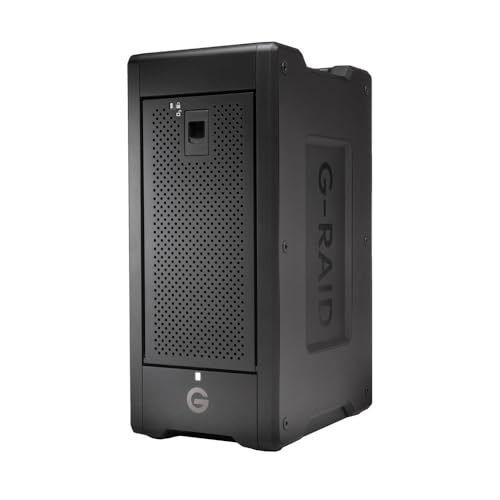
- 160TB capacity with eight removable Ultrastar drives
- Up to 2000MB/s write speeds over Thunderbolt 3
- Supports RAID 5 plus seven additional configurations
Best For: Professional 4K, 8K, and VR editing
Best 5-Bay Expansion Value
ORICO 5-Bay Hardware RAID Enclosure

- Eight hardware RAID and disk-management modes
- Five bays support 2.5-inch and 3.5-inch SATA drives
- Built-in 150W power supply and 80mm cooling fan
Best For: Desktop media libraries and large backup projects
Best Flexible 4-Bay Budget Option
MAIWO 4-Bay 8-Mode RAID Enclosure

- Eight RAID and disk-management modes
- Up to 96TB with four 3.5-inch SATA drives
- Dual switch-controlled cooling fans
Best For: Power users and small editing studios
Best High-Capacity Pick
ORICO 5-Bay 20Gbps RAID Enclosure
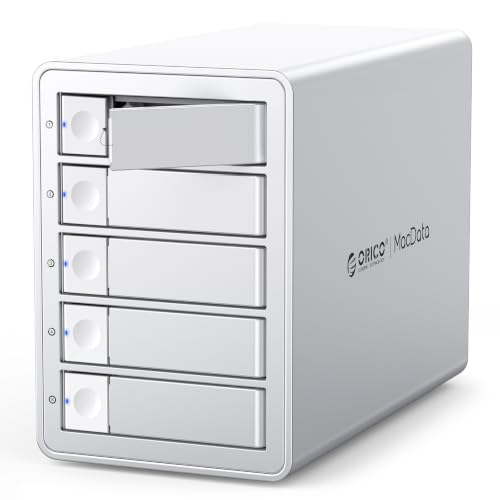
- Five SATA bays with up to 130TB total capacity
- Six RAID modes, including RAID 5 and RAID 10
- USB 3.2 Gen 2x2, cooling, and hot-swapping
Best For: High-capacity video production storage
Best Hybrid Performance Pick
ACASIS 40Gbps Hybrid RAID Enclosure

- Combines two SATA bays with two NVMe bays
- USB4 40Gbps support for dual-NVMe RAID
- Hardware RAID 1, software RAID 0, and LARGE mode
Best For: Fast editing workspace plus HDD archiving
Flexible 4-Bay Workhorse

- Four-bay support for 2.5-inch and 3.5-inch SATA drives
- Eight modes including RAID 0/1/3/5/10 and Clone
- USB 3.0 and eSATA connectivity at up to 5Gbps
Best For: Flexible multi-drive storage for home and small-office editing setups
Portable NVMe Speed Station
NEWQ Dual-Bay RAID SSD Enclosure

- Holds two M.2 2280 NVMe SSDs
- Supports RAID 0/1, JBOD, and Clone modes
- Stated 20Gbps transfer rate with tool-free installation
Best For: Portable, high-speed editing workflows using NVMe SSDs
Studio-Ready Five-Bay Hub
Yottamaster PS500RU3 RAID Enclosure

- Five SATA bays for 2.5-inch and 3.5-inch drives
- Supports RAID 0/1/3/5/10, JBOD, and Clone
- Up to 110TB stated capacity with temperature-controlled cooling
Best For: High-capacity studio and on-location video storage
Best High-Speed 4-Bay Pick – ORICO 4-Bay 20Gbps RAID Enclosure
If you need a flexible raid enclosure for video editing, this ORICO model combines four drive bays, USB 3.2 Gen 2×2 connectivity, and six RAID modes. It supports up to 104TB with four 26TB drives and works with Windows, macOS, and Linux. Note that Thunderbolt connections are limited to about 10Gbps, while a compatible USB4 port can use the enclosure’s full 20Gbps capability.
Best For: Video editors and media professionals building a high-capacity, configurable desktop storage system.
Pros:
- Supports RAID 0, 1, 5, 10, JBOD, and Normal modes.
- Up to 104TB capacity using four 3.5-inch SATA drives.
- Hot-swapping, aluminum construction, and a built-in low-noise cooling fan.
- Built-in 150W power supply supports multi-drive operation.
Cons:
- Full 20Gbps performance requires a compatible USB4 connection.
- Changing RAID modes erases drive contents, so backups are required.
This is a strong choice when capacity, RAID flexibility, and USB4-ready transfer performance matter more than a compact footprint. Its six modes also make it adaptable as your editing and backup needs change.
Best Professional Shuttle – SanDisk G-RAID Shuttle 8 160TB
For demanding workflows, the SanDisk Professional G-RAID Shuttle 8 is a premium raid enclosure for video editing with eight removable Ultrastar hard drives and up to 160TB of storage. Thunderbolt 3 delivers read speeds up to 1900MB/s and write speeds up to 2000MB/s, making it suited to multi-stream 4K, 8K, and VR projects.
Best For: Professional editors who need transportable, high-capacity storage for studio and on-location work.
Pros:
- Up to 160TB of storage in an eight-drive array.
- Supports multi-stream 4K, 8K, and VR editing workflows.
- Preconfigured RAID 5 with options including RAID 0, 1, 6, 10, 50, 60, and JBOD.
- Dual Thunderbolt 3 ports support daisy-chaining and up to 85W USB-C Power Delivery.
Cons:
- At 32 pounds, it is substantially heavier than smaller desktop enclosures.
- Its Thunderbolt-focused design is primarily suited to Mac-based setups.
This is the most capable option here for large professional media libraries and high-throughput editing. The removable enterprise-class drives and broad RAID selection add flexibility for mission-critical footage, though the size and premium positioning make it less practical for casual users.
Best 5-Bay Expansion Value – ORICO 5-Bay Hardware RAID Enclosure
This ORICO 5-bay unit is a practical raid enclosure for video editing when you want to combine multiple SATA drives in a desktop DAS. Its hardware RAID controller supports eight modes, while the five bays accept both 2.5-inch and 3.5-inch HDDs or SSDs. USB 3.0 transfer rates reach up to 230MB/s for backups and media management.
Best For: Editors and creators who need a large, straightforward desktop media library with hardware RAID controls.
Pros:
- Supports RAID 0, 1, 3, 5, 10, JBOD, Clone, and Clear modes.
- Accommodates up to five SATA drives and up to 110TB of stated capacity.
- Built-in 150W power supply supports five mechanical drives.
- Aluminum shell, honeycomb vents, and an 80mm cooling fan support extended operation.
Cons:
- USB 3.0 is slower than the 20Gbps and Thunderbolt options in this roundup.
- The supplied notes list a 110TB capacity despite the product title’s 130TB claim.
Choose this enclosure for bay count and RAID flexibility rather than maximum interface speed. It is well suited to expanding a workstation’s local media library, particularly when 230MB/s transfers are adequate for your backup and editing workflow.
Best Flexible 4-Bay Budget Option – MAIWO 4-Bay 8-Mode RAID Enclosure
The MAIWO 4-Bay enclosure offers a flexible starting point for a raid enclosure for video editing, with eight RAID and disk-management modes and support for up to four 3.5-inch SATA drives. Its USB-A/C 3.1 interface reaches up to 5Gbps, and the enclosure can hold up to 96TB using four 24TB drives.
Best For: Power users and small studios seeking configurable RAID storage for backups, workstations, and media libraries.
Pros:
- Offers Normal, RAID 0, 3, 5, 1/10, Clone, and Large/JBOD modes.
- Supports up to 96TB across four 3.5-inch SATA drives.
- USB-A/C 3.1 connectivity works with compatible systems at up to 5Gbps.
- Two switch-controlled cooling fans and LED drive indicators support ongoing use.
Cons:
- Its 5Gbps interface is slower than the faster enclosures in this roundup.
- It is designed around 3.5-inch drives rather than mixed 2.5-inch and 3.5-inch support.
The MAIWO is a sensible choice when RAID flexibility and cooling are more important than top-end transfer rates. It can serve as a dependable storage and backup enclosure for editing systems, provided your workflow does not require Thunderbolt-class throughput.
Best High-Capacity Pick – ORICO 5-Bay 20Gbps RAID Enclosure
For editors managing large footage libraries, this raid enclosure for video editing combines five SATA drive bays, multiple RAID modes, and a USB 3.2 Gen 2×2 connection. It supports up to 130TB with compatible drives, although Thunderbolt connections are limited to about 10Gbps while USB4 can reach the enclosure’s full 20Gbps capability.
Best For: Video producers and professionals who need high-capacity desktop storage with flexible RAID configurations.
Pros:
- Supports RAID 0, 1, 5, 10, JBOD, and Normal modes.
- Five bays support 3.5-inch or 2.5-inch SATA drives, up to 26TB per drive.
- Includes active cooling, a 150W power supply, and hot-swapping.
- Works with Windows, macOS, and Linux.
Cons:
- Requires new drives or a full backup before changing RAID modes because configuration changes erase drive contents.
- Thunderbolt connectivity does not deliver the full 20Gbps speed.
- Its five-bay desktop design is less portable than an all-flash enclosure.
The ORICO 5-Bay is a strong choice when capacity and RAID flexibility matter more than portability. Its cooling and power features also make it suitable for sustained multi-drive workflows.
Best Portable All-Flash Pick – ORICO 4-Bay 2.5-Inch RAID Enclosure
This raid enclosure for video editing is designed around compact 2.5-inch SSDs and HDDs, making it easier to carry than a traditional 3.5-inch enclosure. It offers seven RAID modes, USB expansion, SD and TF card slots, and up to 40TB of combined drive capacity.
Best For: Mobile editors, photographers, and creators who need portable storage and convenient card-based backups.
Pros:
- Supports RAID 0, 1, 3, 5, 10, JBOD, and CLEAR modes.
- Accepts 2.5-inch drives up to 8TB each, for up to 40TB total.
- Includes two USB 3.2 10Gbps ports plus SD and TF card slots.
- Compact solid-state design is more backpack-friendly and shock-resistant than larger 3.5-inch enclosures.
Cons:
- It does not support 3.5-inch drives.
- Its SATA interface is limited to 5Gbps, while the PSSD connection can reach 10Gbps.
- Drive capacity depends on the installed SSDs or HDDs.
The ORICO 2.5-inch model prioritizes portability and workflow convenience. Its card slots and compact footprint are particularly useful for on-location editing and photography backups.
Best Hybrid Performance Pick – ACASIS 40Gbps Hybrid RAID Enclosure
For demanding editors, this raid enclosure for video editing combines two SATA bays for high-capacity storage with two NVMe bays for faster active projects. Its USB4 40Gbps interface, hybrid RAID options, active cooling, and 8K@60Hz video output make it a versatile desktop hub for high-speed workflows.
Best For: Editors who want fast NVMe project storage alongside larger HDD archives in one enclosure.
Pros:
- Supports 3.5-inch and 2.5-inch SATA drives plus 2230–2280 NVMe SSDs.
- Offers hardware RAID 1 for HDD mirroring, software RAID 0 for NVMe, and LARGE mode for combined capacity.
- Two NVMe SSDs in RAID can reach up to 40Gbps through USB4 or compatible Thunderbolt ports.
- Includes active cooling, a 96W power supply, and 8K@60Hz video output.
Cons:
- Full 40Gbps performance requires compatible USB4 or Thunderbolt connectivity and RAID configuration.
- SATA bays are specified at up to 5Gbps, so they are better suited to archives and backups than maximum-speed editing.
- Drive performance and total capacity depend on the installed storage.
The ACASIS enclosure is the most flexible option of the three for separating active and archival data. Its hybrid design can provide fast NVMe workspace without giving up the capacity of larger SATA drives.
Flexible 4-Bay Workhorse – CENMATE 4-Bay RAID Enclosure
For a practical RAID enclosure for video editing, the CENMATE 4-bay model offers broad drive support, multiple RAID modes, and up to 80TB of stated capacity. Its USB 3.0 and eSATA connections suit desktop storage expansion, though setup and eSATA compatibility require attention.
Best For: Editors and home or small-office users who need a flexible enclosure for multiple 2.5-inch or 3.5-inch SATA drives.
Pros:
- Supports four 2.5-inch or 3.5-inch SATA HDDs or SSDs.
- Offers RAID 0/1/3/5/10, CLONE, LARGE, and NORMAL modes.
- Includes USB-A/C 3.0 and eSATA connectivity with a 12V power adapter.
- Aluminum construction and built-in cooling fans help manage drive heat.
Cons:
- Hot-swapping is not supported.
- Fan noise is rated around 40–50 decibels.
- eSATA access to multiple bays depends on the computer supporting RAID functionality.
The CENMATE is a versatile choice when you want hardware RAID options and room for four SATA drives. Its 5Gbps interface is less suited to users seeking the highest modern external-storage speeds, and RAID changes require a specific manual procedure that can result in data loss.
Portable NVMe Speed Station – NEWQ Dual-Bay RAID SSD Enclosure
This compact RAID enclosure for video editing is designed for two M.2 2280 NVMe SSDs and targets fast project transfers with a stated 20Gbps rate. Its RAID 0, RAID 1, JBOD, and Clone modes give editors options for speed, redundancy, independent drives, or direct duplication.
Best For: Mobile editors and professionals working with NVMe SSDs who prioritize portability, fast file handling, and flexible two-drive configurations.
Pros:
- Supports two M.2 2280 NVMe SSDs.
- Provides RAID 0, RAID 1, JBOD, and Clone modes.
- Offers a stated 20Gbps transfer rate for large files and backups.
- Tool-free installation and aluminum construction improve portability and heat dissipation.
Cons:
- Limited to two NVMe SSDs rather than 2.5-inch or 3.5-inch SATA drives.
- Its listed storage capacity is up to 16TB.
- An auxiliary USB-C input may be needed when using two high-capacity SSDs.
The NEWQ is the most speed-focused and portable option in this group, especially for editors already invested in M.2 NVMe drives. It is less appropriate if you need large SATA disks or a higher bay count, but RAID 1 and Clone modes add useful data-management flexibility.
Studio-Ready Five-Bay Hub – Yottamaster PS500RU3 RAID Enclosure
The Yottamaster PS500RU3 is a strong RAID enclosure for video editing when capacity and drive flexibility matter. It accommodates five 2.5-inch or 3.5-inch SATA drives, supports several RAID configurations, and uses an aluminum shell with temperature-controlled cooling for studio or on-location storage expansion.
Best For: Editors who need a high-capacity, five-drive DAS for organized project storage, backups, and flexible RAID configurations.
Pros:
- Five bays support both 2.5-inch and 3.5-inch SATA HDDs and SSDs.
- Supports RAID 0/1/3/5/10, JBOD, and Clone modes.
- Stated capacity reaches 110TB with five 22TB drives.
- Aluminum construction and an 80mm temperature-controlled fan support cooling with lower noise.
Cons:
- USB transfer speed is listed at up to 5Gbps.
- New drives may need formatting and partitioning before recognition.
- The supplied warranty description is one year.
With five bays and broad RAID support, the Yottamaster is the most capacity-oriented choice here for a studio or larger editing library. Its 5Gbps USB connection may limit peak throughput compared with newer interfaces, but the drive flexibility and temperature-controlled fan make it practical for sustained storage use.
How We Picked the Best Raid Enclosure for Video Editing
We focused on the factors that matter during real editing workloads: sustained transfer performance, drive-bay count, supported storage types, connection standards, cooling, RAID flexibility, and practical capacity. The selection includes USB 3.0 and USB-C models, faster 20Gbps and 40Gbps enclosures, Thunderbolt systems, and options for both SATA drives and NVMe SSDs.
We also considered whether an enclosure is better suited to active editing, media storage, project archiving, or backup. A high maximum capacity is useful, but it does not replace a reliable backup strategy or confirmed compatibility with your computer and drives.
Quick Comparison
| Best For | Recommended Type | What to Prioritize |
|---|---|---|
| High-resolution active editing | Thunderbolt or 40Gbps enclosure | Sustained speed, cooling, and fast SSDs |
| Large video libraries | Four- or five-bay SATA enclosure | Capacity, RAID flexibility, and quiet cooling |
| Maximum turnkey capacity | Preconfigured professional array | Included drives, warranty, and workflow compatibility |
| Portable editing storage | Compact SSD or NVMe enclosure | Size, bus power, heat management, and cable quality |
| Budget expansion | USB 3.0 multi-bay enclosure | Drive support, usable RAID modes, and value |
Key Buying Factors for a Raid Enclosure for Video Editing
Interface and Real-World Speed
Interface ratings are theoretical maximums. USB 3.0 is adequate for general media storage, while 20Gbps USB and 40Gbps connections can reduce transfers and improve editing responsiveness when paired with suitable SSDs. Thunderbolt is often the safer choice for demanding multi-stream workflows, but your computer must support the required standard.
Drive Type and Capacity
3.5-inch SATA hard drives offer economical capacity for footage libraries and backups. SATA SSDs improve responsiveness, while NVMe SSDs can deliver substantially higher performance in compatible enclosures. Check whether the enclosure supports the drive size, interface, capacity per bay, and mixed-drive configurations you plan to use.
RAID Level and Data Protection
RAID 0 maximizes speed and capacity but provides no drive failure protection. RAID 1 mirrors data for redundancy, while RAID 5 or similar parity modes can balance capacity and protection when supported. JBOD is useful when you want disks to remain independent. RAID is not a backup, so keep another copy of important projects elsewhere.
Cooling, Noise, and Compatibility
Video transfers can run for hours, making active cooling important for multi-bay systems and high-performance SSDs. Confirm fan behavior, enclosure dimensions, operating-system support, sleep and wake behavior, and whether the product includes the cables or power supply you need.
Who Should Buy Which Raid Enclosure for Video Editing?
Choose a Thunderbolt or 40Gbps enclosure if you edit directly from storage, work with demanding 4K or higher footage, or frequently move large project files. A four- or five-bay SATA model is a better fit for editors who need affordable bulk capacity, expandable media storage, and flexible RAID modes.
Consider a compact all-flash or NVMe enclosure for travel, portable project work, and fast scratch storage. A preconfigured professional array makes sense for studios that want substantial capacity with fewer installation decisions. For straightforward backup and archive expansion, a USB 3.0 enclosure can offer the best value—provided its speed matches your workflow and your drives are properly protected.