Reliable storage is essential when your photo library includes years of RAW files, edits, catalogs, and client deliverables. The right RAID enclosure can add capacity, improve drive management, and provide useful redundancy without requiring a full NAS setup.
These 10 best RAID enclosures for photo storage cover compact desktop systems, flexible multi-bay designs, and high-capacity enclosures for photographers who need room to grow. Use the buying guide below to match bay count, RAID mode, connectivity, and cooling to your workflow.
Best 10 Raid Enclosures for Photo Storage Picks for 2026
Best High-Capacity Pick
ORICO 5-Bay Hardware RAID Enclosure

- Five bays for 2.5- and 3.5-inch SATA drives
- Hardware RAID 0/1/3/5/10 plus JBOD and Clone
- 150W power supply with 80mm cooling fan
Best For: Photo studios needing flexible, high-capacity DAS storage
Best 4-Bay Option

- Eight RAID and storage modes
- Up to 96TB across four 3.5-inch SATA drives
- USB-A/C 3.1 with switchable dual-fan cooling
Best For: Photo users with 3.5-inch drives and a four-bay requirement
Best Secure 5-Bay Design
ORICO 5-Bay RAID HDD Enclosure

- Five 3.5-inch SATA bays with up to 110TB stated
- Eight RAID and storage modes
- Safety lock, 150W power, and 80mm cooling fan
Best For: Photographers prioritizing accessible and physically secured drive storage
Best for Mixed Drive Types
Yottamaster 5-Bay RAID Enclosure

- Accepts 2.5-inch and 3.5-inch SATA HDDs and SSDs
- Five bays with RAID 0/1/3/5/10, JBOD, and Clone
- USB 3.1 Type-C and temperature-controlled cooling
Best For: Creators combining different SATA drive sizes in one archive
Compact RAID Flexibility
MAIWO Dual-Bay SATA RAID Enclosure

- Two 3.5-inch bays with up to 48TB total capacity
- Four modes: RAID 0, RAID 1, JBOD, and Normal
- USB 3.1 Gen 2, adjustable fan, and 48W power supply
Best For: Compact photo libraries and two-drive backup setups
High-Capacity Four-Bay Storage

- Four bays support up to 88TB total
- Eight RAID, JBOD, Clone, and Clear modes
- Built-in 150W supply and 80mm cooling fan
Best For: Large photo and video archives needing expandable capacity
Versatile DAS Photo Archive

- Supports 2.5- and 3.5-inch SATA HDDs and SSDs
- Eight RAID and storage modes with up to 80TB capacity
- USB A/C 3.0 and eSATA connectivity for Windows, Mac, and Linux
Best For: Mixed-drive photo archives and flexible direct-attached storage
Best with Extra Features
Yottamaster FS5RU3 5-Bay RAID Enclosure
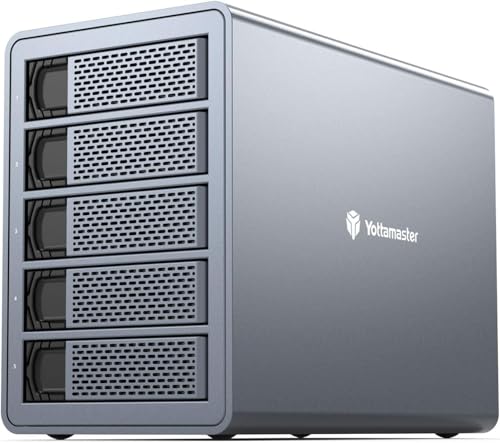
- Up to 120TB across five SATA drives
- Supports RAID 0/1/5/10, JBOD, CLONE, and Normal
- USB 3.0, aluminum body, and built-in cooling fan
Best For: Large photo libraries and studio archives
Maximum-Bay Pick

- Eight bays with capacity up to 160TB
- Seven listed RAID and storage modes
- USB A/C 3.0, eSATA, and dual cooling fans
Best For: Large, expandable photo archives and advanced users
Compact Pick

- Two-bay design supports up to 40TB
- RAID 0, RAID 1, Normal, and JBOD modes
- USB A/C 3.0 with aluminum cooling design
Best For: Home photo storage and compact desktop setups
Best High-Capacity Pick – ORICO 5-Bay Hardware RAID Enclosure
For photographers managing large RAW libraries, edits, and backups, this ORICO enclosure is one of the more flexible raid enclosures for photo storage. Its five bays accept both 2.5-inch and 3.5-inch SATA drives, while the hardware RAID controller offers several storage and redundancy modes without requiring software.
Best For: Photo studios and creators who need substantial capacity, hardware RAID flexibility, and a built-in power supply for multiple drives.
Pros:
- Supports RAID 0, 1, 3, 5, 10, JBOD, Clone, and Clear modes.
- Accepts five 2.5-inch or 3.5-inch SATA HDDs or SSDs, with up to 110TB stated capacity.
- 150W built-in power supply and 80mm cooling fan support sustained multi-drive operation.
- Works with Windows, Mac, and Linux through USB 3.0.
Cons:
- USB 3.0 connectivity is slower than newer USB-C standards.
- Drives are not included.
This is a practical workstation enclosure when capacity and hardware-controlled RAID matter more than having the newest connection standard. Its broad drive compatibility also makes it useful for combining existing photo-storage drives.
Best 4-Bay Option – MAIWO 4-Bay RAID Enclosure
This MAIWO enclosure is a capable choice among raid enclosures for photo storage when four 3.5-inch SATA drives provide enough room for your library. It offers eight configuration modes, USB A/C 3.1 connectivity rated up to 5Gbps, and cooling fans that can be switched on or off.
Best For: Photographers and small workgroups using 3.5-inch SATA hard drives for backups, media libraries, and workstation storage.
Pros:
- Provides Normal, RAID 0, 1, 3, 5, 1/10, Clone, and Large/JBOD modes.
- Supports up to 96TB using four drives rated up to 24TB each.
- Includes USB-A and USB-C cables and LED drive-status indicators.
- Two built-in fans can be controlled with a switch.
Cons:
- Supports 3.5-inch SATA drives rather than both 2.5-inch and 3.5-inch formats.
- Four bays provide less expansion room than five-bay alternatives.
The MAIWO is a sensible fit if your photo workflow is built around desktop hard drives and you want multiple RAID choices without moving to a larger five-bay enclosure. Its included cables make it adaptable to USB-A or USB-C host systems.
Best Secure 5-Bay Design – ORICO 5-Bay RAID HDD Enclosure
This ORICO model combines five-drive capacity with a bracket-free installation design and an independent safety lock. For photographers comparing raid enclosures for photo storage, it offers RAID flexibility, stated support for up to 110TB, and USB 3.0 transfer speeds up to 235MB/s.
Best For: Users who want a five-bay 3.5-inch SATA enclosure with quick drive access, locking protection, and multiple RAID modes.
Pros:
- Supports RAID 0, 1, 3, 5, 10, JBOD, Clone, and Clear modes.
- Accommodates five 3.5-inch SATA drives with up to 22TB per disk stated.
- 150W power supply and 80mm fan help support sustained multi-drive use.
- Independent safety lock and push-pull mounting simplify drive handling and security.
Cons:
- Designed for 3.5-inch drives, limiting compatibility with 2.5-inch disks.
- Uses USB 3.0 rather than a faster modern interface.
Choose this enclosure when easy drive access and physical drive retention are priorities. It is particularly appealing for photographers who want a centralized five-disk archive with several ways to balance capacity and redundancy.
Best for Mixed Drive Types – Yottamaster 5-Bay RAID Enclosure
The Yottamaster PS500RU3 stands out among raid enclosures for photo storage because it accepts both 2.5-inch and 3.5-inch SATA HDDs and SSDs. Its five removable trays, USB 3.1 Type-C connection, and hardware or software RAID setup give photographers flexibility when building or expanding a DAS archive.
Best For: Creators combining desktop hard drives, laptop drives, or SATA SSDs in a five-bay photo-storage system.
Pros:
- Supports RAID 0, 1, 3, 5, 10, JBOD/Span, and Clone modes.
- Accepts five 2.5-inch or 3.5-inch SATA HDDs or SSDs, with up to 110TB stated.
- Removable trays and included screws support secure, straightforward installation.
- Temperature-controlled 80mm fan adjusts cooling based on drive temperature.
Cons:
- New drives may need formatting and partitioning before recognition.
- USB 3.0/3.1 connectivity is rated up to 5Gbps rather than a faster interface.
This is a versatile choice for photographers with mixed drive inventories or plans to reuse existing SATA storage. The temperature-controlled fan and removable trays also make it well suited to an evolving home or studio archive.
Compact RAID Flexibility – MAIWO Dual-Bay SATA RAID Enclosure
For photographers seeking raid enclosures for photo storage without a large desktop footprint, the MAIWO dual-bay enclosure offers room for two 3.5-inch SATA hard drives and four selectable modes. Its USB-C USB 3.1 connection, adjustable fan, and included 48W power supply make it a practical option for organizing and accessing a growing photo library.
Best For: Photographers who need a compact two-drive enclosure for backups, mirrored storage, or expanded capacity.
Pros:
- Supports two 3.5-inch SATA drives, with up to 24TB per drive and 48TB total capacity.
- Offers RAID 0, RAID 1, JBOD, and Normal modes for different storage approaches.
- Includes USB 3.1 Gen 2 connectivity, UASP support, and an adjustable cooling fan.
Cons:
- Designed primarily for 3.5-inch drives; 2.5-inch drives require a separate bracket.
- Although the interface is rated for 10Gbps, mechanical drives are limited to their own speeds.
The MAIWO is a sensible choice when two bays are enough and you want straightforward RAID options in a metal enclosure. It provides useful capacity and cooling, though photographers planning a larger multi-drive archive may prefer a four-bay model.
High-Capacity Four-Bay Storage – ORICO 4-Bay RAID Enclosure
The ORICO 4-bay enclosure is built for photographers managing large collections, high-definition footage, or project archives. It supports four 3.5-inch SATA drives, up to 88TB total, and eight configuration modes, giving you more room and flexibility than a dual-bay solution.
Best For: Users building a high-capacity photo or video archive who want multiple RAID and cloning options.
Pros:
- Supports up to four 22TB 3.5-inch SATA drives for a stated 88TB maximum.
- Provides eight modes, including RAID 0, 1, 3, 5, 10, JBOD, Clone, and Clear.
- Uses a 150W built-in power supply, an 80mm silent cooling fan, and front and rear ventilation.
Cons:
- Uses USB 3.0 with a stated transfer rate of up to 235MB/s, rather than a newer 10Gbps USB interface.
- Its four-bay design may be more enclosure than needed for smaller photo libraries.
For photographers comparing raid enclosures for photo storage, the ORICO stands out for capacity and configuration variety. Its trayless design and independent safety lock add convenience, while the built-in cooling and power supply suit heavier multi-drive use.
Versatile DAS Photo Archive – CENMATE 4-Bay RAID Enclosure
The CENMATE 4-bay enclosure supports both 2.5- and 3.5-inch SATA HDDs and SSDs, making it a flexible choice among raid enclosures for photo storage. With USB A/C 3.0 and eSATA connections, eight RAID modes, and up to 80TB of stated capacity, it can serve as a direct-attached storage system for Windows, Mac, or Linux computers.
Best For: Photographers who want a four-bay DAS enclosure compatible with mixed drive sizes and several RAID layouts.
Pros:
- Accepts 2.5- and 3.5-inch SATA HDDs and SSDs, with up to 20TB per drive and 80TB total.
- Offers RAID 0, 1, 3, 5, 10, Clone, Large, and Normal modes.
- Includes USB-A, USB-C, and eSATA connectivity plus aluminum construction and cooling fans.
Cons:
- Fans are rated around 40–50 decibels, which may be noticeable in quiet workspaces.
- Hot-swapping is not supported.
- Via eSATA, the computer must support RAID functionality to access multiple bays; otherwise, only one bay may be available.
CENMATE offers useful drive-size flexibility and broad operating-system compatibility for a personal or small-business photo archive. Its configuration process is more hands-on, and the fan noise and eSATA limitations are worth considering before installation.
Best with Extra Features – Yottamaster FS5RU3 5-Bay RAID Enclosure
For photographers managing growing image libraries, the Yottamaster FS5RU3 is a flexible choice among RAID enclosures for photo storage. Its five bays support up to 120TB total capacity, with hardware RAID modes for balancing capacity, redundancy, or drive flexibility.
Best For: Photographers, studios, and video creators who need high-capacity desktop storage with multiple RAID options.
Pros:
- Supports five 2.5-inch or 3.5-inch SATA HDDs or SSDs, up to 120TB total.
- Offers RAID 0/1/5/10, JBOD, CLONE, and Normal modes.
- Aluminum construction, ventilation, and an 80mm low-noise fan help manage heat.
- USB 3.0 provides transfer speeds up to 5Gbps and works with Windows, Linux, and Mac.
Cons:
- USB 3.0 is slower than newer USB 3.2 or Thunderbolt storage interfaces.
- RAID configuration and drive installation require more setup than a simple external drive.
The FS5RU3 stands out when capacity and configuration flexibility matter most. It is a practical desktop DAS for photo archives, though users seeking maximum interface speed may want a newer connection standard.
Maximum-Bay Pick – CENMATE 8-Bay RAID Enclosure
The CENMATE 8-bay enclosure is designed for photographers who need substantial expandable storage in one desktop unit. It supports up to 160TB with compatible drives and includes several RAID layouts, but its minimum-drive requirements and configuration process deserve careful attention.
Best For: Advanced photo storage setups, large archives, and users who need eight drive bays in a single enclosure.
Pros:
- Provides eight bays and supports up to 160TB using compatible drives.
- Offers CLONE, LARGE, NORMAL, RAID 0, RAID 5, RAID 50, and RAID 00 modes.
- Supports both 2.5-inch and 3.5-inch SATA HDDs and SSDs.
- Includes USB A/C 3.0 connectivity, eSATA, aluminum construction, and two cooling fans.
Cons:
- At least two drives are required, with drives inserted across the specified bay groups.
- Changing RAID modes involves a manual power-off, switch, and reset procedure and may erase data.
- Fan noise is rated around 40–50 decibels.
This CENMATE offers the greatest expansion potential of the three options, making it suitable for substantial photo collections. Its manual RAID process and audible cooling fans make it better suited to users comfortable with storage hardware than to beginners.
Compact Pick – CENMATE 2-Bay RAID Enclosure
For photographers who want a smaller desktop setup, the CENMATE 2-bay enclosure provides a straightforward way to combine two SATA drives for photo storage. It supports RAID 0, RAID 1, Normal, and JBOD modes, with up to 40TB using two 20TB drives.
Best For: Home photographers and small offices seeking a compact enclosure with basic RAID redundancy or capacity options.
Pros:
- Compact two-bay design supports 2.5-inch and 3.5-inch SATA HDDs and SSDs.
- Supports RAID 0, RAID 1, Normal, and JBOD configurations.
- USB A/C 3.0 connectivity offers transfer speeds up to 5Gbps.
- Aluminum construction and a built-in fan support cooling during use.
Cons:
- Two bays provide less capacity and expansion room than larger enclosures.
- Fan noise is around 40–50 decibels, according to the supplied notes.
- Changing or resetting RAID can cause data loss and requires following the reset instructions.
The 2-bay CENMATE is an accessible starting point for RAID-based photo storage when desk space and drive count are limited. RAID 1 can provide a mirrored setup, but it should not replace a separate backup.
How We Picked the Best Raid Enclosures for Photo Storage
We focused on enclosures that support common 3.5-inch SATA hard drives, with several options also accepting 2.5-inch drives or SSDs. The selection includes two-, four-, five-, and eight-bay models so photographers can choose between a compact archive and a larger expandable array.
We also considered advertised maximum capacity, available RAID modes, USB and eSATA connectivity, cooling features, installation convenience, and compatibility with desktop photo workflows. Because enclosure specifications can vary by drive size, operating system, and RAID configuration, confirm the manufacturer’s current documentation before buying.
Quick Comparison
- Two-bay models: Best for smaller libraries, local backups, and simple RAID 1 mirroring.
- Four-bay models: A practical balance of capacity, flexibility, and desktop footprint.
- Five-bay models: Useful when your archive is growing quickly or you want more RAID layout choices.
- Eight-bay models: Best for large photo collections, advanced storage plans, and future expansion.
- USB 3.0 and USB-C: Convenient for direct-attached storage, but real-world speeds depend on the computer, cable, drives, and array.
Key Buying Factors for Raid Enclosures for Photo Storage
Capacity and Bay Count
Estimate your current library, then account for RAW files, previews, video, working space, and future growth. RAID reduces usable capacity, especially when mirroring data, so advertised maximum storage is not the same as available space.
RAID Level and Protection
RAID 1 mirrors data across two drives and is straightforward for important files. RAID 5 can offer a stronger capacity-to-redundancy balance in multi-bay enclosures, while JBOD or spanning modes prioritize capacity over protection. RAID is not a backup; keep a separate copy off the enclosure.
Cooling and Noise
Multiple hard drives generate heat during imports and backups. Look for an active cooling fan and a ventilated metal chassis, but check reviews or specifications for fan noise if the enclosure will sit beside your editing computer.
Connectivity and Compatibility
Choose USB-C, USB 3.0, or eSATA based on the ports available on your computer. Verify support for your operating system, drive capacities, disk formats, and any hardware or software RAID requirements.
Ease of Installation
Tool-free trays simplify drive swaps, while screw-mounted designs may provide a more secure fit. Confirm whether drives are included—these products are generally enclosures only—and label disks before creating an array.
Who Should Buy Which Raid Enclosures for Photo Storage?
Choose a two-bay enclosure if you need a compact archive or a simple mirrored backup for a modest photo library.
Choose a four-bay enclosure if you want a versatile everyday setup with room for redundancy and expansion without the footprint of a larger tower.
Choose a five-bay enclosure if you maintain a large RAW library, regularly ingest client work, or want more flexibility in balancing usable capacity and drive protection.
Choose an eight-bay enclosure if storage growth, multiple projects, or a long-term media archive justify the extra cost, power use, and desk space. Whichever model you select, combine RAID with an independent backup and periodically test that your files can be restored.