The best sketchbooks for experienced artists need to do more than hold loose ideas. Paper weight, surface texture, binding, portability, and media compatibility all affect how confidently you can work.
We’ve selected 10 sketchbooks spanning lightweight drawing pads, guided practice journals, durable hardcovers, and thick mixed-media options so you can match the format to your process and preferred tools.
Best 10 Sketchbooks for Experienced Artists Picks for 2026
Best Dry-Media Workhorse

- 100 sheets of 68 lb/100 gsm acid-free paper
- Top spiral binding lays flat and pages detach cleanly
- Designed for dry media, not heavy wet techniques
Best For: Large dry-media studies and repeated erasing
Best Mixed-Media Flexibility
MOFUNY 9 x 12 Mixed Media Sketchbook

- 98 lb/160 gsm paper supports multiple media
- 60 sheets in a portable 9 x 12 format
- 360-degree ring binding maximizes workspace
Best For: Artists combining drawing, painting, watercolor, and ink
Best for Urban Sketching
Leda Pocket Landscape Sketchbook

- Compact 3.5 x 5.5-inch panoramic format
- 160 pages of archival-quality 90-pound paper
- Water-resistant cover, sewn binding, and storage pocket
Best For: Portable plein air and urban sketching
Best Hardcover Journal Format

- 160 pages of 70 lb/110 gsm acid-free paper
- Durable hardcover with elastic closure and ribbon marker
- Suitable for drawing, writing, and light mixed media
Best For: Organized studio journals and detailed drawing notes
Best Guided Practice
Art Life Practice: The Guided Sketchbook

- 52 playful prompts inspired by art history
- Covers drawing, painting, collage, and more
- Includes artist quotes and brief biographies
Best For: Artists seeking structured daily creative practice
Best for Dry Media and Tear-Out Work

- 68-pound acid-free paper for dry media
- 360-degree spiral binding and hard backing
- Perforated pages for clean tear-out
Best For: Portable pencil, charcoal, pastel, and crayon work
Best Compact Hardcover Journal

- 160 pages of thick cream 140 gsm paper
- Lay-flat stitched hardcover with elastic band
- Includes bookmark ribbon and expandable pocket
Best For: Portable visual journaling and everyday sketching
Best Everyday Dry-Media Pick

- 90gsm acid-free paper for dry media
- Waterproof hardbound cover
- Spiral binding with perforated pages
Best For: Artists who primarily use dry media and want a durable keepsake sketchbook
Best Large Mixed-Media Format
Artist’s 200GSM Hardcover Sketchbook
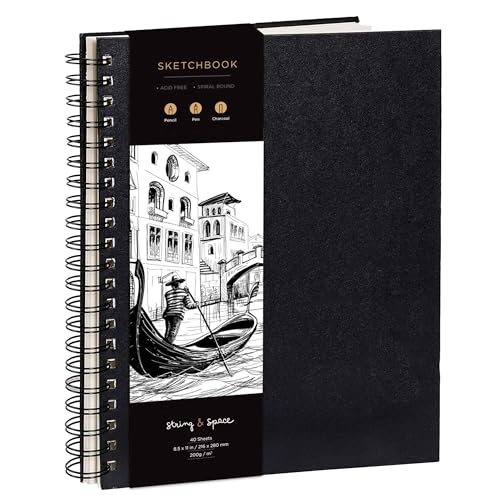
- 200gsm paper for drawing and mixed media
- Large 8.25 x 11.4-inch format
- Hardcover wire binding works portrait or landscape
Best For: Artists wanting thick paper for larger mixed-media studies
Best Portable Thick-Paper Pick
Artist’s 200GSM Compact Sketchbook

- 200gsm paper for several mixed-media uses
- Compact 5.8 x 8.5-inch size
- Hardcover spiral binding for flexible drawing
Best For: Artists who want portable, thick-paper mixed-media sketching
Best Dry-Media Workhorse – Fuxi 9 x 12 Spiral Sketchbook
For experienced artists seeking sketchbooks for experienced artists that prioritize dry-media control and generous working space, the Fuxi 9 x 12 is a practical option. Its 68 lb/100 gsm, acid-free paper has a diagonal tooth suited to graphite, colored pencil, charcoal, pens, light ink, and oil pastels, while the top spiral binding keeps the book flat and pages easy to remove.
Best For: Detailed dry-media studies, figure drawing, shading practice, and artists who prefer a roomy top-bound format.
Pros:
- 100 sheets provide 200 usable sides for extended practice.
- Textured surface supports shading, blending, and repeated erasing.
- Top spiral binding lays flat and keeps the coil above the drawing hand.
- Hard covers provide a firm surface for travel or desk-free sketching.
Cons:
- Not intended for watercolor, acrylic, alcohol markers, or heavy wet media.
- The 100 gsm paper is lighter than dedicated mixed-media stock.
This is a strong value for artists who mainly work in dry media and want a full-size, durable sketchpad. Choose another option if wet-media versatility is central to your practice.
Best Mixed-Media Flexibility – MOFUNY 9 x 12 Mixed Media Sketchbook
Artists comparing sketchbooks for experienced artists will appreciate the MOFUNY 9 x 12 for its thicker 98 lb/160 gsm mixed-media paper. The 60-sheet pad is designed for drawing, ink, watercolor, acrylics, gouache, and other projects, with a ring binding that rotates 360 degrees for flexible positioning.
Best For: Artists who move between drawing, painting, watercolor studies, and other mixed-media techniques.
Pros:
- 160 gsm paper is substantially more substantial than lightweight sketch paper.
- Supports pencil, pen, charcoal, crayons, gel pens, watercolor, acrylic, and gouache.
- 360-degree ring binding maximizes usable workspace and portability.
- Hard cardboard covers help protect artwork in a bag or backpack.
Cons:
- It has fewer sheets than the Fuxi and KINGART options.
- The supplied notes do not specify a warranty.
The MOFUNY is the most versatile choice here for artists who do not want to limit themselves to dry media. Its thicker sheets make it a practical all-rounder for studies and layered work, though dedicated watercolor artists may still prefer a specialized watercolor pad.
Best for Urban Sketching – Leda Pocket Landscape Sketchbook
For experienced artists who sketch on location, the Leda Pocket Landscape Sketchbook offers a compact alternative to larger sketchbooks for experienced artists. Its 3.5 x 5.5-inch panoramic format suits scenic drawings and urban sketches, while 160 pages of 90-pound cream paper accommodate pencils, ink, markers, charcoal, and light watercolor washes.
Best For: Plein air work, travel sketching, panoramic scenes, and artists who need a small book that is easy to carry.
Pros:
- Landscape orientation is well suited to panoramic compositions.
- Water-resistant vegan leather cover adds protection outdoors.
- Sewn binding keeps pages secure, while the elastic closure protects the book.
- Back pocket provides space for pencils and field notes.
Cons:
- The compact pages offer less room for large or highly detailed studies.
- Paper is rated for light watercolor washes rather than heavy wet work.
The Leda stands out for portability and outdoor practicality. It is an excellent companion sketchbook for quick observational work, but artists developing large compositions will likely need a roomier format alongside it.
Best Hardcover Journal Format – KINGART 8.5 x 11 Sketchbook
The KINGART Hardcover Sketchbook suits experienced artists who want sketchbooks for experienced artists with a more finished journal presentation. It combines 80 sheets, or 160 pages, of 70 lb/110 gsm acid-free paper with a hardcover, elastic closure, and ribbon marker for organized drawing, writing, and light mixed-media work.
Best For: Studio journals, detailed drawings, visual notes, and artists who value a secure hardcover book over spiral binding.
Pros:
- 160 pages provide plenty of room for ongoing ideas and studies.
- Acid-free, finely textured paper supports drawing, doodling, writing, and light mixed media.
- Hardcover construction offers a durable, polished journal format.
- Elastic band and ribbon marker help secure the book and track your place.
Cons:
- 110 gsm paper is not intended for heavy wet-media applications.
- Perfect binding does not offer the page-removal convenience of a perforated sketchpad.
This KINGART book is a good fit for artists who want their sketches and notes in one durable journal. It offers a more traditional bound-book experience, but wet-media specialists should choose a heavier mixed-media surface.
Best Guided Practice – Art Life Practice: The Guided Sketchbook
Art Life Practice: The Guided Sketchbook: Artist-Inspired Prompts for a Daily Practice
Check Price On AmazonFor artists seeking sketchbooks for experienced artists that also encourage consistent practice, this guided option combines 52 creative exercises with brief art-history context. Prompts cover drawing, painting, collage, blind contour sketching, and other techniques, making it more structured than a blank book.
Best For: Experienced artists who want fresh prompts, creative experimentation, and a more mindful daily art routine.
Pros:
- Includes 52 playful, art-history-inspired exercises.
- Encourages work across drawing, painting, collage, and other techniques.
- Pairs prompts with artist quotes and brief biographies.
- Offers both creative play and art instruction.
Cons:
- Prompt-led format may be less suitable for artists wanting entirely blank pages.
- At 200 pages and 1.68 pounds, it is less lightweight than a basic pad.
This is a strong choice when the goal is to develop a regular practice rather than simply collect blank drawing space. Its guided format adds direction without limiting the range of media and approaches.
Best for Dry Media and Tear-Out Work – 8.5 × 11 Spiral Sketch Book
Artists comparing sketchbooks for experienced artists may appreciate this practical 8.5 × 11-inch pad for pencil, charcoal, pastel, crayon, and other dry media. Its 68-pound acid-free paper, perforated sheets, and built-in backing make it suitable for studio work, travel, or drawing on uneven surfaces.
Best For: Artists who want a portable, versatile dry-media pad with removable pages and a supportive drawing board.
Pros:
- Acid-free 68-pound/100 gsm paper resists bleed and smudge.
- Spiral binding turns 360 degrees for flexible use.
- Perforated pages allow clean tear-out for display or framing.
- Hard backing supports drawing on laps, outdoors, or uneven surfaces.
Cons:
- The 50-sheet capacity is smaller than many bound sketchbooks.
- Its stated strengths focus on dry media rather than wet techniques.
Choose this pad for flexibility and easy page removal. The classic size fits a standard portfolio, while the spiral construction and sturdy backing support artists who move between desk, lap, and travel drawing.
Best Compact Hardcover Journal – Sakura A5 Sketchbook
For experienced artists looking for sketchbooks for experienced artists that travel easily, the Sakura A5 offers 160 pages in a compact 5.1 × 8.3-inch format. Its cream 140 gsm paper, hardcover construction, lay-flat stitching, and visual-journaling design suit portable sketching and illustration.
Best For: Artists who want a durable, compact sketchbook for visual journaling, field sketches, and everyday creative exploration.
Pros:
- Provides 160 pages of thick cream 140 gsm paper.
- Hardcover, stitch binding, and lay-flat design support regular use.
- Elastic band, bookmark ribbon, and expandable inner pocket add useful organization.
- Compact A5 format is convenient for portable sketching.
Cons:
- The 5.1 × 8.3-inch page size offers less room than a full-size sketch pad.
- The notes do not specify compatibility with particular media.
This sketchbook prioritizes portability and durable everyday use. It is a particularly fitting option for artists who treat sketching as visual journaling and value a refined, organized notebook format.
Best Everyday Dry-Media Pick – Conda Hardbound Sketch Book
For experienced artists seeking sketchbooks for experienced artists, the Conda 8.5 x 11-inch book is a practical choice for pencil, pen, pastels, charcoal, gel pen, and other dry media. Its 90gsm acid-free paper, protective hardcover, and spiral binding make it well suited to regular sketching and keeping finished work together.
Best For: Artists who primarily use dry media and want a large, durable keepsake sketchbook.
Pros:
- Hardbound, textured, waterproof cover helps protect artwork.
- Spiral binding opens flat and allows pages to flip over easily.
- Perforated pages can be separated while remaining secure in the book.
- Acid-free paper is designed to resist yellowing under normal storage.
Cons:
- 90gsm paper is not recommended for markers.
- It is better suited to dry media than heavier wet-media applications.
This is a sensible option when durability, page flexibility, and archival-minded paper matter more than maximum thickness. Artists who need substantial watercolor or mixed-media paper should consider a heavier option.
Best Large Mixed-Media Format – Artist’s 200GSM Hardcover Sketchbook
Among sketchbooks for experienced artists, this 8.25 x 11.4-inch spiral book stands out for its 200gsm paper and generous working area. The thick sheets are intended for charcoal, colored pencils, oil pastels, and watercolor, while the hardcover and wire binding support both landscape and portrait work.
Best For: Artists who want a large-format sketchbook for drawing and selected mixed-media techniques.
Pros:
- Very thick 200gsm paper supports charcoal, colored pencils, oil pastels, and watercolor.
- The product notes describe the pages as resistant to bleed-through.
- Wire binding and hardcover construction allow landscape or portrait use.
- Provides 80 pages across 40 sheets for substantial project work.
Cons:
- It has fewer sheets than the 80-sheet Conda sketchbook.
- The supplied details do not specify that the paper is acid-free.
Choose this model when paper weight and versatility are priorities. Its larger format is useful for developed studies, while the 200gsm stock gives experienced artists more freedom than lightweight sketch paper.
Best Portable Thick-Paper Pick – Artist’s 200GSM Compact Sketchbook
For sketchbooks for experienced artists that need to travel well, this 5.8 x 8.5-inch spiral sketchbook offers the same stated 200gsm paper as the larger version in a more compact format. It is designed for charcoal, colored pencils, oil pastels, and watercolor, with a hardcover and wire binding for flexible use.
Best For: Artists who want thick mixed-media paper in a portable sketchbook size.
Pros:
- 200gsm paper is intended for charcoal, colored pencils, oil pastels, and watercolor.
- Compact dimensions are convenient for carrying to classes, studios, or outdoor sessions.
- Hardcover and spiral construction support portrait or landscape drawing.
- The product notes state that the paper helps prevent bleed-through.
Cons:
- The smaller page size provides less room for large compositions.
- The supplied details do not identify the paper as acid-free.
This is the better fit when portability matters as much as paper performance. It retains the thick-paper advantages of the larger format while offering a more manageable surface for studies and on-the-go work.
How We Picked These Sketchbooks for Experienced Artists
We focused on the features that matter most after the basics: paper weight, page count, binding, cover protection, portability, and versatility across dry and wet media. The selection includes lightweight paper for graphite and ink, heavier stock for markers and mixed media, and lay-flat or spiral formats that make sustained drawing more comfortable.
Acid-free paper was also prioritized where specified, since it helps support longer-term storage. Because artists work differently, no single sketchbook is ideal for every use; the best choice depends on whether you value experimentation, archival handling, travel convenience, or daily practice.
Quick Comparison
| Best for | Look for | Strongest format |
|---|---|---|
| Large studies and finished sketches | 8.5 × 11 or 9 × 12 dimensions | Hardcover or spiral-bound book |
| Mixed media and heavier applications | 160–200 GSM paper | Heavyweight mixed-media sketchbook |
| Portable field work | Compact size and flexible cover | Pocket or A5 hardcover |
| Daily skill development | Prompts and structured exercises | Guided sketchbook journal |
Key Buying Factors for Experienced Artists
Paper Weight and Surface
Paper weight is a useful starting point, but surface texture matters just as much. Lightweight 90–110 GSM sheets generally suit graphite, colored pencil, and controlled ink work. For washes, markers, layering, or mixed media, 160 GSM or 200 GSM paper offers better resistance to buckling and bleed-through. Always check the manufacturer’s media guidance before using wet materials.
Binding and Page Access
Spiral bindings usually open flat and let you work close to the gutter, making them practical for studies and reference sheets. Hardbound books protect completed work and feel more substantial in a portfolio, though they may not open as fully. Top-bound formats can be especially comfortable for left-handed artists or when drawing on a desk.
Size, Portability, and Page Count
Large 8.5 × 11 and 9 × 12 books provide room for anatomy studies, composition thumbnails, and finished drawings. Smaller A5 and pocket books are easier to carry and encourage frequent observational sketches. More pages reduce the need to replace a book often, but also add weight, so consider where you will use it.
Archival and Practical Details
Acid-free paper is preferable for work you plan to keep. Also inspect whether pages are single- or double-sided, perforated, numbered, or suitable for removal. These details can matter when submitting studies, organizing a visual journal, or preserving a sequence of work.
Who Should Buy Which Sketchbooks for Experienced Artists?
- Choose a heavyweight mixed-media sketchbook if you use wet media, markers, ink washes, or layered techniques.
- Choose a large spiral-bound pad if you need generous space for studies and want pages to lie flat.
- Choose a hardcover sketchbook if protection, structure, and long-term organization matter most.
- Choose a compact pocket or A5 book if you sketch outdoors, commute, or prefer always having a book available.
- Choose the guided practice option if prompts help you maintain a consistent drawing routine or explore unfamiliar subjects.
Before buying, match the paper to your primary medium, then confirm the dimensions and binding suit your workspace. For most experienced artists, choosing the right surface and format will make a greater difference than simply selecting the book with the highest page count.