The best 3D printer for crafters makes it easier to turn digital designs into practical tools, decorations, gifts, and custom parts. The right choice depends on your workspace, material needs, and how much setup you want to handle.
We compared ten beginner-friendly and advanced options, including compact enclosed models, high-speed printers, and multicolor systems with automatic material handling.
Best 10 3d Printer for Crafters Picks for 2026
Best Beginner Pick

- Fast, precise printing with 10,000 mm/s² acceleration
- Automatic calibration and active flow-rate compensation
- Optional AMS lite enables multicolor printing
Best For: Beginners and crafters seeking simple, quiet, accurate printing
Best Multimaterial Choice

- Four toolheads switch in about five seconds
- Prints multicolor and mixed-material projects
- Supports a broad range of flexible and engineering filaments
Best For: Advanced crafters, workshops, and multimaterial projects
Best Enclosed Printer

- Enclosed design supports advanced filament printing
- Up to 500 mm/s printing and automatic bed leveling
- Optional AMS connection supports up to 16 colors
Best For: Crafters wanting speed, enclosure benefits, and upgradeable color printing
Best Easy Multicolor Setup

- CANVAS enables automated four-color printing
- Full calibration and 22 sensors simplify setup
- 500 mm/s CoreXY performance with app control
Best For: Beginners seeking convenient, automated multicolor crafting
Best for Kid-Friendly Creativity

- 12,000+ tested models and AI creation tools
- Enclosed, quiet, leveling-free design
- Includes eight PLA rolls and starter tools
Best For: Families and young beginners making toys, decorations, and STEM projects
Best for Multicolor Craft Projects

- AMS lite enables multicolor printing
- Includes an LED kit for lamp projects
- Automatic calibration and flow compensation
Best For: Crafters making colorful décor, lights, and creative gifts
Best Compact Starter

- Fully assembled and ready to start quickly
- App, Wi-Fi, and TF card printing options
- Compact build area for small projects
Best For: Beginners and families crafting in small home workspaces
Best Multicolor Pick
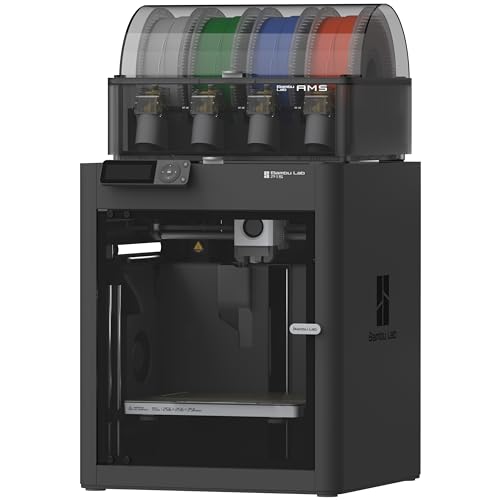
- AMS supports multicolor and multimaterial printing
- 500 mm/s printing with automatic bed leveling
- Enclosed design and 15-minute setup
Best For: Colorful craft projects and easy high-speed printing
Best Fast-Setup Value

- 600 mm/s travel speed and automatic leveling
- Quick nozzle changes and fast warm-up
- Remote monitoring through Flash Studio
Best For: Fast, repeatable craft prints and rapid prototypes
Best Premium Workflow

- 600 mm/s precision printing with flow compensation
- AMS 2 Pro adds multicolor printing and filament drying
- AI detection and adaptive airflow support easier workflows
Best For: Advanced craft projects and demanding multicolor materials
Best Beginner Pick – Bambu Lab A1
The Bambu Lab A1 is a practical 3d printer for crafters who want quick, detailed results without spending much time on setup. Automatic calibration, active flow-rate compensation, and a quiet operating design make it approachable for everyday creative projects.
Best For: Beginners, families, and crafters who prioritize easy operation, accurate prints, and optional multicolor work.
Pros:
- 10,000 mm/s² acceleration supports fast, precise printing.
- Full-auto calibration handles Z-offset and bed leveling.
- Quiet operation, a simplified touchscreen, and a quick-swap nozzle improve usability.
- Supports multicolor printing when paired with AMS lite.
Cons:
- AMS lite is required for multicolor printing and is not included with the standard printer.
- The printer weighs 22 pounds, so it still needs a stable workspace.
The A1 is a strong starting point for crafters who want reliable, low-fuss FDM printing. Choose the A1 Combo or add AMS lite if multicolor projects are part of your plans.
Best Multimaterial Choice – Snapmaker U1
The Snapmaker U1 is a capable 3d printer for crafters who want genuine multicolor and multimaterial flexibility. Its four independent toolheads change in about five seconds, reducing purging and making complex creative or functional prints more efficient.
Best For: Advanced crafters, workshops, and creators working with multiple colors, flexible materials, soluble supports, or engineering filaments.
Pros:
- Four preloaded toolheads enable true multicolor and multimaterial printing.
- Five-second tool changes can reduce waste and speed up color transitions.
- Supports materials including PLA, PETG, TPU, PVA, ABS, ASA, PA, and PC.
- Automatic calibration, print monitoring, remote control, and a built-in model library simplify operation.
Cons:
- At 57.9 pounds, it is substantially heavier than the other listed options.
- Its advanced toolhead system may be more capability than casual crafters need.
With a 270 × 270 × 270 mm build volume and CoreXY speeds up to 500 mm/s, the U1 is designed for ambitious projects. It is the most compelling choice here when material versatility matters as much as color.
Best Enclosed Printer – Bambu Lab P1S
The Bambu Lab P1S is a ready-to-use 3d printer for crafters who want high-speed production in an enclosed machine. Its automatic bed leveling and approximately 15-minute setup make it a convenient option for moving from design to finished print quickly.
Best For: Crafters who want an enclosed printer for PLA, PETG, TPU, PVA, PET, ABS, or ASA projects, with optional multicolor expansion.
Pros:
- Prints at up to 500 mm/s with 20,000 mm/s² acceleration.
- Enclosed design improves performance with advanced filaments.
- Automatic bed leveling supports more consistent first layers.
- Can support up to 16 colors when connected to a Bambu Lab AMS.
Cons:
- Bambu Lab AMS is required for multicolor or multimaterial printing.
- Carbon- or glass-fiber-reinforced polymers are not recommended.
- At 38.9 pounds, it requires a sturdy setup location.
The P1S balances speed, convenience, and enclosure benefits well. It is a sensible upgrade for crafters who expect to use a wider selection of supported filaments or want to expand into multicolor later.
Best Easy Multicolor Setup – ELEGOO Centauri 2 Combo
The ELEGOO Centauri 2 Combo is a beginner-friendly 3d printer for crafters who want multicolor printing with a guided workflow. Its CANVAS system, automatic calibration, and smart pre-print checks are designed to reduce manual adjustments while maintaining high-speed CoreXY performance.
Best For: Beginners and everyday makers who want convenient four-color printing, remote control, and automated print monitoring.
Pros:
- CANVAS provides four-color printing with RFID filament recognition and auto refill.
- Full auto calibration and 22 intelligent sensors help simplify printing.
- CoreXY motion reaches up to 500 mm/s with 20,000 mm/s² acceleration.
- A 5-inch touchscreen, model library, slicer, and mobile app support a seamless workflow.
Cons:
- The 19.69 × 18.9 × 23.23-inch footprint may require considerable desk space.
- Its four-color CANVAS workflow is less expansive than systems designed for more colors.
The Centauri 2 Combo stands out for making colorful printing feel approachable. It is a strong fit for crafters who value automation and an integrated software ecosystem over extensive manual control.
Best for Kid-Friendly Creativity – AI 3D Printer for Kids
For families seeking a 3d printer for crafters, this enclosed AOSEED model emphasizes approachable, low-fuss creativity. Its app-based AI tools, ready-to-print library, and starter materials make it easy to move from an idea to a small toy, decoration, or personalized project.
Best For: Kids and families who want guided, beginner-friendly crafting and STEM projects at home.
Pros:
- Includes access to more than 12,000 human-reviewed, print-tested models.
- AI Doodle, AI MiniMe, and MINIMAKIE support creation from voice, text, images, or photos.
- Enclosed, pinch-resistant design with quiet operation and a leveling-free platform.
- Starter kit includes eight PLA rolls, tools, a magnetic build plate, and stickers.
Cons:
- Supports single-color printing only; multicolor designs require separate parts and assembly.
- Its kid-focused features may be less suitable for advanced makers wanting extensive manual control.
With camera monitoring, automatic time-lapse creation, filament runout detection, and quick-release nozzle access, this printer is built around convenience. It is a particularly approachable option when the goal is shared family crafting rather than highly technical experimentation.
Best for Multicolor Craft Projects – Bambu Lab A1 Combo
For crafters who want colorful, detailed results, the Bambu Lab A1 Combo is a strong 3d printer for crafters. Its included AMS lite supports multicolor printing, while the LED lamp kit adds a practical outlet for decorative models and custom lighting projects.
Best For: Makers creating multicolor décor, illuminated models, gifts, and functional craft projects.
Pros:
- AMS lite enables accessible multicolor printing.
- Included LED kit supports compatible illuminated lamp designs.
- Automatic calibration handles Z-offset, bed leveling, and related setup tasks.
- Active flow-rate compensation and 10,000 mm/s² acceleration support fast, precise printing.
Cons:
- Multicolor printing requires the AMS lite, so it is important to confirm the Combo configuration.
- The printer has a substantially larger footprint and higher weight than the compact mini models here.
Quiet motor noise canceling, a simplified touchscreen, and a one-clip quick-swap nozzle make this a convenient choice for regular crafting. It is best suited to users who will take advantage of multicolor work and the included lighting capability.
Best Compact Starter – Entina Tina2C Mini 3D Printer
The Entina Tina2C is a compact 3d printer for crafters who want a simple starting point for small projects. Guided setup, app and Wi-Fi control, auto-leveling, and a flexible magnetic build plate reduce the usual beginner friction.
Best For: First-time users, families, and crafters making small models in limited workspace.
Pros:
- Fully assembled design can start a first print in as little as eight minutes.
- Poloprint Cloud offers AI search, photo-to-print features, and more than 25 creative modules.
- Supports both 2.4G Wi-Fi printing and TF card offline printing.
- Compact 3.9 × 3.9 × 3.9-inch print volume suits small creative builds.
Cons:
- The small build volume limits the size of projects it can produce.
- Its beginner-focused feature set may not provide the same flexibility as a larger advanced printer.
Auto-leveling, power-loss recovery, a quick-swap printhead, and a self-cleaning nozzle help simplify routine use. With Windows, macOS, Linux, and Chromebook compatibility, it can also grow into a practical learning tool for home crafting and STEM activities.
Best Multicolor Pick – Bambu Lab P1S Combo
For crafters who want vivid, ready-to-use projects, the Bambu Lab P1S Combo is a capable 3d printer for crafters with an enclosed design, automatic bed leveling, and included AMS for multicolor printing. It sets up in about 15 minutes and supports popular materials such as PLA, PETG, TPU, PVA, PET ABS, and ASA.
Best For: Crafters making colorful models, decorative pieces, and functional projects who value fast printing and guided setup.
Pros:
- AMS enables multi-color and multi-material printing, with up to 16 colors when configured accordingly.
- High-speed printing reaches 500 mm/s with 20,000 mm/s² acceleration.
- Enclosed body supports improved performance with advanced filaments.
- Automatic bed leveling and 15-minute setup reduce hands-on preparation.
Cons:
- Multi-color printing requires the Bambu Lab AMS, included in this Combo configuration.
- It is relatively heavy at 40.8 pounds.
- Carbon- and glass-fiber-reinforced polymers are not recommended.
The P1S Combo stands out when color variety and convenience matter most. Its enclosure and broad filament support add flexibility, while the AMS makes it especially appealing for detailed craft projects with multiple colors.
Best Fast-Setup Value – FLASHFORGE Adventurer 5M
The FLASHFORGE Adventurer 5M is a practical 3d printer for crafters who want quick starts and rapid production. Its CoreXY structure, fully automatic leveling, direct-drive extruder, and remote app monitoring make it well suited to repeated craft runs and rapid prototypes.
Best For: Crafters who prioritize speed, simple first-layer setup, and convenient monitoring from a phone or computer.
Pros:
- Reaches up to 600 mm/s travel speed with 20,000 mm/s² acceleration.
- Fully automatic bed leveling helps deliver consistent first layers.
- Three-second detachable nozzle changes and a 35-second warm-up to 200°C streamline workflows.
- Dual-sided PEI platform and remote Flash Studio monitoring add convenience.
Cons:
- The 220 × 220 × 220 mm build volume may limit larger craft designs.
- The standard nozzle is 0.4 mm; other nozzle sizes are optional.
- Its 280°C extruder may be less versatile for materials requiring higher temperatures.
Choose the Adventurer 5M when efficient production is more important than multicolor capability. Automatic leveling, quick nozzle swaps, and app controls keep routine crafting straightforward, while the optional nozzle range supports different levels of detail.
Best Premium Workflow – Bambu Lab P2S Combo
The Bambu Lab P2S Combo is a premium 3d printer for crafters seeking high-speed precision and an integrated multicolor workflow. Its AMS 2 Pro adds filament drying, while automatic calibration, AI failure detection, and adaptive airflow are designed to make complex projects easier to manage.
Best For: Experienced or ambitious crafters who want precise multicolor work, filament-drying features, and broader material flexibility.
Pros:
- Prints at up to 600 mm/s with active flowrate compensation for consistent layers.
- AMS 2 Pro enables multicolor and multimaterial printing and dries filament up to 65°C.
- AI failure detection, automatic calibration, and quick-swap nozzles simplify operation.
- Adaptive airflow can maintain a chamber temperature of up to 50°C for engineering-grade materials.
Cons:
- Multicolor printing requires the Combo configuration with AMS 2 Pro; the standalone P2S does not support it.
- At 47.5 pounds, it is the heaviest option in this group.
- Its larger 18 × 22 × 18-inch footprint requires substantial workspace.
The P2S Combo is the strongest fit for crafters who want a more automated, polished workflow and plan to explore demanding materials. It costs workspace and weight, but combines precision, color handling, drying, and smart monitoring in one system.
How We Picked the Best 3d Printer for Crafters
We focused on features that matter during real creative projects: setup time, print reliability, ease of calibration, print speed, build volume, material compatibility, safety, software, and multicolor capability. We also considered whether each machine suits beginners, families, classrooms, or experienced makers.
A good 3d Printer for Crafters should reduce friction between an idea and a finished object. Automatic bed leveling, a dependable first layer, accessible controls, and readily available replacement parts can matter as much as headline speed.
Quick Comparison
- Best for straightforward beginner use: Bambu Lab A1 or Entina Tina2C.
- Best for multicolor crafting: Bambu Lab A1 Combo, P1S Combo, or P2S Combo.
- Best for enclosed printing and demanding materials: Bambu Lab P1S or P1S Combo.
- Best for children and supervised family projects: AOSEED’s enclosed kids-focused printer.
- Best for tool-changing experimentation: Snapmaker U1.
- Best for high-speed single-color printing: FLASHFORGE Adventurer 5M.
Key Buying Factors for a 3d Printer for Crafters
Print Size and Project Type
Check the build volume before buying. Small machines work well for ornaments, miniatures, prototypes, organizers, and classroom projects. A larger build area is more useful for cosplay accessories, lampshades, larger décor, and functional household parts.
Single-Color Versus Multicolor Printing
Single-color printers generally require less hardware and material management. Multicolor systems can make toys, signs, figurines, and gifts more visually appealing, but they may use extra filament during color changes and require more space.
Materials and Enclosure
PLA is an easy starting material for most crafts. PETG offers improved toughness and moisture resistance, while ABS and similar materials typically benefit from an enclosed, well-ventilated printer. Confirm the hot-end temperature, heated-bed specifications, and recommended materials.
Ease of Use and Maintenance
Automatic leveling, guided software, Wi-Fi control, and a removable build plate simplify routine printing. Still, every printer needs occasional nozzle cleaning, surface maintenance, firmware updates, and filament storage.
Safety and Workspace
An enclosed printer can help keep small hands away from moving parts and hot components, but it does not eliminate the need for supervision. Place any printer on a stable, heat-resistant surface with suitable ventilation and enough clearance for filament handling.
Who Should Buy Which 3d Printer for Crafters?
New makers should prioritize a ready-to-use printer with automatic calibration, reliable presets, and clear software. Families and educators may prefer an enclosed model with simple controls and built-in design access. Multicolor enthusiasts should choose a compatible bundle with automated material handling rather than adding accessories later. Experienced crafters can benefit from faster machines, larger material options, or tool-changing systems that support more specialized workflows.
Before ordering, measure your available space, estimate how often you will print, and price recurring filament and accessory costs. The best match is the printer whose workflow you will actually enjoy using—not necessarily the one with the highest advertised speed.