Choosing the best 3D scanner for clay models means balancing fine detail, reliable tracking, working distance, and software that can turn a physical sculpture into a clean digital file. Clay can contain subtle contours, soft edges, and low-contrast surfaces that expose weaknesses in scanning hardware.
This roundup compares 10 handheld and all-in-one scanners for sculptors, 3D-printing enthusiasts, educators, and small studios. Use the buying guide below to match scanner performance and workflow features to the size, finish, and detail level of your models.
Best 10 3d Scanner for Clay Models Picks for 2026
Best All-Around Pick

- 0.03mm accuracy with blue laser detail capture
- Wireless, portable design with dual batteries
- Scans small to large objects and exports common formats
Best For: Clay artists needing a versatile portable scanner
Best for Fine Detail
- Up to 0.02mm single-frame precision
- Blue light captures intricate small-object detail
- Lightweight body with USB-C and Wi-Fi 6
Best For: Small clay sculptures and detailed miniatures
Best for Large Clay Sculptures

- 17-line blue laser mode reaches 90 fps
- VCSEL infrared mode supports larger objects
- Wireless scanning with up to three hours of battery life
Best For: Medium-to-large clay sculptures and varied studio work
Best Premium Feature Set

- 0.03mm accuracy with five scanning modes
- Handles objects from 10mm up to 2m
- AI segmentation and wireless four-hour scanning
Best For: Advanced clay digitization and photorealistic model workflows
Best for Easy Setup

- 0.05mm accuracy with 30fps scanning
- 24-bit color texture capture
- Scans objects from 0.8 to 78 inches
Best For: Versatile clay figures, artwork, and prototype scanning
Best for Precision Work

- Up to 0.01mm single-frame precision
- Five scanning modes for varied geometry
- Up to 90fps scanning with supported hardware
Best For: Technical users needing accurate, detailed clay scans
Best Beginner-Friendly Option
- Up to 0.03mm accuracy with blue-light scanning
- AI tracking and anti-shake assistance
- Integrated scanning, editing, and optimization
Best For: Beginners scanning clay sculptures and print-ready models
Best for Large, Detailed Clay Work

- Near and Far modes cover small and large clay forms
- Optical zoom and 48MP RGB camera capture fine, colorful detail
- Portable all-in-one design with broad export support
Best For: Artists scanning detailed sculptures and larger clay models
Best for Marker-Free Clay Scanning

- AI tracking helps scan smooth surfaces without markers
- Up to 0.03mm accuracy and 0.07mm resolution
- Integrated JMStudio workflow for scanning and optimization
Best For: Clay modelers seeking detailed, computer-based scanning
Best for Lightweight, Flexible Scanning

- 190g body supports portable handheld scanning
- Wireless Wi-Fi 6 and dual scanning modes add flexibility
- AI segmentation helps clean background noise on Windows
Best For: Makers needing a lightweight scanner for mobile and mixed-surface work
Best All-Around Pick – Creality Pika
The Creality Pika is a versatile 3d scanner for clay models when you want fine detail capture, wireless portability, and flexible scanning modes in one compact device. Its blue laser mode targets intricate surfaces, while NIR structured light handles larger objects.
Best For: Clay artists who want a portable scanner for detailed models ranging from miniatures to larger sculptures.
Pros:
- Up to 0.03mm accuracy and 0.1mm 3D resolution for capturing fine details.
- Dual blue laser and NIR structured-light modes cover small through life-size objects.
- Wireless Wi-Fi 6 operation, dual batteries, and support for scans outdoors up to 110,000 lux.
- Exports STL, OBJ, PLY, and ASC files for 3D printing and CAD workflows.
Cons:
- Its broad feature set may be more than needed for occasional small clay scans.
- AI body-completion features are oriented toward people rather than clay-model workflows.
For clay work, the Pika stands out as a flexible option that combines detailed capture with convenient marker-free and wireless operation. The included tripod, turntable, and calibration board also make it easier to establish a repeatable setup.
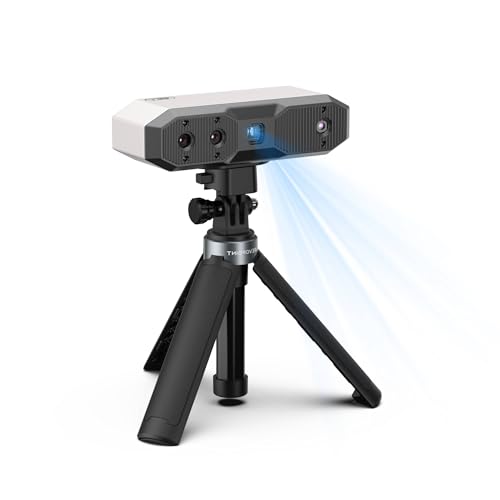
Best for Fine Detail – Revopoint MINI 2
The Revopoint MINI 2 is a focused 3d scanner for clay models, particularly small sculptures, figurines, and intricate surface work. Its industrial-grade blue light technology offers up to 0.02mm single-frame precision, while the larger capture range helps reduce interruptions when scanning small-to-medium pieces.
Best For: Detailed clay miniatures and artists prioritizing precision over scanning very large objects.
Pros:
- Up to 0.02mm single-frame precision for fine model details.
- Blue-light technology helps filter ambient-light interference.
- RGB camera, larger aperture, and six flash LEDs support color and texture capture.
- Lightweight 175g body with USB-C and Wi-Fi 6 connectivity.
Cons:
- Scanning spray may improve results depending on the clay’s material and color.
- Its supported object range tops out at 0.5m per dimension, limiting large sculpture work.
- Revo Design CAD software is sold separately and supports Windows only.
The MINI 2 is a strong choice when your clay pieces are relatively small and surface fidelity matters most. Expect to spend more time preparing challenging surfaces, especially when the model’s color or finish affects blue-light scanning.
Best for Large Clay Sculptures – EINSTAR 2
The EINSTAR 2 is a capable 3d scanner for clay models when your projects range from small forms to larger sculptures. It combines 17 parallel blue laser lines for detailed capture with VCSEL infrared scanning for larger objects, black surfaces, and outdoor work.
Best For: Artists scanning medium-to-large clay pieces who value wireless operation and broad material adaptability.
Pros:
- 17-line blue laser array supports detailed small-object scanning at up to 90 fps.
- VCSEL infrared mode handles larger objects and captures detail at up to 20 fps.
- Scans black and reflective objects without spray according to the supplied notes.
- Swappable battery provides up to three hours of scanning, with wireless and cable options.
Cons:
- The supplied notes do not specify a scanner accuracy figure.
- Its larger feature set may be unnecessary for simple tabletop clay pieces.
The EINSTAR 2 makes the most sense for a studio that scans clay work across several sizes. Its separate laser and infrared modes provide useful flexibility, while the ability to switch to a cable connection can help when Wi-Fi interference appears.
Best Premium Feature Set – Revopoint POP 4
The Revopoint POP 4 is a premium 3d scanner for clay models designed for users who want multiple capture modes, strong detail, and advanced processing tools. It supports objects from 10mm up to 2m and combines blue laser, NIR, AI segmentation, and photo-based texturing features.
Best For: Advanced clay workflows involving detailed scans, larger sculptures, outdoor capture, or photorealistic model output.
Pros:
- Up to 0.03mm single-frame accuracy and multiple scanning modes for different surfaces.
- 30-cross blue laser mode supports dark and highly reflective objects without scanning spray.
- AI segmentation can isolate the target and filter background noise on Windows.
- Wi-Fi 6 and a 5500mAh battery grip provide wireless scanning for up to four hours.
Cons:
- Some advanced AI features are limited to Windows.
- The extensive feature set may be excessive for basic clay digitization.
- Outdoor laser scanning performance varies by mode and lighting conditions.
POP 4 is the most feature-rich option here for creators who want room to expand beyond straightforward clay scanning. Its object-size range and five scanning modes are especially useful for studios handling both small detailed pieces and large forms.
Best for Easy Setup – Creality Otter Lite Basic
If you want a versatile 3d scanner for clay models, the Creality Otter Lite Basic combines fine detail capture, full-color textures, and a broad object-size range. Its 0.05mm accuracy and 30fps scanning can suit clay figures, prototypes, and larger sculptural work, while marker, geometry, and texture alignment provide workflow flexibility.
Best For: Artists and makers scanning clay figures, artwork, prototypes, and objects that may include dark or reflective surfaces.
Pros:
- 0.05mm accuracy and scanning speeds up to 30fps.
- Captures 24-bit color textures with its built-in RGB camera and LED fill lights.
- Supports objects from 0.8 to 78 inches and exports to formats including OBJ, STL, PLY, and 3MF.
- Can scan dark and metallic surfaces without spray and supports Wi-Fi 6.
Cons:
- The optional Scan Bridge handle is sold separately.
- Its wide feature set may be more than needed for simple, small clay projects.
The Otter Lite Basic is a strong general-purpose choice when color, portability, and object-size flexibility matter alongside clay-surface detail. Its multi-platform CrealityScan software also makes it convenient for users working across Windows, macOS, iOS, or Android.
Best for Precision Work – Revopoint MetroY Ultra
The Revopoint MetroY Ultra is an advanced option for a 3d scanner for clay models when dimensional precision and fast acquisition are priorities. Its blue-laser modes, up to 0.01mm single-frame precision, and multiple scanning patterns are particularly useful for detailed forms, reverse engineering, and projects that need accurate digital geometry.
Best For: Experienced makers, studios, and technical users who need high-precision scans of detailed clay models or related parts.
Pros:
- Offers up to 0.01mm single-frame precision and 0.015 + 0.04mm × L (m) volumetric accuracy.
- Provides five scanning modes, including fine-detail, deep-hole, structured-light, and automatic turntable modes.
- Scans at up to 90fps with an NVIDIA GPU or 60fps using a CPU.
- Includes a 5500mAh battery grip rated for about 2.5 hours of use.
Cons:
- The listed Windows configuration requires 32GB RAM and an RTX 3060-class GPU.
- Its precision-oriented workflow may be excessive for casual clay scanning.
MetroY Ultra stands out when accuracy and scanning speed outweigh simplicity. The included Revo Metro software supports point-cloud editing, model processing, alignment, and exports such as STL, OBJ, PLY, 3MF, and FBX.
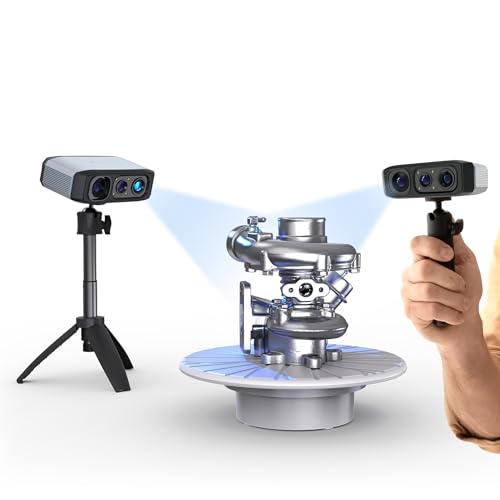
Best Beginner-Friendly Option – 3DMakerpro Moose Lite
The 3DMakerpro Moose Lite is a practical 3d scanner for clay models for users who want guided processing and detailed results without a highly technical workflow. Its blue-light system, AI tracking, optical anti-shake modules, and integrated JMStudio software help simplify scanning, editing, and optimization.
Best For: Beginners and hobbyists scanning clay sculptures, display models, and 3D-printing projects on Windows or macOS.
Pros:
- Blue-light scanning provides up to 0.03mm accuracy and 0.07mm resolution.
- AI tracking and point-cloud processing support a more beginner-friendly workflow.
- Optical anti-shake modules help reduce problems from unsteady hands.
- Its 24-bit color camera supports full-color model capture, while JMStudio handles editing and optimization.
Cons:
- Compatibility is limited to Windows 10/11 64-bit and macOS 12/13 in the supplied specifications.
- The Smart Grip for smartphone scanning is optional.
- The listed export formats do not include 3MF or FBX.
Moose Lite is appealing for clay artists who value assistance during capture and post-processing. The re-scanning function can also help recover from interruptions, making it a considerate choice for longer handheld sessions.
Best for Large, Detailed Clay Work – MIRACO Plus
For artists seeking a 3d scanner for clay models, the Revopoint MIRACO Plus offers flexible capture modes, high point-cloud accuracy, and strong detail reproduction. Its Near and Far modes suit small sculptural details as well as larger clay forms, while the integrated hardware supports a portable, self-contained workflow.
Best For: Clay artists and makers scanning detailed sculptures, larger models, or projects that may benefit from photogrammetric measurement.
Pros:
- Near mode captures fine details on small objects, while Far mode handles larger surfaces.
- High-resolution optical infrared zoom and a 48MP RGB camera support detailed, colorful scans.
- Built-in processing, 32GB RAM, 256GB storage, and exports including STL, OBJ, PLY, and 3MF reduce dependence on a computer during capture.
- Photogrammetric kit supports large-object detail capture and reported length accuracy of 0.02 mm + 0.05 mm x L(m).
Cons:
- At 750g, it is heavier than the INSPIRE 2 for extended handheld scanning.
- Revo Design for scan-to-CAD workflows is sold separately.
- Continuous scanning battery life is listed at up to two hours.
The MIRACO Plus is a strong choice when clay projects vary widely in size or require a more complete on-device workflow. Its extra measurement features are most useful for users who need more than basic shape capture.
Best for Marker-Free Clay Scanning – Moose Standard
The 3DMakerpro Moose Standard is a practical 3d scanner for clay models when you want detailed captures without relying heavily on physical markers. AI visual tracking and encoded structured light help identify surface features, while JMStudio combines scanning and data preparation in one software workflow.
Best For: Clay modelers who prioritize detailed scans, marker-free tracking, and straightforward Windows or macOS post-processing.
Pros:
- Blue light scanning is specified at up to 0.03mm accuracy with 0.07mm resolution.
- AI visual tracking and encoded structured light improve feature detection on smooth surfaces.
- Up to 100mm scan depth helps capture vertically complex forms and recessed details.
- Nine levels of light adjustment support scanning in dark conditions and across different materials.
Cons:
- JMStudio exports OBJ, STL, PLY, and ASC, but the listed format range is narrower than the MIRACO Plus.
- Windows 10/11 64-bit or macOS 12/13 compatibility should be checked before purchase.
- The optional Smart Grip for smartphone scanning is available separately.
Moose Standard stands out for clay work where smooth surfaces can make tracking difficult. Its combination of AI assistance, depth capability, and integrated software makes it a focused option for detailed model capture.
Best for Lightweight, Flexible Scanning – INSPIRE 2 Premium
For a portable 3d scanner for clay models, the Revopoint INSPIRE 2 combines a 190g design with wireless scanning and two capture technologies. Infrared structured light and multi-line laser scanning provide flexibility across different surfaces, while AI-powered segmentation can help produce cleaner scan data on supported Windows systems.
Best For: Makers who want a lightweight scanner for clay work, mobile use, mixed geometries, and occasional outdoor capture.
Pros:
- At 190g, it is lightweight and easy to transport for handheld scanning.
- Wi-Fi 6 enables mobile scanning and real-time PC-to-mobile interactive streaming.
- Dual infrared structured light and multi-line laser modes accommodate different materials and shapes.
- AI segmentation can identify the target, track it, and filter background noise on Windows.
Cons:
- AI object segmentation is listed as Windows-only.
- The required computer specifications are relatively demanding, including 16GB RAM and a specified modern CPU/GPU configuration.
- Revo Design for scan-to-CAD is sold separately.
INSPIRE 2 is appealing when portability and scanning flexibility matter more than an all-in-one standalone device. Its included tripod, turntable, calibration board, and filters also provide a useful starting kit for varied scanning setups.
How We Picked the Best 3d Scanner for Clay Models
We focused on scanners that can capture sculptural form accurately while remaining practical for studio use. The comparison considers stated precision, scanning speed, tracking technologies, supported object sizes, color capture, wireless or standalone operation, and the availability of alignment and cleanup tools. We also gave weight to workflow flexibility: a scanner should produce usable data for editing, archiving, reference, or 3D printing rather than simply generating a visually impressive preview.
Because clay models vary from small maquettes to larger figures, no single specification determines the best choice. A scanner with excellent detail may be less suitable for a large piece, while a fast long-range model may require more cleanup around tiny features.
Quick Comparison
- For fine small details: Consider a high-precision structured-light or laser scanner designed for small objects, such as the Revopoint MINI 2.
- For mixed-size studio work: Look for dual-mode systems with blue laser, infrared, or structured-light options, such as the Creality Pika.
- For portability: Standalone or wireless models, including the Revopoint MIRACO Plus and EINSTAR 2, can reduce dependence on a computer during capture.
- For color references: Full-color scanners can preserve visual information useful for documenting painted or marked clay, although color does not replace geometric accuracy.
- For fast capture: Higher frame rates and strong tracking can make large scans easier, especially when scanning around a full figure or complex sculpture.
Key Buying Factors for a 3d Scanner for Clay Models
Accuracy and Detail Resolution
Check both advertised accuracy and the scanner’s intended object size. Fine facial features, tool marks, and shallow reliefs benefit from higher precision, but real-world results also depend on lighting, scan distance, calibration, and surface texture.
Tracking and Surface Handling
Clay is often matte, which generally helps optical scanning, but uniform surfaces can still challenge tracking. Texture tracking, markers, AI-assisted alignment, blue laser, and infrared modes can help maintain registration across larger or visually repetitive areas.
Size, Speed, and Working Distance
Small busts and maquettes favor close-range detail. Larger sculptures need a wider field of view, stable tracking, and enough speed to reduce fatigue and alignment drift. Confirm the scanner’s supported range before buying.
Software and Export Options
Prioritize software with hole filling, alignment, mesh cleanup, decimation, and texture handling. Verify that exports such as STL, OBJ, or PLY fit your modeling and slicer workflow, and check operating-system requirements before purchase.
Who Should Buy Which 3d Scanner for Clay Models?
Choose a precision-focused scanner if you mainly digitize small clay heads, figurines, or detailed maquettes. Choose a versatile dual-mode scanner if your studio handles both small studies and larger sculptures. Choose a wireless or standalone model if you work in different locations or want a streamlined capture setup. Choose a fast, wider-range scanner for larger clay figures and repeated production scans. Finally, choose full-color capture when documenting surface appearance matters alongside geometry.