Detailed printmaking demands more than simple pressure. The right press helps transfer fine lines, textures, and carefully prepared plates evenly while giving you enough control to work consistently.
We selected 10 presses spanning compact lino tools, beginner-friendly lever models, adjustable block presses, and larger tabletop machines. Use the guide below to match press size, pressure control, construction, and workflow to your studio.
Best 10 Printmaking Presses for Detailed Work Picks for 2026
Best Large-Format Choice

- 19.7-by-12.6-inch panel
- Adjustable roller height
- Stable handwheel operation
Best For: Larger tabletop printmaking projects
Best Technique Versatility
PRECISTECH Home Printing Press

- Supports multiple engraving methods
- Adjustable screw-height roller
- Compact 31-by-17-centimeter plate
Best For: Small studios and mixed printmaking techniques
Best Portable Option
Mini Stainless Steel Printmaking Press

- Compact 200-by-100-millimeter bed
- Dual brass pressure controls
- About 2.5 kilograms
Best For: Small-format work and portable workshops
Best Starter Bundle

- Handles prints up to 9 by 15 inches
- Includes felt and base plate
- Supports several printmaking techniques
Best For: Beginners and compact studio setups
Compact Block Press

- Even hand pressure for clearer block prints
- Two adjustable height settings
- Portable steel design for 6 x 8-inch work
Best For: Small block prints at home or in the classroom
All-Metal Etching Press
Basic Professional Printing Machine

- Handles etching, embossing, and block printing
- Durable all-metal structure
- Approximate 11 x 10-inch printing area
Best For: Multi-technique printmaking in a compact studio setup
Large-Format Slab Roller
BEILOCKERY Adjustable Studio Press
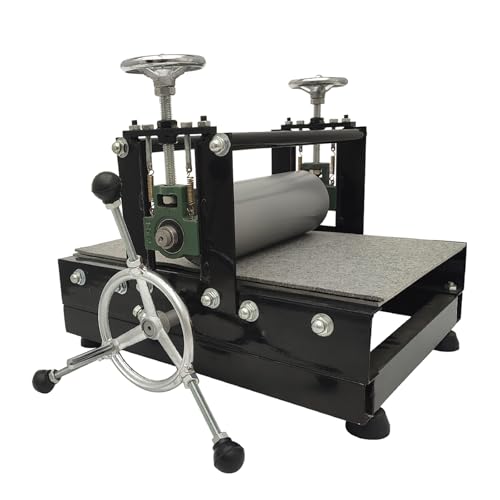
- 19.7 x 12.6-inch workspace
- Adjustable roller height for varied substrates
- Stable iron frame with low-effort handwheel
Best For: Large copperplate, woodblock, gravure, and relief prints
Portable Precision Pick
Lounsweer Adjustable Block Printing Press

- Adjustable height for flexible setups
- Handles prints up to 6 x 8 inches
- Lightweight steel design for portability
Best For: Small linocut, woodcut, and letterpress projects
Heavy-Duty Roller Choice
PreAsion Tabletop Etching Press

- 11-inch smooth roller for even pressure
- Adjustable roller height and anti-slip feet
- Heavy 58.9-pound tabletop construction
Best For: Etching, printmaking, and slab-rolling work
Beginner-Friendly Detail Press

- Three pressure settings for controlled printing
- Fits A4 paper and blocks up to 25 mm
- Beech wood and 304 stainless steel construction
Best For: Beginners making A4 linocut and relief prints
Best Large-Format Choice – TECHTONGDA Slab Roller Press
For artists comparing printmaking presses for detailed work, the TECHTONGDA offers a larger 19.7-by-12.6-inch panel and handwheel-controlled pressure. Its adjustable roller height and stable tabletop design make it suitable for relief, gravure, and other pressed artwork.
Best For: Artists needing a relatively spacious manual press for tabletop printmaking and repeated projects.
Pros:
- Large 19.7-by-12.6-inch working panel
- Adjustable roller height up to about 1.57 inches
- Handwheel operation is designed for even pressure
- Anti-slip feet improve tabletop stability
Cons:
- At 58 pounds, it is not especially portable
- Its larger footprint may be excessive for very small workspaces
The iron frame, PVC surface, and adjustable setup give this press a practical balance of stability and flexibility. It is a strong option when working area matters more than portability.
Best Technique Versatility – PRECISTECH Home Printing Press
This compact home printing press is worth considering among printmaking presses for detailed work because its screw-adjusted roller is designed to distribute pressure evenly. It supports relief, lino, wood, typographic, embossed, and copper engraving techniques on a 31-by-17-centimeter plate.
Best For: Home users, students, and small studios that want one press for multiple engraving and relief techniques.
Pros:
- Supports wood, lino, copper, relief, and embossed techniques
- Screw height adjustment helps tune pressure
- Compact plate suits desks and tight creative spaces
- Aluminum alloy plate and reinforced steel frame provide a sturdy build
Cons:
- The 31-by-17-centimeter plate limits larger projects
- The notes do not specify included accessories
Its main advantage is versatility in a compact format. The adjustable roller and metal construction make it a practical choice for detailed small-format work without requiring a large studio setup.
Best Portable Option – Mini Stainless Steel Printmaking Press
For portable printmaking presses for detailed work, this mini model combines dual brass pressure knobs with a manual handwheel to help produce crisp, evenly rolled prints. Its 200-by-100-millimeter bed is intended for small-format copperplate, woodcut, linoleum, and composite plates.
Best For: Beginners, hobbyists, and artists who need a lightweight press for small projects, workshops, or classes.
Pros:
- 304 stainless steel and brass construction resists rust
- Dual knobs allow pressure adjustment for different plate thicknesses
- Compact 20-by-15-by-16-centimeter design weighs about 2.5 kilograms
- Supports plates with up to a 7-millimeter gap and paper up to 150 millimeters wide
Cons:
- The small bed is unsuitable for larger prints
- Manual operation may require more hands-on effort
This is the most travel-friendly choice in the group. Its pressure controls and rigid metal build are well matched to detailed small-format practice, though the compact dimensions clearly limit scale.
Best Starter Bundle – Basic Etching Press with Felt
This basic etching machine is a straightforward pick among printmaking presses for detailed work, with a smooth roller, included felt pad, and base plate. It accommodates prints up to 9 by 15 inches and supports etching, embossing, block printing, monotype, lithography, and relief work.
Best For: Beginners, schools, workshops, and home studios seeking a compact press with essential accessories included.
Pros:
- Supports a broad range of printmaking techniques
- Included felt pad helps cushion paper and distribute pressure
- Base plate allows use without buying a separate support
- 360-degree L-shaped handle is designed for smoother operation
Cons:
- Its compact size limits the maximum print area
- At 18.5 pounds, it is portable but not ultralight
The included felt and base plate make this an accessible starting package. Its heavy-duty steel construction and smooth roller add useful stability, while the 9-by-15-inch capacity keeps it focused on moderate-size work.
Compact Block Press – Speedball Model B Steel Press
Speedball Block Printing Press - Adjustable Height Model B Steel Press For Printmaking
Check Price On AmazonFor artists seeking printmaking presses for detailed work on small blocks, the Speedball Model B offers a compact, straightforward setup. Its steel construction and hand-operated design provide even pressure for clearer prints on projects up to 6 x 8 inches.
Best For: Home printmakers, classrooms, and hobbyists producing small block prints.
Pros:
- Produces even, firm pressure for clearer impressions.
- Two adjustable height settings support different substrates.
- Compact, portable design weighs about 5.7 pounds.
- Durable steel construction works with hard and soft substrates.
Cons:
- Printing area is limited to projects up to 6 x 8 inches.
- Its simple block-press design may be less suitable for larger or more specialized techniques.
This is a practical choice when portability and ease of use matter more than a large workspace. Its adjustable settings and consistent hand pressure make it well suited to small, detailed block-printing projects.
All-Metal Etching Press – Basic Professional Printing Machine
This all-metal machine is a versatile option among printmaking presses for detailed work, supporting etching, embossing, block printing, and monochrome printing. Its precise mechanisms and approximately 11 x 10-inch printing area are designed for sharp, detailed results across varied projects.
Best For: Artists and printmakers who need one compact machine for etching, embossing, and block-printing techniques.
Pros:
- Supports etching, embossing, block printing, and other techniques.
- All-metal construction is built for durability.
- Designed to produce sharp, detailed professional-quality prints.
- Offers a larger work area than a small block press, at about 11 x 10 inches.
Cons:
- Weighs 25 pounds, so it is less portable than lightweight presses.
- The supplied notes do not specify adjustable height or a detailed pressure-control system.
Choose this press if versatility and sturdy construction are priorities. It provides a useful middle ground for artists who want to explore multiple techniques without moving to a much larger machine.
Large-Format Slab Roller – BEILOCKERY Adjustable Studio Press
For larger projects requiring printmaking presses for detailed work, the BEILOCKERY manual slab roller provides a 19.7 x 12.6-inch workspace. Its adjustable roller height, stable iron frame, and large handwheel help deliver controlled, even pressure for copperplate, woodblock, gravure, and relief printing.
Best For: Studio artists, universities, and printmakers working with larger copper plates, woodblocks, and paper prints.
Pros:
- Large 19.7 x 12.6-inch work area accommodates larger projects.
- Adjustable roller height supports different material thicknesses.
- Large-diameter handwheel is designed for smooth, lower-effort operation.
- Iron construction and four non-slip feet promote stability.
Cons:
- Its 19.7 x 13.8 x 16.1-inch footprint requires substantial tabletop space.
- Manual operation requires the user to turn the handwheel for each print.
- Its larger studio-oriented design is less convenient for casual, highly portable use.
This press stands out when workspace and material flexibility are more important than a compact footprint. Adjustable height and even roller pressure make it a strong fit for detailed gravure and relief work across varied substrates.
Portable Precision Pick – Lounsweer Adjustable Block Printing Press
For shoppers comparing printmaking presses for detailed work, the Lounsweer is a compact option for small linocut, woodcut, and letterpress projects. Its adjustable-height design and steel construction are suited to prints up to 6 x 8 inches, while its 5.17-pound weight makes it practical for portable use.
Best For: Home artists, students, and enthusiasts working on small-format relief and letterpress projects.
Pros:
- Adjustable height helps accommodate different printing setups.
- Compact and lightweight enough to move between workspaces.
- Designed for ink block printing, woodcut printing, and letterpress applications.
- Steel construction supports use with hard and soft substrates.
Cons:
- The 6 x 8-inch print capacity limits larger projects.
- A protective rubber or carpet mat is recommended beneath the press.
This press makes the most sense when portability and straightforward manual operation matter more than a large working area. Its adjustable format can help with controlled small prints, but larger or more production-oriented work will require a bigger press.
Heavy-Duty Roller Choice – PreAsion Tabletop Etching Press
Among printmaking presses for detailed work, the PreAsion stands out for its roller-based format and substantial 58.9-pound build. The handwheel controls movement while the adjustable roller and anti-slip feet help create a stable tabletop setup for paper, plaster, wood, and slab-rolling applications.
Best For: Artists and classrooms needing a heavier tabletop press for etching, printmaking, and varied craft materials.
Pros:
- Thick, smooth 11-inch roller is designed for more uniform pressure.
- Roller height adjusts by approximately 4 cm.
- Four anti-slip feet have adjustable height for tabletop stability.
- Large 19.7 x 12.6-inch panel supports a useful working area.
Cons:
- At 58.9 pounds, it is difficult to move frequently.
- Its overall footprint is considerably larger than compact hand presses.
- The iron frame is painted to slow rusting, but storage conditions still matter.
The PreAsion is the strongest fit here for users who value a substantial roller mechanism and stable pressure over portability. Its larger footprint and weight are trade-offs for a more robust tabletop workflow.
Beginner-Friendly Detail Press – A4 Beech Wood Linocut Machine
For detailed work on standard-size relief prints, this A4 linocut press combines a beech wood pressure plate and handle with a 304 stainless steel frame. Three pressure settings, a felt pad, and a compact tabletop format make it approachable for beginners while supporting linocut, woodcut, rubber, and letterpress-style projects.
Best For: Beginners, teens, home studios, classrooms, and artists making A4-size relief prints.
Pros:
- Three adjustable pressure settings accommodate different blocks and paper.
- Supports carving blocks up to 25 mm thick and A4 paper.
- Felt pad helps protect blocks and promote even ink transfer.
- Stainless steel frame is designed for stability and corrosion resistance.
Cons:
- Its 13-pound weight is less portable than a small travel press.
- The A4 format is not intended for oversized prints.
- Manual lever operation may be slower for high-volume production.
This is a well-rounded choice for learning and precise small-to-medium relief printing. The pressure adjustments and protective felt pad add useful control, while the compact design keeps it suitable for home and classroom work.
How We Picked the Best Printmaking Presses for Detailed Work
We focused on the features that matter most when reproducing fine marks: adjustable pressure, a stable printing bed, reliable contact between the plate and paper, and a frame that resists flexing. We also considered working area, portability, setup demands, and whether each design suits relief printing, intaglio, embossing, or mixed studio use.
Because “detailed work” means different things to different artists, this selection includes both compact presses for lino and small editions and larger machines designed for copperplate, woodblock, etching, and broader sheets.
Quick Comparison
| Press type | Best suited to | Main advantage | Watch for |
|---|---|---|---|
| Mini or A4 lever press | Beginners and small prints | Compact, accessible operation | Limited bed size and pressure range |
| Block printing press | Lino, woodblock, and relief work | Fast, straightforward registration | May not suit deep intaglio plates |
| Basic etching press | Mixed techniques and studio practice | More even pressure and versatility | Can require careful setup and alignment |
| Slab roller-style press | Larger plates and detailed editions | Broad working area and adjustable pressure | Needs more room and a stable surface |
Key Buying Factors for Printmaking Presses for Detailed Work
Pressure Control
Fine lines can disappear under insufficient pressure, while excessive force may damage paper, plates, or delicate relief. Look for adjustable pressure or height settings so you can tune the press to the plate, paper thickness, and blankets being used.
Bed Size and Usable Clearance
Check the actual printing area rather than the machine’s overall dimensions. A compact bed is efficient for small lino blocks, but larger copperplate or woodblock projects need enough clearance for the plate, paper, and any protective layers.
Stability and Construction
Rigid metal frames generally handle repeated pressure with less movement. Wood models can be practical and approachable, especially for beginners, but a stable base and smooth lever action are essential for consistent impressions.
Technique Compatibility
Relief presses are often easiest for lino and woodblock printing. Etching presses are better suited to intaglio, embossing, and projects requiring controlled, even pressure. If you use several techniques, prioritize adjustability over a single-purpose design.
Workflow and Maintenance
Consider how easily you can position paper, clean the bed, change blankets, and repeat registration. A press that is slightly slower to adjust but consistent between impressions may be more useful than a faster model with limited control.
Who Should Buy Which Printmaking Presses for Detailed Work?
Beginners and students: Choose a compact A4, mini, or beech-wood lever press if you mainly make small lino or relief prints and need an approachable learning tool.
Relief-print specialists: An adjustable block press is a practical choice for repeated lino and woodblock work, especially when speed and simple operation matter.
Mixed-media artists: Select a basic etching press with a base plate and felt if you want to explore embossing, intaglio, relief, and paper-based experiments.
Detailed or larger-format printers: A rigid, adjustable slab roller-style or professional etching press is the better fit when you need a wider bed, repeatable pressure, and room for larger plates.
Before buying, measure your available workspace and confirm the press’s working dimensions, adjustment range, and intended printing methods. Matching those specifications to your actual projects is the simplest way to get sharper, more consistent results.