Choosing a resin printer for a school means balancing fine detail with safe classroom procedures, manageable maintenance, and a workflow students can learn without constant troubleshooting.
This roundup compares 10 strong options across compact desktop models, high-resolution printers, larger-format machines, and bundles that include washing and curing equipment.
Best 10 Resin Printers for Schools Picks for 2026
Fast Detail Specialist
- 9K display with 18 μm XY resolution
- Up to 150 mm/h printing with tilt release
- AI monitoring and Wi-Fi cluster control
Best For: Busy school labs needing detailed, efficient workflows
Beginner-Friendly Detail Pick

- 10K LCD with 17 × 17 μm pixels
- Four-point leveling suited to beginners
- Power-resume feature helps limit waste
Best For: Classrooms introducing students to detailed resin printing
Large-Format Classroom Workhorse

- 10-inch 12K mono LCD for detailed output
- Generous 250 mm vertical build capacity
- Uniform light source and strong plate adhesion
Best For: Schools producing larger models and batch projects
Automated Reliability Choice

- Auto-leveling with factory calibration
- AI checks, resin monitoring, and residue detection
- 14K precision and support for high-viscosity resins
Best For: Advanced labs needing automated setup and inspection
High-Capacity Choice

- 16K resolution for intricate models
- Automatic resin tank heating
- AI monitoring and 150 mm/h printing
Best For: Schools needing detailed, larger-format resin prints
Accessible Classroom Pick

- 10K detail from a 7-inch mono LCD
- Compact 11-pound design
- Power-loss resume and one-year warranty
Best For: Schools wanting a compact, easy-to-start resin printer
Complete Workflow Bundle
Saturn 4 Ultra 16K with Mercury Plus V3.0

- Includes a 16K resin printer
- Adds a 7.5-liter wash and cure station
- Printer supports 150 mm/h printing
Best For: Schools building a complete shared resin-printing workflow
Best Beginner Pick
- One-click automatic leveling
- 4K mono LCD for detailed prints
- Sensors for residue, resin, and leveling issues
Best For: Classrooms introducing students to resin printing
Best Safety-Focused Option

- Sensor detects resin and printing issues
- Automatic leveling with laser-engraved plate
- 4K LCD with up to 70 mm/h speed
Best For: Classrooms prioritizing monitoring and simple operation
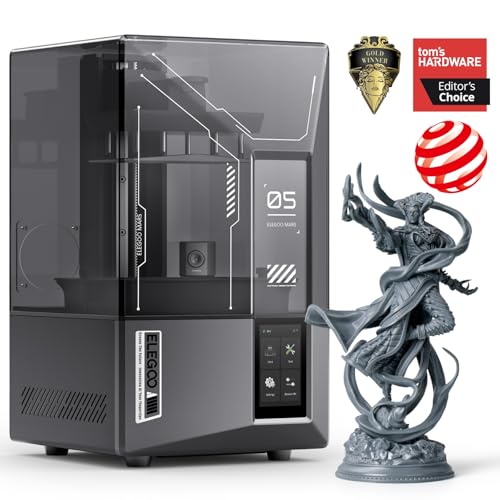
Fast Detail Specialist – ELEGOO Mars 5 Ultra
The ELEGOO Mars 5 Ultra is a strong option for schools seeking resin printers for schools that combine fine detail, fast production, and helpful monitoring features. Its 9K display, tilt-release system, and Wi-Fi cluster printing support detailed classroom projects and multi-printer workflows.
Best For: Schools running detailed projects or coordinating multiple compatible printers.
Pros:
- 9K mono LCD provides 18 μm XY resolution for intricate models.
- Print speeds reach up to 150 mm/h with tilt-release technology.
- AI camera and sensors help detect errors, resin shortages, leveling failures, and residue.
- Wi-Fi cluster printing supports control of multiple Mars 5 Ultra printers.
Cons:
- AI detection results can vary with the environment, models, and resin types.
- Its feature set may be more than needed for occasional basic printing.
Choose this model when productivity and oversight matter as much as resolution. The combination of fast printing, automated alerts, and cluster control is particularly useful for busy school labs.
Beginner-Friendly Detail Pick – ANYCUBIC Photon Mono 4
The ANYCUBIC Photon Mono 4 is a practical choice for schools seeking resin printers for schools with high-resolution output and a straightforward setup. Its 10K screen, stable light source, fixed four-point leveling approach, and power-resume feature suit classroom projects and routine use.
Best For: Beginners and classrooms that need detailed prints without repeated manual leveling.
Pros:
- 7-inch 10K LCD delivers 17 × 17 μm pixel size and detailed models.
- Uniform LighTurbo illumination helps reduce layer lines and rasterization.
- Build volume supports models up to 153.4 × 87 × 165 mm.
- Power-loss recovery can reduce wasted material and printing time.
Cons:
- Anycubic APP service is not supported.
- Its build volume is smaller than larger-format options in this roundup.
The Photon Mono 4 emphasizes accessible operation and crisp results. It is well suited to introductory resin printing where students benefit from a repeatable leveling process and a manageable machine size.
Large-Format Classroom Workhorse – ELEGOO Saturn 3
The ELEGOO Saturn 3 is designed for schools seeking resin printers for schools that can handle larger models and ambitious projects. Its 10-inch 12K display, generous build volume, protective tempered glass, and multiple print modes provide a capable platform for advanced classroom work.
Best For: Schools printing larger prototypes, detailed models, or multiple smaller parts in one batch.
Pros:
- 12K mono LCD produces highly detailed prints.
- Large 218.88 × 122.88 × 250 mm build volume accommodates bigger projects.
- COB and Fresnel optics provide uniform 405 nm illumination.
- Laser-carved build plate supports strong print adhesion.
Cons:
- At 33 pounds, it is relatively heavy to move.
- Its larger footprint requires more dedicated workspace.
- Maximum listed printing speed is up to 70 mm/h.
This Saturn 3 makes the most sense when build capacity is a priority. It offers the room needed for substantial models while retaining high-resolution output and compatibility with popular third-party slicers.
Automated Reliability Choice – ANYCUBIC Photon P1
The ANYCUBIC Photon P1 is a compelling option for schools seeking resin printers for schools with automated setup and inspection features. Auto-leveling, AI monitoring, resin-level checks, and support for high-viscosity materials can simplify supervision while its 14K screen delivers precise detail.
Best For: Advanced school labs prioritizing automation, reliable setup, and specialty resin compatibility.
Pros:
- Factory-calibrated Smart Leveling 3.0 removes routine manual bed leveling.
- AI inspection checks plate installation and bottom-layer separation.
- Wave Release Technology reduces release force by 60%.
- 14K mono LCD supports 16.8 × 24.8 μm pixel size and fine details.
Cons:
- The printer is relatively large, measuring 16.93 × 24.41 × 16.54 inches.
- Its advanced resin support may be unnecessary for basic classroom projects.
The Photon P1 stands out for reducing hands-on setup and monitoring. Schools with experienced operators or specialty-material projects may particularly value its automatic checks, sturdy motion system, and high-resolution screen.
High-Capacity Choice – ELEGOO Saturn 4 Ultra 16K
For schools seeking resin printers for schools that can handle detailed classroom models and larger projects, the ELEGOO Saturn 4 Ultra 16K combines a high-resolution screen, automatic resin heating, and a generous build area. Its monitoring and leveling features can also simplify routine operation for different experience levels.
Best For: Schools that need detailed prints, larger models, and helpful monitoring features.
Pros:
- 16K LCD provides 15120 x 6230-pixel resolution and 14 x 19 μm XY resolution.
- Automatic tank heating activates below 25°C to help maintain printing conditions.
- AI camera, resin monitoring, foreign-object detection, automatic leveling, Wi-Fi transfer, and power-on resume support classroom workflows.
- Prints at speeds up to 150 mm/h with a build volume of 8.33 x 4.66 x 8.66 inches.
Cons:
- Its 35.4-pound weight and 12.8 x 12.9 x 21.5-inch dimensions require a dedicated workspace.
- The advanced feature set may be more than a small class needs.
This is a strong school-focused option when print detail, monitoring, and larger capacity matter more than compact size. Automatic checks and leveling are particularly useful when multiple users share the printer.
Accessible Classroom Pick – ANYCUBIC Photon Mono 4
The ANYCUBIC Photon Mono 4 is a practical starting point for resin printers for schools, offering a compact design, 10K detail, and a pre-tested setup. Its stable build platform and power-loss resume feature can help reduce avoidable print failures during classroom projects.
Best For: Schools and student makers that want a compact, detailed printer with straightforward setup.
Pros:
- 7-inch 10K monochrome LCD delivers 9024 x 5120 resolution and 17 x 17 μm XY pixels.
- LighTurbo matrix lighting is designed for balanced exposure and smoother surfaces.
- Build volume measures 6.04 x 3.42 x 6.49 inches, providing room for everyday projects.
- Pre-assembled and tested before shipment, with power-loss resume and a one-year warranty.
Cons:
- Its build volume is smaller than the Saturn models in this roundup.
- It does not list automatic resin heating or an integrated monitoring camera.
With an 11-pound chassis and a smaller footprint, the Photon Mono 4 may fit shared workspaces more easily than larger alternatives. It is a sensible choice for schools prioritizing accessibility, detail, and routine project sizes.
Complete Workflow Bundle – Saturn 4 Ultra 16K with Mercury Plus V3.0
ELEGOO Saturn 4 Ultra 16K Resin 3D Printer and ELEGOO Mercury Plus V3.0 Wash and Cure Station
Check Price On AmazonThis bundle pairs a high-resolution ELEGOO resin printer with the Mercury Plus V3.0 wash and cure station, making it a convenient option for resin printers for schools that want printing and post-processing equipment together. The included station has a 7.5-liter capacity and supports multiple printer types.
Best For: Schools that want an integrated print, wash, and cure setup for shared projects.
Pros:
- Includes the Saturn 4 Ultra 16K printer with a flip-up lid and 150 mm/h printing.
- Automatic tank heating is specified at 30°C to support consistent resin conditions.
- Includes the Mercury Plus V3.0 wash and cure station with a 7.5-liter capacity.
- The station is compatible with Mars, Saturn, Photon, Halot, MSLA, LCD, and DLP 3D printers.
Cons:
- The combined setup requires more space than a printer alone.
- Schools must accommodate both printing and post-processing equipment in their workflow.
The main advantage is convenience: this package covers the printer and a dedicated wash-and-cure stage in one purchase. It is especially appealing for classrooms or labs that want a more complete resin-printing workflow rather than a standalone machine.
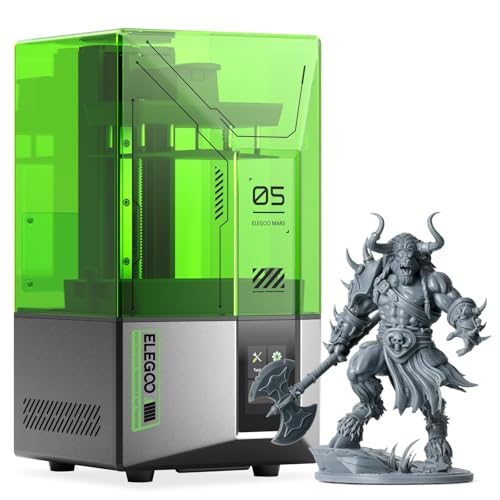
Best Beginner Pick – ELEGOO Mars 5
For schools seeking resin printers for schools that are approachable for students and educators, the ELEGOO Mars 5 emphasizes simple setup and automated checks. One-click leveling, self-check functionality, and residue detection can help reduce common setup and printing issues.
Best For: Classrooms introducing students to detailed resin printing with a compact, easy-to-operate machine.
Pros:
- One-click automatic leveling simplifies initial setup.
- Self-check and smart sensors help identify potential printing problems.
- 4K mono LCD and COB lighting support detailed models.
- Overheat protection can halt printing if LED temperature exceeds 80°C.
Cons:
- Its build area is smaller than the Jupiter 2, limiting larger classroom projects.
- Resin printing still requires appropriate handling and cleanup procedures.
The Mars 5 is a practical choice when ease of use and print detail matter more than maximum capacity. Its automated setup and monitoring features can reduce friction in supervised educational projects.
Best for Large Projects – ELEGOO Jupiter 2
The ELEGOO Jupiter 2 stands out among resin printers for schools when a class needs substantial build capacity. Its 302.4 × 161.98 × 300 mm volume can accommodate larger objects or multiple smaller models in one job, while automated resin management and monitoring support extended use.
Best For: School labs, design programs, and shared makerspaces producing large prototypes or batches of models.
Pros:
- Large build volume supports bigger objects and multiple models.
- 16K resolution and 20 × 26 μm XY resolution support fine detail.
- Multi-point auto leveling, tank heating, and automated resin supply simplify operation.
- Wi-Fi cluster management, camera monitoring, and power-loss recovery suit shared lab use.
Cons:
- At 63.8 pounds, it is substantially heavier and less portable than the Mars models.
- Its large footprint requires considerable dedicated workspace.
- The extensive feature set may be more than a small introductory class needs.
Jupiter 2 is the strongest fit for schools prioritizing throughput and object size. Its capacity and network-oriented features can support a centralized lab, provided the school has adequate space and supervision.
Best Safety-Focused Option – ELEGOO Mars 5 MSLA
For schools comparing resin printers for schools, this Mars 5 MSLA model combines automatic leveling with an intelligent mechanical sensor. It can detect low resin, foreign objects, release-film replacement needs, and overheating, giving educators useful safeguards during supervised printing.
Best For: Instructional settings that value straightforward operation, print monitoring, and a compact classroom footprint.
Pros:
- Intelligent sensor checks for several common printing and maintenance issues.
- Automatic leveling and a laser-engraved build plate support easier setup and adhesion.
- 6.6-inch 4K monochrome LCD delivers 4098 × 2560 resolution and 35 × 35 μm XY resolution.
- Cooling fans and copper tubes help manage operating temperature.
Cons:
- Print success still depends on correct machine settings, supports, and resin-tank cleaning.
- Its stated print speed of up to 70 mm/h may not suit every high-volume classroom workflow.
This Mars 5 is a sensible classroom option for educators who want automated setup and issue detection without moving to a much larger printer. Its maintenance guidance should still be incorporated into school procedures.
How We Picked These Resin Printers for Schools
We focused on the factors that matter in educational settings: print quality, usable build volume, setup simplicity, consistency, operating cost, and the availability of a practical post-processing workflow. Resolution is useful for detailed models, but it is only one part of the decision. A printer that is easy to level, monitor, clean, and return to service can be more valuable than a technically superior model that creates extra work for staff.
We also included different printer sizes and configurations so schools can match the machine to its curriculum. Compact models suit introductory projects and limited workspaces, while larger Saturn and Jupiter options are better for batch production, engineering prototypes, or a well-equipped makerspace.
Quick Comparison
| Priority | Best fit | What to consider |
|---|---|---|
| Small classroom footprint | ELEGOO Mars 5, Mars 5 Ultra, or ANYCUBIC Photon Mono 4 | Lower space demands and simpler handling, but smaller build areas |
| Fine detail | High-resolution Saturn, Photon P1, or Saturn 4 Ultra models | Excellent detail requires careful exposure settings and post-processing |
| Batch printing | ELEGOO Saturn series or Jupiter 2 | Larger platforms improve throughput but need more ventilation and workspace |
| Complete workflow | Saturn 4 Ultra bundle | Includes wash-and-cure equipment, reducing accessory planning |
Key Buying Factors for Resin Printers for Schools
Safety and Ventilation
Resin printing requires more supervision than typical filament printing. Use the printer in a controlled, well-ventilated area, follow the resin manufacturer’s handling guidance, and provide suitable gloves, eye protection, spill supplies, and labeled storage. Students should not handle uncured resin or solvents without trained adult supervision.
Workflow and Maintenance
Look for features that reduce setup errors, such as auto-leveling, mechanical sensors, reliable vat handling, and clear touchscreen controls. Plan for routine cleaning, replacing release films, filtering or disposing of resin responsibly, and curing every finished part. A wash-and-cure station can make the process more repeatable and less messy.
Resolution, Speed, and Build Volume
Higher pixel counts can produce sharper small features, but they do not automatically make every print better. Consider the models students will create, the number of parts needed per lesson, and whether a larger platform will reduce repeated print runs. A compact printer may be the better choice when projects are small and bench space is limited.
Total Classroom Cost
Budget for resin, replacement films, build plates, cleaning supplies, gloves, ventilation, wash solution, curing equipment, and failed prints. Also check software compatibility, replacement-part availability, warranty terms, and whether staff can obtain support quickly.
Who Should Buy Which Resin Printers for Schools?
Choose a Mars 5 or Photon Mono 4 for introductory classes, smaller student projects, and schools prioritizing a compact footprint. Step up to a Mars 5 Ultra or Photon P1 when convenience features and sharper detail are more important. Saturn models are stronger choices for makerspaces that need larger platforms and higher throughput, while the Jupiter 2 suits advanced programs with ample room and a need for large-format printing. Choose the Saturn 4 Ultra bundle if having a coordinated wash-and-cure workflow is worth the added cost and storage space.