Wireless flashes can transform flat, on-camera lighting into clean, flexible light that looks far more professional. They also make it easier to move your light off-camera for portraits, events, and product shots.
Below, we focus on the best wireless camera flashes for 2026, with options for different camera systems, budgets, and shooting needs.
Best 10 Wireless Camera Flashes Picks for 2026
Wireless X System Value Pick
Godox TT600 Manual Wireless Speedlite

- Built-in 2.4G X wireless system
- GN60 output with 100m transmission
- Wide multi-brand hot shoe compatibility
Best For: Manual flash users building a Godox wireless setup
Sony Radio Control Pro Choice

- Sony radio wireless communication
- GN46 output for pro work
- TTL, manual, and HSS support
Best For: Sony Alpha photographers needing a branded wireless flash
Magnetic TTL Kit Pick
Godox iT32 + X5C Wireless Flash

- Magnetic flash-and-trigger system
- Built-in 2.4G Godox X wireless control
- Includes diffuser, reflector, and trigger
Best For: Canon users wanting an all-in-one wireless flash kit
Universal Budget Manual Pick
PHOTOOLEX FK300 Wireless Speedlite

- S1/S2 optical wireless modes
- 8-level manual power control
- Universal hot shoe compatibility
Best For: Beginners who want an affordable manual flash
Adaptive Sony Wireless Flash Kit
Godox iT32 TTL with X5S Trigger
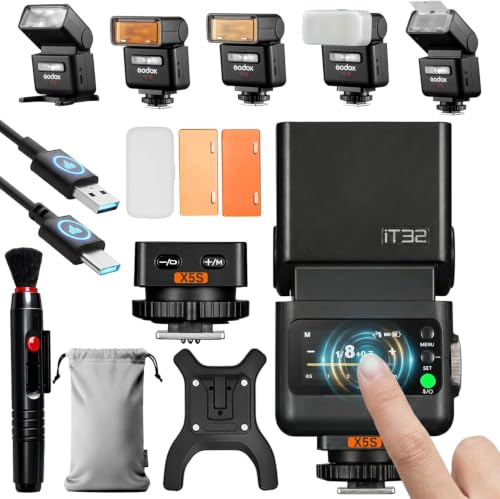
- Magnetic X5 hotshoe and trigger in one
- Built-in 2.4GHz receiver for Godox X system
- Auto-detects model, battery, and charging status
Best For: Sony users who want fast switching between on-camera and wireless flash
Budget Universal Wireless Flash
Godox TT520II Manual Speedlite

- 433MHz wireless transmission with 16 channels
- 8 power levels from 1/128 to full
- Built-in receiver plus RT transmitter
Best For: Budget-conscious shooters who want manual wireless flash control
Canon Smart TTL Wireless Flash
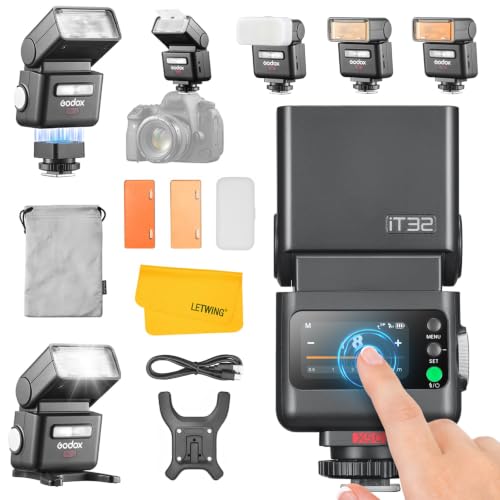
- TTL and HSS up to 1/8000s
- Magnetic X5C trigger for hotshoe or wireless use
- Built-in receiver and USB-C charging
Best For: Canon shooters who want compact TTL flash performance with wireless control
Compact Wireless Off-Camera Flash
MEDALight F2 Mini Wireless Flash

- 2.4GHz remote control up to 10 meters
- Four power levels and adjustable head
- Magnetic base plus USB-C rechargeable battery
Best For: portable off-camera lighting with simple controls
Wireless Studio Flash Trigger Kit

- 433MHz radio triggering with stable response
- Includes 1 transmitter and 2 receivers
- Designed for studio flashes and on-location use
Best For: triggering multiple studio flashes on a budget
Wireless X System Value Pick – Godox TT600 Manual Wireless Speedlite
If you want one of the more practical wireless camera flashes for building a simple off-camera setup, the Godox TT600 is a strong value option. Its built-in 2.4G X system works with other Godox flashes, strobes, and compatible triggers, and the wide camera support makes it easy to slot into different kits.
Best For: Budget-conscious shooters who want a manual flash with dependable wireless control in the Godox ecosystem.
Pros:
- Built-in 2.4G wireless system supports remote control with compatible Godox triggers
- 100m transmission range helps with off-camera placement flexibility
- GN60 output and 0.1-2.6s recycle time offer solid power for the class
- Works with Canon, Nikon, Pentax, Olympus, Fujifilm, and Panasonic hot shoes
Cons:
- Does not do HSS when mounted directly on the camera hot shoe
- TTL wireless trigger is sold separately for advanced remote functions
- AA batteries are required and not included
The TT600 is a straightforward choice if you mainly want wireless triggering and manual flash control without paying for extra automation. It is especially appealing for photographers already using Godox X-system gear.
Sony Radio Control Pro Choice – Sony HVL-F46RM Wireless Flash
For Sony shooters comparing wireless camera flashes, the HVL-F46RM stands out for its integrated radio control and camera communication. It is built around Sony’s genuine flash system and delivers GN46 output, making it a fit for portraits, wedding work, and other demanding assignments.
Best For: Sony Alpha users who want a branded flash with radio wireless control and fast, dependable operation.
Pros:
- Versatile radio wireless communication for compatible Sony setups
- GN46 output is aimed at professional portrait and event use
- Supports TTL, manual, and high-speed sync exposure modes
- Fast recycle and quick flash head angle adjustment
Cons:
- Only compatible with Sony Alpha cameras
- Flash sync speed is listed at 1/400
- AA batteries are required and not included
This is the most polished option here for photographers invested in Sony’s system. If you want integrated wireless control and a flash designed around Sony compatibility, it is the most specialized pick in the group.
Magnetic TTL Kit Pick – Godox iT32 + X5C Wireless Flash
If you want a more modern take on wireless camera flashes, the Godox iT32 + X5C combo is built for fast setup and flexible control. The flash and trigger use a magnetic interface, and the X5 trigger can work as both a hotshoe attachment and a wireless master for Godox X-system lights.
Best For: Canon shooters who want a compact TTL flash kit with a built-in wireless ecosystem and quick magnetic mounting.
Pros:
- Magnetic hotshoe and trigger design makes attachment fast and simple
- Built-in 2.4G X wireless system supports remote multi-light use
- Includes iT32 flash, X5C trigger, reflector, and diffuser in the box
- HSS up to 1/8000s and rechargeable USB-C power add flexibility
Cons:
- Made for Canon users, with adapter notes for some bodies and accessories
- Not water resistant
- Fewer details are provided here about guide number or recycle time
The iT32 + X5C is appealing if you want a ready-to-shoot kit instead of piecing together a flash and trigger separately. Its magnetic system and Godox wireless compatibility make it especially convenient for fast-moving Canon setups.
Universal Budget Manual Pick – PHOTOOLEX FK300 Wireless Speedlite
The PHOTOOLEX FK300 is a simple, budget-friendly entry in wireless camera flashes for photographers who mainly need manual control and basic off-camera firing. It offers S1 and S2 wireless trigger modes, a standard hot shoe fit, and universal compatibility across many popular camera brands.
Best For: Beginners and budget shoppers who want a straightforward manual flash with basic wireless trigger modes.
Pros:
- S1 and S2 optical wireless modes support off-camera multi-light setups
- 8-level power adjustment from 1/128 to 1/1 gives useful manual control
- Universal hot shoe compatibility covers many major camera brands
- Includes a flash stand, pouch, and 12 color filters
Cons:
- No TTL or radio wireless features
- Flash sync speed is limited to 1/250
- Wired connectivity only, with no trigger included
As a starter flash, the FK300 focuses on the basics rather than advanced automation. That makes it a practical pick if you want an inexpensive way to explore off-camera flash without committing to a larger system.
Adaptive Sony Wireless Flash Kit – Godox iT32 TTL with X5S Trigger
If you want wireless camera flashes that move easily between on-camera and off-camera use, the Godox iT32 with X5S is built for speed and flexibility. Its magnetic X5 module works as both a hotshoe mount and a wireless transmitter, while the iT32 supports Godox’s 2.4GHz X system for multi-light setups without manual pairing.
Best For: Sony shooters who want a compact TTL flash that can switch quickly between camera-mounted use and wireless multi-light control.
Pros:
- Magnetic X5 connection makes attaching and detaching fast and secure.
- X5 doubles as hotshoe mount and wireless transmitter.
- Built-in 2.4GHz receiver supports simple multi-flash setups in the Godox X system.
- Automatic recognition shows model, battery, and charging status on-screen.
Cons:
- Designed specifically around Sony compatibility and the X5 system.
- Guide number of 18 is modest compared with larger speedlites.
This is a smart choice if your priority is streamlined setup rather than maximum output. The interchangeable magnetic design and wireless trigger function make it especially practical for photographers who regularly switch shooting styles.
Budget Universal Wireless Flash – Godox TT520II Manual Speedlite
The Godox TT520II is a straightforward option if you want wireless camera flashes with simple manual control and broad hotshoe compatibility. It uses 433MHz wireless transmission with 16 channels, and its optical pulse support plus S1/S2 modes make it useful for basic off-camera lighting.
Best For: Photographers who need an affordable manual flash with wireless triggering for standard hotshoe DSLR setups.
Pros:
- 433MHz wireless transmission with 16 channels.
- Built-in receiver and RT transmitter support wireless triggering.
- 8 output levels from 1/128 to full power.
- S1 and S2 modes add basic off-camera flexibility.
Cons:
- Does not support TTL.
- Requires 4 AA batteries.
- Compatibility is aimed at standard hotshoe DSLR cameras.
If you value simplicity and manual control, this flash covers the basics well. It is best suited to shooters who want a dependable wireless speedlite without paying for advanced automation.
Canon Smart TTL Wireless Flash – Godox iT32 with X5C Trigger
The Godox iT32 with X5C is a compact answer for wireless camera flashes when you want TTL, HSS, and quick wireless control in a small package. It features a built-in 2.4G receiver, the X5C acts as the transmitter, and the magnetic detachable design helps you switch between on-camera and off-camera work quickly.
Best For: Canon users who want a compact TTL flash with wireless multi-light support and high-speed sync.
Pros:
- Supports TTL, manual control, front/rear curtain sync, and HSS up to 1/8000s.
- X5C hotshoe trigger also works as a wireless transmitter.
- Magnetic detachable design speeds up on-camera to off-camera changes.
- Includes LED modeling light, reflector, diffuser, and USB-C charging support.
Cons:
- Canon-focused compatibility limits its cross-brand use.
- X5 module has no separate charging port and must be charged through the iT32 body.
This model stands out for photographers who want modern flash features in a compact form. The combination of TTL, HSS, and wireless control makes it especially practical for faster-paced shooting and multi-light workflows.
Compact Wireless Off-Camera Flash – MEDALight F2 Mini Wireless Flash
The MEDALight F2 is a compact option for shoppers comparing wireless camera flashes for simple off-camera lighting. Its 2.4GHz remote control, adjustable power levels, and rotatable head make it easy to shape light for portraits, product shots, and low-light scenes without a bulky setup.
Best For: Creators who want a small wireless flash for portable off-camera use and quick lighting adjustments.
Pros:
- 2.4GHz wireless control works up to 10 meters in accessible environments.
- Four power levels let you match output to distance and scene needs.
- Magnetic base and 1/4-inch threaded interface add flexible mounting options.
- Built-in LED fill light can help with focusing in dim conditions.
Cons:
- Compatibility is limited to cameras with a single-contact hot shoe.
- Not compatible with Sony ZV-1F.
- Wireless range is dependent on an accessible environment.
Overall, the F2 is a practical pick if you want wireless triggering in a small package and value easy positioning over advanced studio control. It focuses on portability and straightforward off-camera use rather than maximum power.
Wireless Studio Flash Trigger Kit – Godox CT-16 Radio Trigger Kit
If you need wireless camera flashes support for a studio-style setup, the Godox CT-16 is built around reliable radio triggering rather than on-camera flash output. With a 433MHz signal, matched channels, and included receivers, it is designed to fire compatible studio flashes quickly and keep the workflow simple.
Best For: Photographers who need an affordable wireless trigger kit for studio flashes and multi-light setups.
Pros:
- 433MHz transmission is designed for fast response and stable triggering.
- Includes one transmitter and two receivers for multi-light use.
- Maximum synchronous speed is listed up to 1/250 second, depending on camera.
- Hot shoe transmitter and studio flash receiver setup is straightforward.
Cons:
- Transmitter and receiver must be set to the same channel.
- Receiver batteries are not included.
- This is a trigger kit, not a flash unit.
The CT-16 makes sense if you already own studio flashes and mainly need dependable wireless firing. It is more about coordination than flash features, so it fits a budget-minded lighting kit well.
Manual Wireless Speedlite Bundle – Godox TT520II GN33 Speedlite
The Godox TT520II is a more traditional flash option in the wireless camera flashes category, combining a hot shoe speedlite with 433MHz wireless triggering. It offers manual control, multiple flash modes, and included light-shaping accessories, making it a flexible choice for photographers who want basic flash control and wireless convenience.
Best For: DSLR shooters who want a manual speedlite with wireless triggering and included diffuser/filter accessories.
Pros:
- 433MHz wireless transmission with RT transmitter and 16 channels.
- Manual power control from 1/128 to full output.
- Three flash modes: M, S1, and S2.
- Includes diffuser, color filters, mini stand, and protection bag.
Cons:
- Manual-only exposure control may not suit users wanting TTL.
- Wireless connectivity is listed as 433MHz rather than modern 2.4GHz.
- Compatibility is limited to supported Canon, Nikon, Sony, Olympus, Pentax, and Fuji DSLR cameras.
For photographers comfortable working manually, the TT520II offers a lot of utility for the price. It is best viewed as a versatile entry-level speedlite with wireless triggering, not an advanced automation-focused flash.
How We Picked the Best Wireless Camera Flashes
We looked for Wireless Camera Flashes that balance compatibility, trigger reliability, output, and ease of use. We also favored models with practical features such as TTL support, manual control, high-speed sync, built-in receivers, and straightforward radio systems.
Because flash needs vary widely, our selections include beginner-friendly options, stronger all-purpose speedlites, and models that are better suited to off-camera setups or brand-specific systems.
Quick Comparison
In simple terms: TTL flashes are the easiest for changing light conditions, manual flashes give you more consistent repeatable control, and radio-triggered systems are usually the most dependable for off-camera use. If you want a single flash for casual shooting, look for a versatile unit with both on-camera and wireless operation. If you want to build a multi-light setup, prioritize a flash with a built-in receiver or a trigger ecosystem that matches your camera brand.
Key Buying Factors for Wireless Camera Flashes
Compatibility
Make sure the flash and trigger support your camera brand and, if needed, your exact model. Some Wireless Camera Flashes are universal in manual mode, while others are designed for specific TTL systems.
TTL Vs. Manual
TTL is helpful for fast-paced shooting because the camera helps set flash power automatically. Manual flashes are often better for studio work, product photography, and photographers who want consistent output frame to frame.
Wireless Range and Reliability
Radio systems generally offer better range and fewer line-of-sight limitations than optical triggers. If you plan to place flashes behind subjects, in softboxes, or across a room, radio control is a major advantage.
Power and Sync Features
Guide number, recycle speed, and high-speed sync can all affect real-world performance. Stronger output helps in bright environments, while faster recycle times matter when shooting events or action.
Portability and Power Source
Smaller flashes are easier to travel with, while larger units may offer more power and better battery life. Consider whether you prefer AA batteries or rechargeable lithium systems based on how often you shoot.
Who Should Buy Which Wireless Camera Flashes?
Choose a TTL wireless flash if you shoot weddings, events, or run-and-gun portraits and need speed. Choose a manual flash if you want lower cost and predictable control for creative setups. Choose a brand-matched radio flash if you want the cleanest path to off-camera lighting with fewer compatibility headaches. For hybrid photographers and creators, a compact wireless flash can be the best balance of portability and everyday usefulness.