Large-format 3D printers make it possible to produce oversized prototypes, functional parts, cosplay pieces, fixtures, and multi-part designs with fewer seams and less assembly. The trade-off is that bigger machines demand more space, careful material planning, and a closer look at motion systems, temperature control, and maintenance.
This roundup compares 10 notable options across enclosed CoreXY, high-speed FDM, multi-color, and multi-toolhead designs. Use the guide below to narrow the field by build volume, workflow, material needs, and the kind of projects you plan to print most often.
Best 10 Large Format 3d Printers Picks for 2026
Best Enclosed Large-Format Pick

- 11.8 × 11.8 × 12.99-inch build volume
- Actively heated 60°C chamber
- Offline-first design with automated setup
Best For: Engineering parts, cosplay helmets, and advanced filaments
Best Industrial Material Flexibility
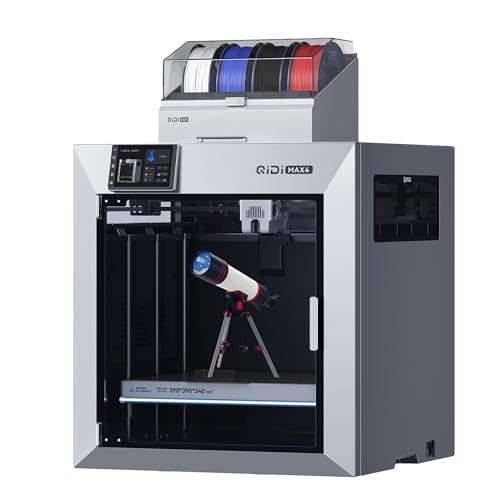
- 390 × 390 × 340mm build volume
- 65°C active heated chamber
- Supports abrasive and high-temperature materials
Best For: Large prototypes, molds, and industrial-grade parts
Best Value for Oversized Props

- Expansive 88L build volume
- 300°C full-metal hotend
- Up to 600mm/s printing speed
Best For: Oversized props, reliefs, and large functional parts
Best Low-Waste Multi-Material System

- Four independent toolheads
- 7-second low-waste tool changing
- 65°C heated chamber with filtration
Best For: Industrial multicolor and multimaterial production
Best Large-Capacity Multicolor Pick

- 350 × 350 × 350 mm build volume
- Up to 600 mm/s enclosed CoreXY printing
- Four-color printing, expandable to 16 colors
Best For: Large models, batch printing, and engineering materials
Best for Low-Waste Multimaterial Printing

- Four toolheads with five-second changes
- Up to 5X less waste during changes
- 270 mm CoreXY build volume and 500 mm/s speed
Best For: Mixed-material prototypes and efficient multicolor production
Best for Fast Large Prototypes
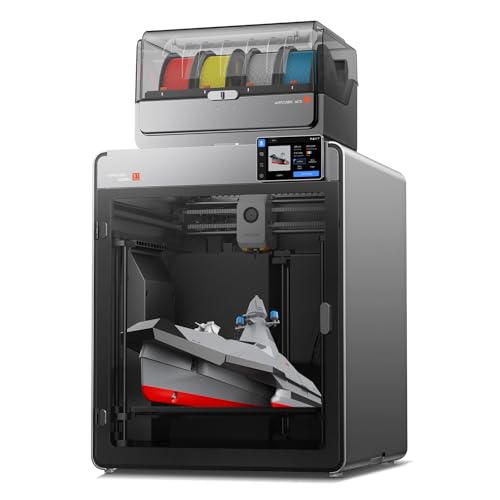
- 350 × 350 × 350 mm workspace
- Up to 600 mm/s and 20,000 mm/s² acceleration
- 65°C chamber with four-color printing
Best For: Large enclosures, prototypes, and tall models
Best Value Large-Format Pick

- 320 × 320 × 400 mm build volume
- Up to 500 mm/s printing speed
- Auto leveling and direct-drive extrusion
Best For: Makers and prototype users seeking a spacious, automated printer
Best Multicolor Workflow

- Up to 600 mm/s printing speed
- AMS 2 Pro multi-color and filament drying
- Automatic calibration and AI failure detection
Best For: Users prioritizing convenient, multi-color 3D printing
Best for Print Farms

- 400 × 400 × 400 mm build volume
- Up to 700 mm/s CoreXY printing
- WLAN control for multiple printers
Best For: Studios, businesses, and scaled production workflows
Best Enclosed Large-Format Pick – Prusa CORE One L
The Original Prusa CORE One L is a strong choice among large format 3d printers when you need an enclosed, high-rigidity machine for sizable parts and demanding materials. Its 11.8 × 11.8 × 12.99-inch build volume, actively heated chamber, and automated setup support practical production with less manual preparation.
Best For: Engineering parts, architectural models, cosplay helmets, and users who print ASA, ABS, PC, or Nylon.
Pros:
- Large build area can handle many full-size projects without splitting.
- Actively heated 60°C chamber helps reduce warping with advanced materials.
- CoreXY frame, high-flow extrusion, and automated preparation support fast, consistent printing.
- Offline functionality, optional connectivity, and extensive support resources improve long-term usability.
Cons:
- Its 68.4-pound weight and 18.5 × 20.5 × 25-inch dimensions require substantial space.
- The enclosed, engineering-focused design may be more than casual PLA users need.
Choose the CORE One L if material capability and a stable enclosed environment matter as much as build size. It is particularly compelling for users who want a large printer with a straightforward setup and a platform designed for continued expansion.
Best Industrial Material Flexibility – QIDI Max4 Combo
The QIDI Max4 Combo stands out among large format 3d printers for combining a 390 × 390 × 340mm build volume with a 65°C active heated chamber. Closed-loop X/Y motors, a high-flow hotend, and automated monitoring make it suited to large prototypes and technically demanding materials.
Best For: Industrial parts, molds, prototypes, and users working with abrasive or high-temperature materials.
Pros:
- Large build volume supports printing substantial parts in one piece.
- 65°C heated chamber and high-flow hotend support materials including ABS-CF, PC, and PPS-CF.
- Closed-loop motors and anti-backlash Z-axis hardware are designed for precise, stable results.
- AI monitoring can detect failures, while QIDI BOX compatibility enables up to 16-color printing.
Cons:
- At 120 pounds and 28 × 28 × 30 inches, it needs a robust, dedicated workspace.
- The Polar Cooler is not included and must be purchased separately.
The Max4 Combo is a practical fit when high-temperature material support and production-oriented automation take priority. Its large footprint and optional Polar Cooler should be accounted for before purchase.
Best Value for Oversized Props – Anycubic Kobra 3 Max V2
The Anycubic Kobra 3 Max V2 offers one of the roomiest build spaces in this large format 3d printers roundup, with an 88L volume measuring 16.5 × 16.5 × 19.7 inches. Its 300°C full-metal hotend, high-speed motion system, and optional multicolor expansion make it versatile for large creative projects.
Best For: Oversized props, pet houses, reliefs, functional parts, and makers who want optional multicolor printing.
Pros:
- 88L build volume reduces the need to split large models into multiple pieces.
- 300°C full-metal hotend supports PLA, PETG, and TPU.
- Speeds up to 600mm/s and 10,000mm/s² acceleration can shorten print times.
- One-click calibration, smart flow adjustment, and app monitoring simplify operation.
Cons:
- The large 27.8 × 25.2 × 29.65-inch footprint requires considerable room.
- Multicolor printing requires one or two separately paired ACE 2 Pro units.
- The listed material support is narrower than printers designed for advanced engineering filaments.
This Kobra 3 Max V2 is best when maximum volume and fast production of large, visually focused parts are the priorities. Consider it a flexible creative machine, with multicolor capability available as an add-on rather than a standard feature.
Best Low-Waste Multi-Material System – Flashforge Creator 5 Pro
The Flashforge Creator 5 Pro is a specialized option among large format 3d printers for users who need efficient multicolor or multimaterial production. Four independent toolheads, a 7-second changer, a 65°C heated chamber, and a CoreXY system target fast, low-waste printing with engineering filaments.
Best For: Industrial users producing multicolor or multimaterial parts with ABS, PC, or PA.
Pros:
- Four independent toolheads switch without filament flushing, reducing purge waste.
- Active chamber heating supports advanced materials and helps prevent warping.
- CoreXY motion, linear rails, and 600mm/s speeds are designed for stable rapid printing.
- HEPA 13 and activated-carbon filtration, automated calibration, and remote monitoring add convenience.
Cons:
- Its 16 × 14 × 18-inch dimensions indicate a more compact build platform than the other listed large-format models.
- The four-toolhead system is most valuable for users who regularly need multicolor or multimaterial output.
- Industrial features may be unnecessary for straightforward single-material printing.
The Creator 5 Pro makes the most sense when minimizing purge waste and changing materials efficiently are central requirements. Its enclosed, filtered design and heated chamber also make it a strong candidate for technical workshop environments.
Best Large-Capacity Multicolor Pick – Anycubic Kobra S1 Max Combo
The Anycubic Kobra S1 Max Combo is one of the more capable large format 3d printers for makers who need substantial build space, fast production, and multicolor output. Its 350 × 350 × 350 mm build volume accommodates large models or batches of smaller parts, while the enclosed CoreXY design and automatic leveling support consistent results.
Best For: Creators, engineers, and professional makers printing large or technically demanding projects.
Pros:
- Large 350 × 350 × 350 mm build volume for one-piece models and batch printing.
- Up to 600 mm/s printing with vibration compensation and a fully enclosed CoreXY system.
- ACE 2 Pro enables four-color printing out of the box, with expansion up to 16 colors.
- 65°C heated chamber and 350°C hotend support a broad range of filaments.
Cons:
- Its 78.8-pound weight and large footprint may require a dedicated, sturdy location.
- The most advanced multicolor capability requires additional ACE 2 Pro units.
The Kobra S1 Max Combo stands out when build volume and material flexibility matter as much as speed. It is a particularly strong fit for users who want large-format production with built-in multicolor capability and automated print-protection features.
Best for Low-Waste Multimaterial Printing – Snapmaker U1
The Snapmaker U1 is a practical choice among large format 3d printers for users who prioritize rapid tool changes and efficient multicolor or multimaterial work. Its four independent toolheads switch in about five seconds, reducing purging and making it easier to combine rigid, flexible, support, and engineering materials in one print.
Best For: Workshops, small businesses, and creators producing multicolor prototypes, functional parts, and mixed-material models.
Pros:
- Four independent toolheads and a roughly five-second automatic tool change.
- Reduces filament waste during color and material changes compared with traditional systems.
- Supports materials including PLA, PVA, TPU, PETG, ABS, ASA, PA, and PC.
- Automatic calibration, print monitoring, remote control, and a built-in model library simplify operation.
Cons:
- The 270 × 270 × 270 mm build volume is smaller than the 350 mm-class printers in this roundup.
- Its 500 mm/s maximum speed is lower than the 600 mm/s maximum offered by the Anycubic alternatives.
The U1’s main advantage is its tool-changing approach: it offers genuine multimaterial flexibility without repeatedly swapping and purging the same filament path. Choose it when material efficiency and workflow convenience are more important than maximum build volume.
Best for Fast Large Prototypes – Anycubic Kobra S1 Max Combo
The Anycubic Kobra S1 Max Combo is built for users comparing large format 3d printers for full-size prototypes, enclosures, and tall models. Its 350 × 350 × 350 mm workspace can handle sizeable parts in one piece, while the rigid enclosed CoreXY frame is designed to maintain smooth motion at speeds up to 600 mm/s.
Best For: Engineers and makers who need large, fast, one-piece prints with optional four-color output.
Pros:
- 350 × 350 × 350 mm build volume supports large prototypes and enclosures without splitting.
- Up to 600 mm/s speed and 20,000 mm/s² acceleration can shorten production times.
- Bundled ACE 2 Pro provides native four-color printing, expandable to 16 colors.
- 65°C heated chamber and 350°C hotend support PLA, PETG, TPU, ABS, ASA, and PVA.
Cons:
- The approximately 77.8-pound printer needs substantial space and support.
- Its large-format size may be more than necessary for users mainly printing small parts.
This Kobra S1 Max variant is a strong fit when the priority is combining a generous build area with high-speed production. Its heated chamber, broad filament support, and automatic 49-point leveling also make it suitable for demanding prototype workflows.
Best Value Large-Format Pick – LONGER LK10 Plus
The LONGER LK10 Plus is a practical choice among large format 3d printers for makers who need room for oversized prototypes, multiple parts, or creative projects without moving to an especially heavy machine. Its 320 × 320 × 400 mm build volume is paired with fast printing, automatic calibration, and remote-control features.
Best For: Home makers, prototype development, engineering projects, and users who want a large build area with beginner-friendly automation.
Pros:
- 320 × 320 × 400 mm build volume supports large models and batch printing.
- Up to 500 mm/s speed with Klipper firmware and 10,000 mm/s² acceleration.
- Direct-drive extrusion supports PLA, PETG, ABS, TPU, Nylon, and other filaments.
- Automatic bed leveling, smart Z offset, filament detection, and power-loss recovery simplify operation.
Cons:
- Its build volume is smaller than the 400 mm cubed capacity of the Creality Ender 5 Max.
- The 30.5-pound unit still requires substantial dedicated workspace.
The LK10 Plus balances generous capacity and useful automation with a relatively manageable footprint. It is a strong all-around option when large-format capability matters but print-farm features are not the main priority.
Best Multicolor Workflow – Bambu Lab P2S Combo
The Bambu Lab P2S Combo stands out among large format 3d printers for users who value a streamlined, high-speed workflow and multi-color capability. The included AMS 2 Pro adds multi-material printing and filament drying, while automatic calibration and AI failure detection are designed to reduce setup and monitoring effort.
Best For: Beginners and experienced creators who prioritize fast setup, precision, multi-color printing, and an integrated software workflow.
Pros:
- Prints at up to 600 mm/s with active flowrate compensation for consistent layers.
- AMS 2 Pro enables multi-color and multi-material printing with filament drying up to 65 °C.
- Automatic calibration, quick-swap nozzles, and AI failure detection simplify operation.
- Adaptive airflow can cool overhangs or maintain a 50 °C chamber for engineering materials.
Cons:
- The P2S itself does not support multi-color printing; that capability requires this Combo version.
- The supplied notes do not specify a build volume, so capacity is harder to compare with the other large-format models here.
The P2S Combo is best viewed as a convenience- and workflow-focused choice rather than a clearly documented maximum-capacity machine. Its strongest advantages are fast operation, guided setup, and integrated multi-color printing.
Best for Print Farms – Creality Ender 5 Max
The Creality Ender 5 Max is one of the most production-oriented large format 3d printers in this lineup. Its 400 × 400 × 400 mm build volume accommodates oversized prototypes or multiple parts, while CoreXY motion, WLAN multi-printer control, a rigid frame, and a 1000W heated bed support demanding, repeatable workflows.
Best For: Print farms, studios, businesses, and users producing large models or multiple parts on a continuing schedule.
Pros:
- 400 × 400 × 400 mm build volume provides the largest stated capacity in this roundup.
- CoreXY motion system supports printing speeds up to 700 mm/s.
- WLAN multi-printer control and grouped management suit scaled production.
- 64-point auto leveling, automatic Z offset, and a dual-gear direct-drive extruder support repeatable operation.
Cons:
- At 70.4 pounds, it is substantially heavier than the LONGER LK10 Plus.
- The 1000W rapid-heating bed and broad material support may be more capability than casual users need.
- The listed product dimensions should be verified against the available 400 mm build volume before planning installation space.
The Ender 5 Max is the most compelling choice when capacity and throughput take priority. Its print-farm controls and robust construction make it especially suitable for users managing multiple machines or running larger production jobs.
How We Picked the Best Large Format 3d Printers
We focused on printers that offer genuinely useful build capacity, rather than treating a slightly larger-than-average bed as large format. We compared advertised build volume, enclosure and chamber features, tool-changing or multi-color capabilities, automation, print speed, and the materials each platform is positioned to handle. We also considered practical factors such as footprint, included accessories, setup complexity, and whether the machine suits beginners, makers, or demanding workshop use.
Because specifications and firmware can change, verify the manufacturer’s current dimensions, supported materials, power requirements, and included components before ordering.
Quick Comparison
| Priority | Look for | Best fit |
|---|---|---|
| Maximum single-piece size | Build volumes around 400mm or larger on one or more axes | Cosplay, props, enclosures, and large prototypes |
| Engineering materials | Heated chamber, enclosure, high-temperature hotend, and stable bed heating | ABS, ASA, nylon, and carbon-fiber composites |
| Multi-color printing | Reliable tool-changing or material-management system | Display models, signs, toys, and visual prototypes |
| Fast production | Rigid frame, automatic calibration, and high-speed motion system | Frequent functional or small-batch printing |
| Lower entry cost | Simple single-extruder design and accessible replacement parts | New users and occasional large prints |
Key Buying Factors for Large Format 3d Printers
Build Volume and Usable Space
Check all three dimensions, not just the advertised bed width. A tall Z axis helps with helmets and architectural models, while a wide X-Y area is more useful for panels and batch production. Remember that skirts, brims, purge lines, and bed clips can reduce practical space.
Temperature Control and Material Support
An enclosed printer is helpful for temperature-sensitive materials, but a genuinely heated chamber provides more consistent conditions for demanding polymers. For PLA and PETG, an enclosure may be less important than dependable bed heating and ventilation. Confirm nozzle temperature, chamber temperature, and hardened-component requirements before selecting abrasive filament.
Speed, Accuracy, and Automation
Headline speed is only one part of performance. A rigid frame, input shaping, automatic bed leveling, flow calibration, and dependable filament detection can matter more in everyday use. Large prints amplify small errors, so consistency is often more valuable than the highest claimed acceleration.
Workflow, Noise, and Maintenance
Multi-toolhead and multi-color systems can reduce manual intervention, but they may add calibration, purge, or software complexity. Measure the printer’s footprint with doors and spool holders installed, and leave room for ventilation, maintenance, and access to the build plate. Also check nozzle availability, replacement-part support, and warranty coverage.
Who Should Buy Which Large Format 3d Printers?
Choose a high-volume single-extruder machine if your priority is large functional parts, props, or prototypes at a reasonable cost. An enclosed, chamber-heated model is the stronger choice for users working regularly with ABS, ASA, nylon, or composite filaments. Pick a multi-color or multi-toolhead printer when presentation, material separation, or reduced manual filament changes matters more than simplicity. A fast, automated CoreXY model is well suited to makers and small businesses that value repeatable production, while a simpler open-frame printer can be the better choice for first-time buyers who mainly use PLA or PETG. Finally, confirm that your workspace, electrical supply, and lifting access can accommodate the selected machine before purchasing.