The best 3D printers for hobbyists make it easier to turn digital designs into useful parts, creative projects, tabletop models, and personalized gifts. Today’s leading machines range from compact beginner printers to fast CoreXY systems with automated calibration and multicolor capability.
This roundup compares 10 notable options across ease of use, print speed, material support, automation, build volume, and expansion potential, so you can choose a printer that matches your space, experience, and project goals.
Best 10 3d Printers for Hobbyists Picks for 2026
Best Beginner Pick

- Automatic calibration simplifies setup
- Fast, precise printing with quiet operation
- Optional AMS lite supports multi-color prints
Best For: Beginners, families, and easy everyday hobby printing
Best Enclosed All-Rounder

- Enclosed body supports advanced filaments
- 500mm/s high-speed printing
- Optional AMS enables up to 16 colors
Best For: Versatile, enclosed hobby printing
Best Value Speedster

- 600mm/s CoreXY printing with auto leveling
- Quick-swap nozzle and rapid warm-up
- Remote monitoring through Flash Studio
Best For: Fast prototypes and convenient everyday printing
Best Multicolor Pick

- Native four-color printing with expansion up to 19 colors
- 600mm/s maximum speed and automatic 49-point leveling
- Supports PLA, PETG, TPU, PVA, and ASA
Best For: Hobbyists exploring multicolor and multi-material printing
Best Ready-to-Print Speedster
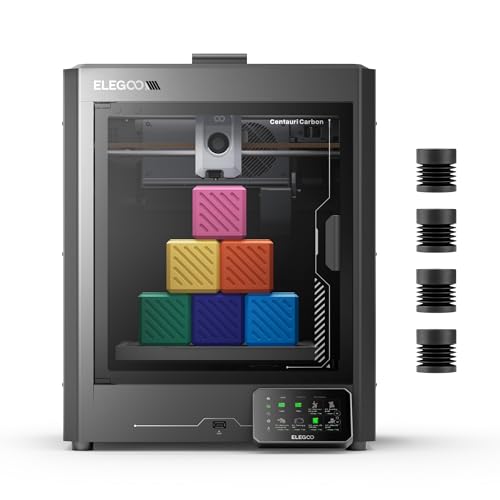
- Fully assembled and pre-calibrated for quick setup
- 500mm/s CoreXY printing with a 320°C hardened-steel nozzle
- Enclosed design and camera support advanced projects
Best For: Makers seeking fast, enclosed, low-fuss printing
Best Premium Multicolor Combo

- 600mm/s printing with active flowrate compensation
- AMS 2 Pro adds multicolor printing and filament drying
- AI failure detection and automatic calibration simplify setup
Best For: Frequent hobby printers wanting an automated multicolor workflow
Best with Extra Features

- Fully assembled with guided setup
- Auto leveling and flexible magnetic plate
- Compact WiFi printer with STEM tools
Best For: First-time users, families, and small home projects
Best Multimaterial Choice

- Four independent toolheads for multicolor printing
- Five-second changes reduce waste
- 500 mm/s CoreXY printing with a large build volume
Best For: Makers creating multicolor, mixed-material, and functional parts
Best High-Speed Combo

- 600 mm/s printing with a 260 mm build cube
- Included CFS enables multicolor printing
- Preassembled with auto leveling and AI camera
Best For: Hobbyists wanting fast, larger, and monitored multicolor prints
Best Beginner Pick – Bambu Lab A1
The Bambu Lab A1 is a ready-to-use option for hobbyists who want fast, precise FDM printing without spending much time on setup. Automatic calibration, flow-rate compensation, and a simple touchscreen make it approachable for beginners and kids.
Best For: Beginners, families, and hobbyists who prioritize easy setup and quiet operation.
Pros:
- Automatic Z-offset and bed-leveling calibration reduce setup work.
- High-speed printing with acceleration up to 10,000 mm/s².
- Quiet operation and a convenient 1-Clip quick-swap nozzle.
- Optional AMS lite support enables multi-color printing.
Cons:
- AMS lite is required for multi-color printing and is not included with every configuration.
- The supplied notes do not indicate an enclosed design for advanced filament use.
The A1 is a practical starting point among 3d printers for hobbyists, especially when ease of use and automated calibration matter more than specialized materials.
Best for Carbon-Fiber Filament – Creality K1C
The Creality K1C combines a compact CoreXY design with speeds up to 600mm/s, making it a strong choice for hobbyists who want rapid prints and broader filament flexibility. Its enclosed chamber, hardened steel nozzle tip, and AI camera add useful features for demanding projects.
Best For: Hobbyists printing carbon-fiber blends, prototypes, and fast batches.
Pros:
- CoreXY system supports speeds up to 600mm/s and acceleration up to 20,000mm/s².
- Enclosed chamber and hardened steel nozzle support carbon-fiber filaments.
- AI camera can monitor prints, record time-lapses, and flag errors.
- Built-in carbon filter and silent mode rated at 45dB or less.
Cons:
- The feature set may be more than beginners need for basic PLA projects.
- Carbon-fiber printing requires suitable filament and benefits from the hardened nozzle.
For experienced makers, the K1C stands out among 3d printers for hobbyists because it pairs high speed with an enclosed, carbon-fiber-capable setup.
Best Enclosed All-Rounder – Bambu Lab P1S
The Bambu Lab P1S is an enclosed, ready-to-use FDM printer for hobbyists who want high-speed printing and room to explore materials beyond basic PLA. Automatic bed leveling and a setup time of about 15 minutes keep the learning curve manageable.
Best For: Hobbyists seeking an enclosed printer for fast, versatile FDM projects.
Pros:
- Prints at up to 500mm/s with acceleration up to 20,000mm/s².
- Enclosed body helps support advanced filaments.
- Automatic bed leveling improves first-layer consistency.
- Optional Bambu Lab AMS enables multi-color and multi-material printing.
Cons:
- AMS is required for multi-color printing and is not part of the base setup.
- Carbon- and glass-fiber-reinforced polymers are not recommended.
- It is heavier than some alternatives at 38.9 pounds.
The P1S is a balanced choice among 3d printers for hobbyists who want speed, an enclosure, and a clear upgrade path to multi-color printing.
Best Value Speedster – FLASHFORGE Adventurer 5M
The FLASHFORGE Adventurer 5M is designed for hobbyists who want fast CoreXY printing with minimal manual adjustment. One-click automatic leveling, quick nozzle changes, and remote monitoring make it a convenient option for frequent projects and rapid prototypes.
Best For: Hobbyists who want fast, low-maintenance printing and app-based monitoring.
Pros:
- CoreXY design reaches travel speeds up to 600mm/s with 20,000mm/s² acceleration.
- Automatic bed leveling helps produce consistent first layers.
- Three-second nozzle changes and a 35-second warm-up to 200°C streamline workflow.
- Flash Studio supports remote monitoring, adjustments, and status alerts.
Cons:
- The standard extruder temperature is limited to 280°C.
- Only a 0.4mm nozzle is included; other sizes are optional.
- The supplied notes do not mention an enclosed chamber.
With its fast motion system and automatic setup features, the Adventurer 5M is a practical pick among 3d printers for hobbyists focused on efficient everyday printing.
Best Multicolor Pick – Anycubic Kobra X
For hobbyists who want colorful projects without a complicated starting process, the Anycubic Kobra X is a capable choice among 3d printers for hobbyists. It includes native four-color printing, automatic 49-point bed leveling, app-based monitoring, and a 260mm cubed build volume.
Best For: Home users, schools, and makerspaces interested in multicolor printing and broad filament compatibility.
Pros:
- Native four-color printing can expand to up to 19 colors with four ACE 2 Pro units.
- Up to 600mm/s printing, vibration compensation, and a hardened steel nozzle support fast, detailed work.
- LeviQ 3.0 automatic leveling, AI monitoring, Wi-Fi, and LAN make operation more convenient.
- Supports PLA, PETG, TPU, PVA, and ASA with a 300°C nozzle.
Cons:
- Filament is not included.
- Additional ACE 2 Pro units are required for the expanded color capacity.
- The 260mm cubed build volume may be limiting for larger projects.
The Kobra X stands out for hobbyists who value multicolor capability, automation, and flexible material support. Its high speed and remote monitoring add convenience, while the optional color expansion gives advanced makers room to grow.
Best Ready-to-Print Speedster – ELEGOO Centauri Carbon
The ELEGOO Centauri Carbon is a strong option for 3d printers for hobbyists who want a fast, enclosed machine with minimal setup. It arrives assembled and pre-calibrated, combines a CoreXY design with automatic calibration, and offers a 256mm cubed build volume.
Best For: Beginners and experienced makers who want rapid printing, remote monitoring, and support for advanced reinforced filaments.
Pros:
- Ready to print out of the box with auto bed leveling and touchscreen controls.
- CoreXY mechanics deliver speeds up to 500mm/s with 20,000mm/s² acceleration.
- A 320°C hardened-steel nozzle and enclosed chamber support carbon-fiber-reinforced materials.
- Built-in camera, dual LED lighting, vibration compensation, and a dual-sided build plate improve usability.
Cons:
- At 38.5 pounds, it is relatively heavy to move.
- The 256mm cubed build volume is smaller than some larger-format hobbyist printers.
- Advanced filament printing may require more material-specific tuning than basic PLA work.
Choose the Centauri Carbon if speed, enclosure, and out-of-box convenience matter more than multicolor printing. Its rigid frame and high-temperature hardware make it especially appealing for functional parts and demanding materials.
Best Premium Multicolor Combo – Bambu Lab P2S Combo
The Bambu Lab P2S Combo is designed for hobbyists who want a streamlined multicolor workflow. The printer reaches up to 600mm/s, while the included AMS 2 Pro adds multi-color and multi-material printing plus filament drying up to 65°C.
Best For: Hobbyists who want automated, high-speed printing with an integrated multicolor and filament-management system.
Pros:
- Up to 600mm/s printing with active flowrate compensation for consistent layers.
- Ready to print in about 15 minutes with automatic calibration and AI failure detection.
- AMS 2 Pro enables multi-color and multi-material printing and dries filament up to 65°C.
- Adaptive airflow, a carbon filter, quick-swap nozzles, and access to MakerWorld add workflow convenience.
Cons:
- The standard P2S does not support multicolor printing; the Combo version is required.
- At 47.5 pounds, the complete system is substantial.
- The many automated features may be more than casual single-color users need.
The P2S Combo is a compelling all-in-one choice when convenience and color flexibility are priorities. Its fast setup, monitoring features, and AMS 2 Pro make it well suited to hobbyists who expect to print frequently and experiment with different materials.
Best with Extra Features – Entina Tina2C
For hobbyists taking their first steps into 3D printing, the Entina Tina2C focuses on a quick, low-friction setup. It arrives fully assembled, offers guided app support, and combines auto leveling with a compact design suited to home creative projects.
Best For: Beginners, families, STEM learning, and small home projects.
Pros:
- Fully assembled setup can get beginners printing in as little as 8 minutes.
- Auto leveling, power-loss recovery, and a flexible magnetic build plate simplify everyday use.
- Poloprint Cloud provides AI-powered searches, photo-to-print features, 25+ creative modules, and access to 3,500+ models.
- Compact, quiet design supports home, office, and creative-workspace use.
Cons:
- The 3.9 × 3.9 × 3.9-inch print volume is best suited to smaller models.
- Its beginner-oriented feature set may be limiting for users seeking a larger or more advanced machine.
The Tina2C is a practical entry point for 3d printers for hobbyists who value simplicity over scale. WiFi and TF card printing offer flexibility, while compatibility with Windows, macOS, Linux, Chromebook, Cura, and Simplify3D leaves room to expand your workflow.
Best Multimaterial Choice – Snapmaker U1
The Snapmaker U1 stands out among 3d printers for hobbyists who want fast, automated multicolor and multimaterial printing. Its four independent toolheads switch in about five seconds, helping reduce purge waste while supporting detailed models, prototypes, and functional parts.
Best For: Experienced hobbyists, makers, workshops, and creators producing multicolor or mixed-material parts.
Pros:
- Four toolheads support true multicolor and mixed-material printing without manual filament changes.
- Tool changes take about five seconds and can reduce filament waste by up to five times.
- Automatic calibration, vibration compensation, AI print monitoring, and remote app control streamline operation.
- CoreXY printing reaches speeds up to 500 mm/s across a 270 × 270 × 270 mm build volume.
Cons:
- At 57.9 pounds, this is a substantial printer that needs a dedicated workspace.
- Its advanced toolhead and material capabilities may be more than casual beginners need.
With support for materials including PLA, PVA, TPU, PETG, ABS, ASA, PA, and PC, the U1 offers broad creative flexibility. The built-in model library and Snapmaker Orca software help ease the learning curve, while its one-year warranty adds reassurance.
Best High-Speed Combo – Creality K2 Combo
The Creality K2 Combo is a strong option among 3d printers for hobbyists who want speed, a generous build area, and multicolor potential. Its preassembled design, automatic leveling, and AI camera make it easier to move from unpacking to monitored printing.
Best For: Hobbyists printing larger models who want high speed, multicolor capability, and automated monitoring.
Pros:
- Prints at speeds up to 600 mm/s with a 260 × 260 × 260 mm build volume.
- The included CFS supports multicolor printing, with up to 16 colors possible when using four CFS units.
- Preassembled construction, smart auto leveling, and a next-generation direct-drive extruder support a plug-and-play workflow.
- AI camera monitoring can watch for spaghetti failures and idling, while Silent Mode reduces operating noise.
Cons:
- The 65.9-pound printer has a large footprint and requires considerable placement space.
- The included combo has one CFS; reaching up to 16 colors requires adding three more CFS units.
The K2 Combo balances accessible setup with enthusiast-level performance. Its sturdy frame and step-servo motors are designed to improve speed, extrusion consistency, accuracy, and noise control, while support for PLA, PETG, ABS, PLA-CF, and PET expands material options.
How We Picked the Best 3d Printers for Hobbyists
We evaluated these printers by focusing on the features that matter most in real home workshops: setup time, automatic bed leveling, first-layer consistency, print speed, reliability, software experience, maintenance requirements, and the range of materials each machine can handle. We also considered whether a printer is best suited to beginners, families, model makers, functional-part builders, or users who want multicolor printing.
Features such as enclosed frames, direct-drive extruders, cameras, filament-management systems, and automatic calibration were weighed for their practical value rather than treated as necessities for every buyer. A more advanced printer is not automatically the better choice if its capabilities exceed your needs.
Quick Comparison
| Best for | What to prioritize |
|---|---|
| First-time users and families | Simple setup, automatic leveling, guided software, and dependable presets |
| Fast everyday printing | High-speed motion system, input shaping, good cooling, and reliable calibration |
| Functional parts | Enclosure, heated bed, direct-drive extrusion, and support for stronger filaments |
| Multicolor projects | Dedicated material-management system, low-waste color changes, and compatible software |
| Small workspaces | Compact footprint, manageable noise, and accessible maintenance points |
Key Buying Factors for 3d Printers for Hobbyists
Build Volume and Printer Design
Check the maximum model dimensions against the objects you expect to make. A compact printer is easier to place and often simpler to operate, while a larger machine is more useful for cosplay parts, organizers, and oversized prototypes. Enclosed models can also help maintain a steadier environment for temperature-sensitive materials.
Materials and Extrusion System
PLA is the easiest starting material, but PETG, TPU, ABS, ASA, and composite filaments have different temperature and ventilation requirements. A direct-drive extruder is useful for flexible filament, while a higher-temperature nozzle and heated enclosure expand material options.
Automation, Speed, and Reliability
Automatic leveling, flow calibration, filament sensors, remote monitoring, and recovery features reduce hands-on troubleshooting. Advertised speed matters less than consistent results, so look for machines that combine fast movement with good cooling, rigid construction, and mature software profiles.
Multicolor Capability and Running Costs
Multicolor systems add creative flexibility but can increase purchase price, print time, filament waste, and setup complexity. Consider whether you truly need several colors in one print or would be happier changing filament manually for occasional projects.
Who Should Buy Which 3d Printers for Hobbyists?
Beginners should favor a ready-to-use printer with automatic leveling, clear software, and a forgiving material ecosystem. Compact starter models are especially practical for children, classrooms, apartments, and buyers who want to learn without managing a complex machine.
Experienced hobbyists who print frequently should look for higher speed, stronger automation, a direct-drive extruder, and broader material support. An enclosed CoreXY printer is a sensible direction for functional parts and demanding materials, while a multicolor model is worthwhile for decorative models, labels, and presentation-ready designs.
Before buying, confirm the printer’s footprint, noise level, required ventilation, replacement-part availability, and software compatibility. The best choice is the one whose workflow you will actually use—not necessarily the fastest or most feature-packed option.